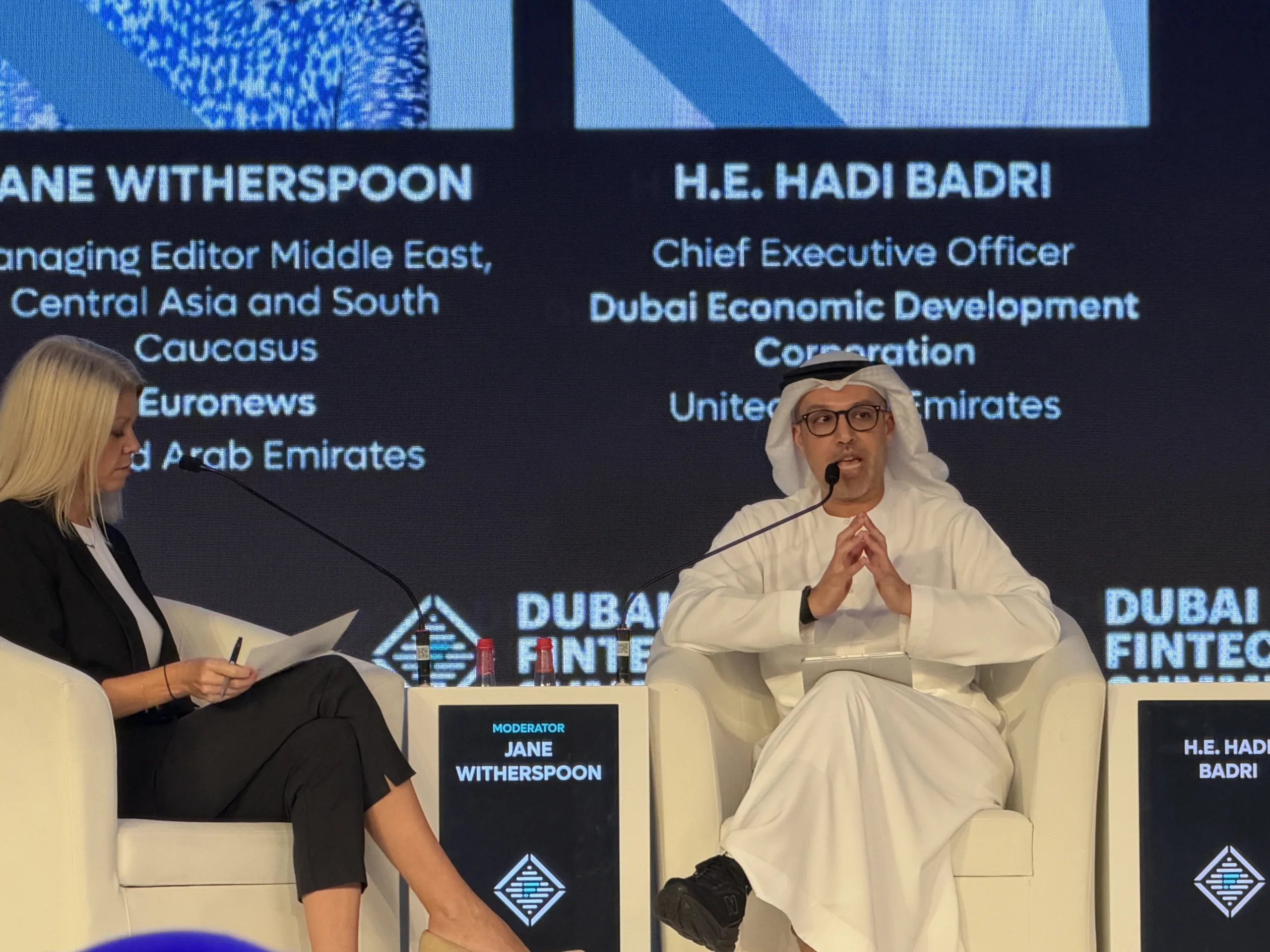
There is no shortage of jobs in Dubai, with the emirate creating employment opportunities for Emiratis and international talent as it seeks to double the size of its economy by 2033, according to Hadi Badri, Chief Executive Officer of Dubai Economic Development Corporation.
“There’s no shortage of job creation in Dubai,” Badri said during a discussion at the Dubai FinTech Summit 2026.
“It’s not so much balancing. It’s actually accommodating for both talent that comes from abroad, and also making sure that our talent here, especially Emiratis, are getting the exposure they want.”
Badri said the UAE’s financial services sector currently employs approximately 25,000 Emiratis, with 10,000 joining the industry over the past four years. “This is a sector in the UAE where we have 25,000 Emiratis. Just in the past four years, the sector has employed 10,000 Emiratis in the financial services sector,” he said.
He pointed to the growing interest in business education among Emirati students, saying business was the most pursued university programme in the UAE, attracting three times as many students as the next programme.
“We have Emiratis that are getting the exposure, the experience they want from a business and finance perspective. We obviously also have Emiratis that are studying abroad. They’re coming back to contribute to the economy here,” he said.
However, Badri said the next step was to ensure that Emiratis entering the workforce gained experience in roles that could lead to management positions. “Where we need to work as a government is to make sure that those Emiratis that are now entering financial services are really getting exposure to revenue-owned roles,” he said.
“We want employers to actually send Emiratis abroad to get the exposure they need in headquarters.”
He also stressed the importance of professional qualifications, including the Chartered Financial Analyst (CFA) and Chartered Accountant (CA) credentials. “We need to pursue also hard credentials. You know, the CFA, the CA, these are important credentials in the financial services space,” he said.
Dubai D33 to accelerate economic growth across sectors
Speaking about his responsibilities, Badri said his mandate was to support the leadership’s plans to accelerate Dubai’s economic growth through the development of sectors and investment opportunities.
“Our mandate in economy and tourism is really to deliver on the leadership vision of accelerating Dubai, growing much faster in the next years than we have in the past years.”
He said the work involved “being very deliberate about sector-by-sector development, making sure that Dubai is competitive, and making sure that we are firing on all cylinders because that’s the Dubai way.”
Under the Dubai Economic Agenda D33, the emirate aims to double the size of its economy by 2033 and establish itself among the world’s top three cities.
Badri said the agenda required Dubai to expand the contribution of sectors already established in the economy while developing industries that could generate sources of growth.
“We take existing sectors that we do very well in, we take them to their full potential. We want more sectors to contribute to growth overall. And we create new sectors, like in longevity,” he said.
Dubai aims to become the banking hub of the region
Badri said financial services would play a role in achieving Dubai’s economic ambitions, pointing to the sector’s development over the past 25 years. “Twenty-five years ago, we were really not a credible player in financial services. It wasn’t so long ago, right?” he said.
“At the end of the day, it was the DFM that launched in the year 2000. We didn’t have an international regulator 25 years ago. We didn’t even have freehold property upon which we could actually do mortgages.”
He said Dubai had since risen to seventh place in the ranking of global financial centres, after being outside the top 20 just three years earlier.
“If you look at where we’ve come from in a relatively short period of time for Dubai to be the number seven global financial centre in the world, and to have achieved that within that period of time, I think is nothing short of impressive,” he said, attributing the emirate’s progress to a combination of talent, regulation and access to markets.
“Talent, regulation, international access. These are the things that people look for when they’re looking to trust a market. And that’s ultimately what this was down to. It’s trust,” he added.
He said Dubai’s ambition under D33 was to develop its position in financial services and become a banking centre for the region.
“What we’re focused on under D33 within finance, which is a really important sector, is to position Dubai as the bank of the region, similar to how Switzerland is the bank of Europe,” he said.
The strategy includes expanding trade finance, increasing private equity and venture capital investment, developing capital markets and enabling banks to lend more to small and medium-sized enterprises (SMEs).
“For us to accelerate trade finance, for us to really embed much more growth capital, private equity and venture capital, allow for banks to actually lend more to SMEs. We think they’re a really important component of the economy going forward,” he said.
Badri also identified company listings and the growth of insurance and reinsurance activities as priorities. “And of course, continue to enrich the capital markets through listings, more insurance, more reinsurance activity to happen here,” he said.
‘Speed is in our DNA’: Dubai’s approach to regulation
Addressing how Dubai balances innovation with regulation and governance, Badri said moving quickly did not mean compromising oversight. “Speed is in our DNA,” he said.
“It is something that is expected from the top down. It is something expected also because we’ve been conditioned in that way. It’s not to say that we don’t take regulation seriously.”
“On the contrary, we know how to set up regulators and we know how to regulate very well,” he added.
He cited the Dubai International Financial Centre (DIFC) and its regulator, the Dubai Financial Services Authority (DFSA), as examples of the emirate’s experience in financial regulation.
Badri also pointed to the Virtual Assets Regulatory Authority (VARA), which he said was established within a short period and had become one of the world’s top three regulators in its sector. “The sign of a good regulator is one that issues licences, one that protects parties within the ecosystem, but equally one that revokes licences if someone misbehaves,” he said.
He also referred to the launch of the Dubai Longevity Authority, saying the initiative would help develop opportunities in healthcare and longevity. “That’s also going to, at record pace, unlock the potential of Dubai from a healthcare and longevity perspective,” he said.
For Dubai, he argued, regulation and innovation were not competing priorities. “It’s not a trade-off for us. It’s about moving quickly on regulation because that’s a superpower that we have in Dubai and the UAE, but to do so in a proper way,” he said.
“The risk is if we don’t move quickly enough.”
AI talent and productivity to support Dubai’s GDP growth
Badri identified artificial intelligence as one of the sectors expected to contribute to Dubai’s economic growth. “An obvious one, which is AI. But let me explain why. Because at the end of the day, we believe that smart money follows smart talent,” he said.
He said the UAE ranked among the world’s top 20 markets for AI talent density and had recorded the fastest growth in AI talent concentration over the past five years. “What we see in the UAE is an incredible trajectory in terms of AI talent,” he said.
“The UAE today is a top 20 market in terms of AI talent density. Over the past five years, we have been the fastest growing in terms of AI talent concentration.”
Badri said the concentration of AI specialists was encouraging entrepreneurs to establish businesses in the UAE while helping existing companies adopt technology to improve their operations.
“Obviously that creates a talent pool for people to come and set up their AI-first businesses, and for businesses that are not AI-first to actually tap into this talent pool to be able to become much more productive,” he said.
He added that the UAE’s approach to technology adoption, together with government initiatives and collaboration with the private sector, would support the development of AI.
“This is a market, as everyone knows here, that adopts technology very quickly, is keen to try new things, and where the government is leading from the front in AI adoption and working with the private sector to support AI adoption as well.”
Badri said AI would have an impact on Dubai’s economy because the city had the talent, companies and government support required for adoption. However, he stressed that the contribution of technology to the economy would depend on how widely it was implemented.
“If we look at our 10-year plan, 60 per cent of that outcome is actually going to come from productivity enhancements,” he said. “So it’s going to come from the adoption of technologies, including AI and others. And so it’s a really integral part of making sure that we deliver on what we want to deliver, which is a doubling of GDP.”
He said Dubai was working to connect companies with start-ups and scale-ups, enabling businesses to adopt the technologies being developed in the emirate. “It’s not just about attracting talent. It is attracting talent and making sure that those technologies that are created by that talent in the city, that are built by the talent in the city, are adopted,” he said.
“We play a very active role as government to do some matchmaking, to make sure that we create the right ecosystem and enablers for accelerators to happen, for corporates to be able to tap into those start-ups and scale-ups.”
Economic diversification key amid geopolitical disruption
Badri said global developments had increased the importance of economic diversification, particularly as disruptions to business and trade had become more frequent. “We used to think that there were Black Swan events maybe two or three times a lifetime, and now it feels like every year there’s a Black Swan event,” he said.
“And so what that necessitates is diversification. At the end of the day, that is something that we are very focused on. That’s embedded in D33, our 10-year plan.”
He said developments over the previous eight months had demonstrated the importance of having several sectors contributing to the economy. “Some sectors were affected more than others, but even those that were affected, there were nuances,” he said.
“You can say hospitality, entertainment were affected. You can say logistics were affected. But at the end of the day, it was maritime logistics that was more affected, and air cargo stepped in the way.”
Badri also pointed to changes in travel patterns during the period, noting that hospitality and entertainment had faced disruption even as travel demand shifted. “We were looking to bring the world to Dubai. But we’ve seen intra-regional travel really spike during this period,” he said.
He said Dubai needed to continue developing sources of economic activity to respond to changes in global markets. “As we focus on diversification, we need to create new engines of growth,” he said.
Dubai leads world in foreign direct investment projects
Discussing Dubai’s position as an investment destination, Badri said the emirate had maintained its lead in attracting foreign direct investment projects for five consecutive years. “The city has been the number one city in the world for five consecutive years in terms of attracting foreign direct investment,” he said.
“When you look at FDI in terms of the number of projects, Dubai has more FDI projects than the next five cities combined.”
He said the government regularly asked investors what influenced their decision to establish businesses in Dubai. “And so we ask investors all the time, you know, what is it? And they tell us, trust in government,” he said.
“We know what we’re getting when we invest in Dubai. We know that we can sit across the table and engage with the government,” he added, describing the feedback received from investors.
Another factor, Badri explained, was the freedom investors had to use the profits generated from their businesses. “They tell us we can make money, we can do whatever we want with that profit. We can repatriate it, we can reinvest it, we can show it,” he said.
“It’s interesting because we live in a world where in other cities you can’t show your money, but you can show your money and you can enjoy it and you can reinvest it.”
He said this environment encouraged investors to establish businesses and continue investing in the emirate. “I think the trust in government, the certainty in how our value system is set up, I think this creates the right ecosystem for people to invest in the city and continue to do so,” he said.
Dubai to remain open to international investors and businesses
Asked how Dubai could build resilience amid geopolitical changes without reducing its openness to international trade and investment, Badri said maintaining access to the world was part of its economic strategy. “It’s actually to stay open to the rest of the world,” he said.
He pointed to the network of financial institutions, advisers, lawyers and brokers operating in the emirate, which provides family offices and other investors with access to services. “If you look at our ecosystem, what’s been created in Dubai is rich,” he said.
“Any family office that comes here, they have a very broad range of choices in terms of the banks that they can work with, the advisers, the lawyers, the brokers, and so the sovereignty is available. The choice is available for them.”
Badri said investors from different countries could access financial institutions from their home markets while operating in Dubai. “If you’re a Chinese family that wants to come here, you have your choice of the top Chinese banks that you can bank with,” he said.
“And the same is true in terms of banking from France, from Germany, from South Africa, from India. There is familiarity in the city.”
He said this allowed international investors to conduct business in Dubai without feeling disconnected from their home markets. “Any investor that comes in, it’s not a foreign place for them. Dubai is a cosmopolitan city where they can do business as a global investor,” he said.
‘This is ours for the taking’: Dubai’s ambitions for 2033
Looking ahead to 2033, Badri said Dubai would need to maintain its pace of development to achieve the objectives of its economic agenda.
“It’s not to stand still,” he said. “It’s to be very focused, very aggressive, aggressive in a good way. I don’t mean aggressive in a negative way.”
He said Dubai and the UAE had already developed their economic position but should continue pursuing opportunities as other markets faced challenges.
“Dubai has achieved so much, the UAE has achieved so much, but equally there are other markets around the world that are not doing a good job,” he said. “And so this is ours for the taking. I think now even more than ever, we have an opportunity to really seize the moment.”