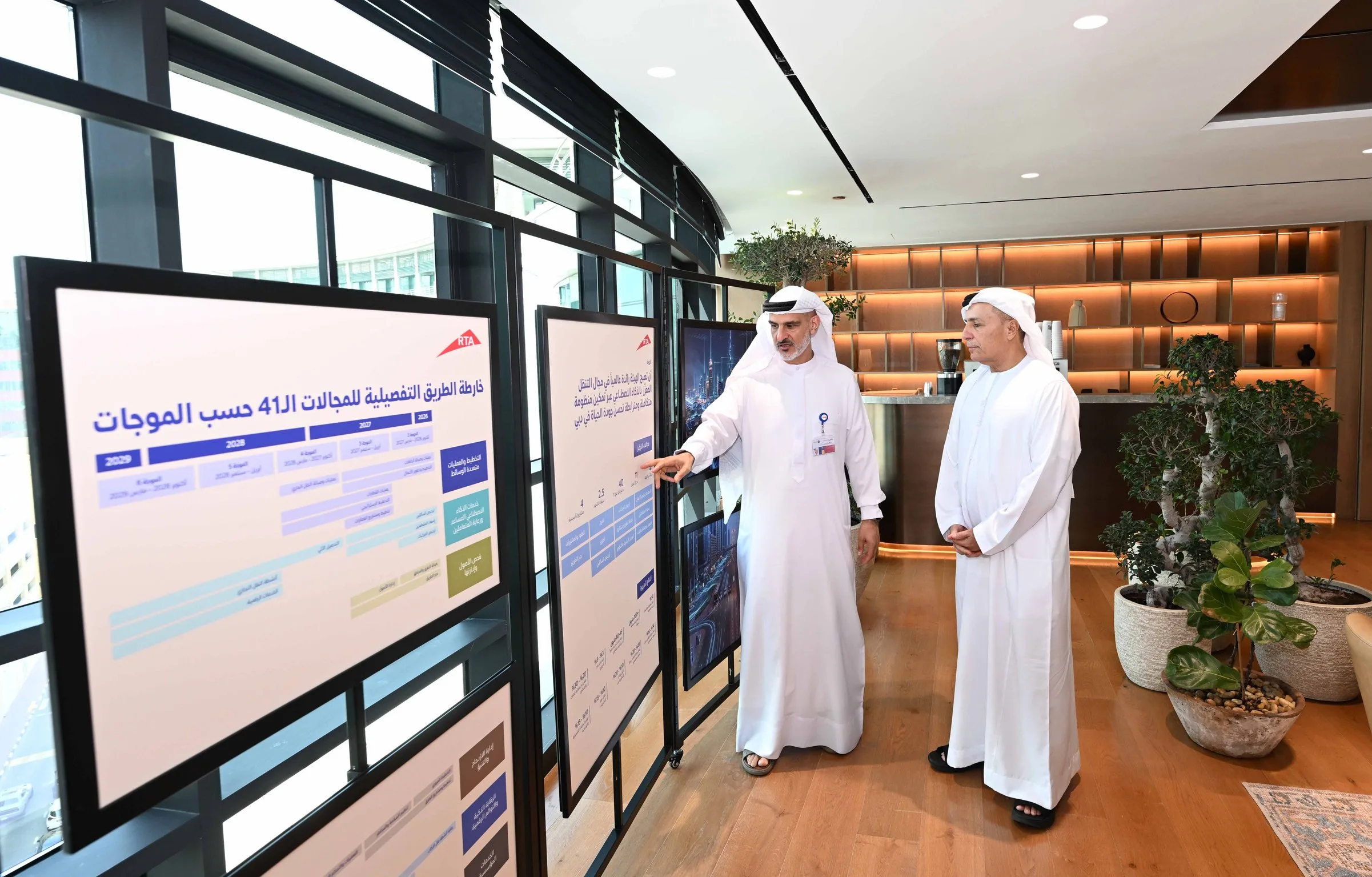
Dubai’s Roads and Transport Authority has unveiled an updated artificial intelligence strategy, with Director General Mattar Al Tayer launching the plan at an event on Saturday. The strategy spans 41 areas across RTA agencies, sectors and departments, and aims to generate more than AED 300 million in annual added value over a two-and-a-half-year implementation period.
The plan’s central ambition is to transition 50% of RTA operations and services to an Agentic AI ecosystem, a shift that the authority says will enable faster, more flexible service delivery. The first two rollout waves focus on 11 business areas, including planning and business development, vehicle licensing, traffic management, driver licensing, and human resources. Across those areas, 40 AI products have been identified, 11 of which are already live, alongside four foundational projects.
“The launch of RTA’s updated Artificial Intelligence Strategy aligns with the directives of the wise leadership to accelerate AI adoption, expand its use across government sectors, reinforce Dubai’s position as a global hub for developing and deploying smart, innovative solutions, and develop human-centred services that promote happiness and wellbeing,” Al Tayer said in a statement.
“The strategy marks an advanced stage in RTA’s digital transformation journey, paving the way for a fundamental shift from AI applications that support operations to intelligent systems capable of analysing data, predicting outcomes, supporting decision-making and delivering end-to-end services. Through this strategy, we aim to expand the use of future technologies in planning, operating and managing road and public transport networks, while developing proactive, personalised services that meet customer needs, save time and effort, and make mobility easier. These efforts will contribute to enhancing quality of life and bringing happiness to Dubai’s residents and visitors,” he added.
Key performance targets are specific. The strategy sets out reductions in traffic congestion of 3% to 5%, cuts to case and complaint processing times of 20% to 30%, and a 14% to 16% reduction in waiting times at Customer Happiness Centres. It also targets a 10% to 20% drop in accidents involving newly licensed drivers and procurement cycle savings of 10% to 15%.
Ahmed Hashem Bahrozyan, CEO of RTA’s Corporate Technology Support Services Sector, outlined what the first wave has delivered so far. Microsoft Copilot has been rolled out with active usage exceeding 90% among its users and a reported 10% saving in working time. RTA has submitted 34 works for intellectual property registration, won the AI World Series 2026 Award, and developed eight strategic initiatives with partners including Huawei, Boston Consulting Group and Microsoft.
Several flagship products are either live or in development. The Mahboub smart chatbot is being upgraded using Agentic AI to handle full end-to-end transactions rather than just enquiries. Integrated with UAE PASS and Dubai Pay, the system currently supports five vehicle licensing services, with completion targeted in under five minutes. The authority aims to route 10% of services through the platform by end of 2026, rising to 50% by end of 2027.
The Agentic AI-powered No Objection Certificate system, which processes around 130,000 certificates annually with demand growing by roughly 11%, aims to accelerate review procedures threefold and save more than 700,000 working days each year. A separate AI auditor, built for the Licensing Agency, targets a 21-times acceleration in auditing processes and 100% document coverage, saving more than 25,000 hours of manual work annually.
In public transport, the Agentic AI-powered Bus Network Planner deploys around 20 AI agents to support planners in assessing and adjusting Dubai’s bus network. The system aims to cut service change implementation time from approximately 60 to 48 days and improve on-time performance by up to 10%.