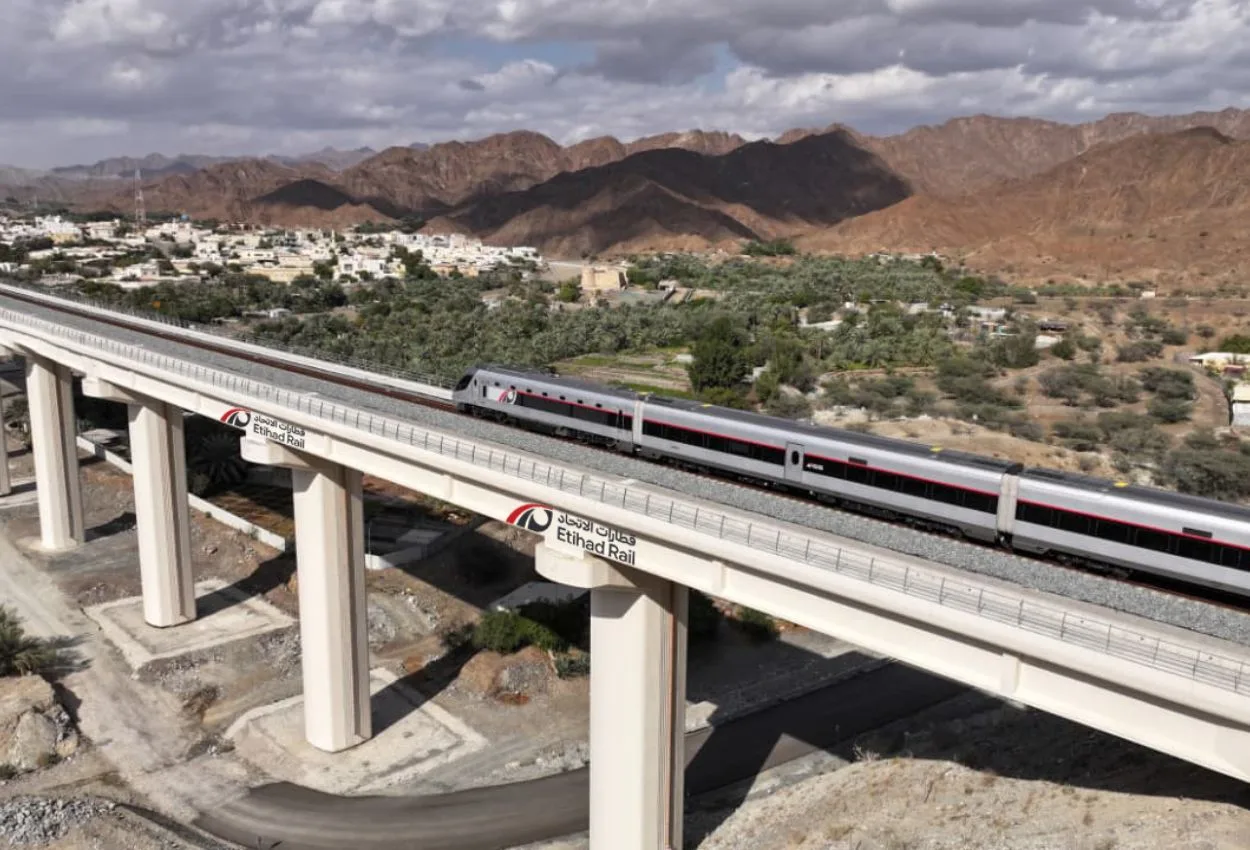
Etihad Rail is to launch passenger services in 2026, connecting Abu Dhabi and Dubai before extending to Fujairah on the east coast, the company’s Director of Public Policy and Sustainability has confirmed.
Azra Al Mansouri revealed launch operations on the sidelines of the Make in the Emirates 2026 forum, speaking to the Emirates News Agency (WAM) in an exclusive interview.
She said operations would proceed “in gradual and well-studied phases,” with routes determined on the basis of population density, demand volume, and connectivity priorities between the emirates.
Etihad Rail freight volumes rise in 2026 as passenger services set for launch
Alongside the passenger announcement, Al Mansouri confirmed that Etihad Rail transported 1.8 million tonnes of sulphur and more than four million tonnes of stones and gravel during 2026, in addition to more than 129,000 containers. She compared the container figure to the 148,000 transported during 2025, describing it as evidence of “the company’s ability to continue growing and enhancing the efficiency of its operational processes.”
Al Mansouri said the network had eliminated more than 340,000 truck trips from roads and reduced carbon emissions by between 70 and 80 per cent per trip. “Rail freight services represent an integrated, cost-effective and reliable operational solution, available throughout the UAE,” she said.
The network connects Khalifa Port, Jebel Ali Port and Abu Dhabi Industrial City (ICAD) to the country’s logistics centres through 11 stations, including four main ports. Each freight train carries the load equivalent of 300 heavy trucks.
The company’s current freight customers include ADNOC for sulphur transport, Stephen Rock for aggregate transport, and Borouge for petrochemical transport. Trains run on fixed schedules on dedicated lanes, removing dependence on road conditions and insulating operations from traffic congestion and road incidents.
97% local supplier base underpins ‘Made in the UAE’ identity
Al Mansouri confirmed that freight services have grown continuously since launching in February 2023, contributing to trade and supply chains in line with the requirements of the industrial sector.
Al Mansouri said Etihad Rail was participating in “Made in the UAE 2026” for the second year in a row, noting that 70 per cent of the building materials used in developing and operating the network were sourced from local companies. Local suppliers account for 97 per cent of the company’s total supplier base.
“The Etihad Rail network represents an integrated national model that embodies the concept of ‘Made in the UAE,’” she said.
She concluded by affirming the company’s commitment to “continuing to develop an infrastructure that supports sustainable mobility and serves the community and future generations through projects that include passenger and freight trains within the UAE’s national railway network.”