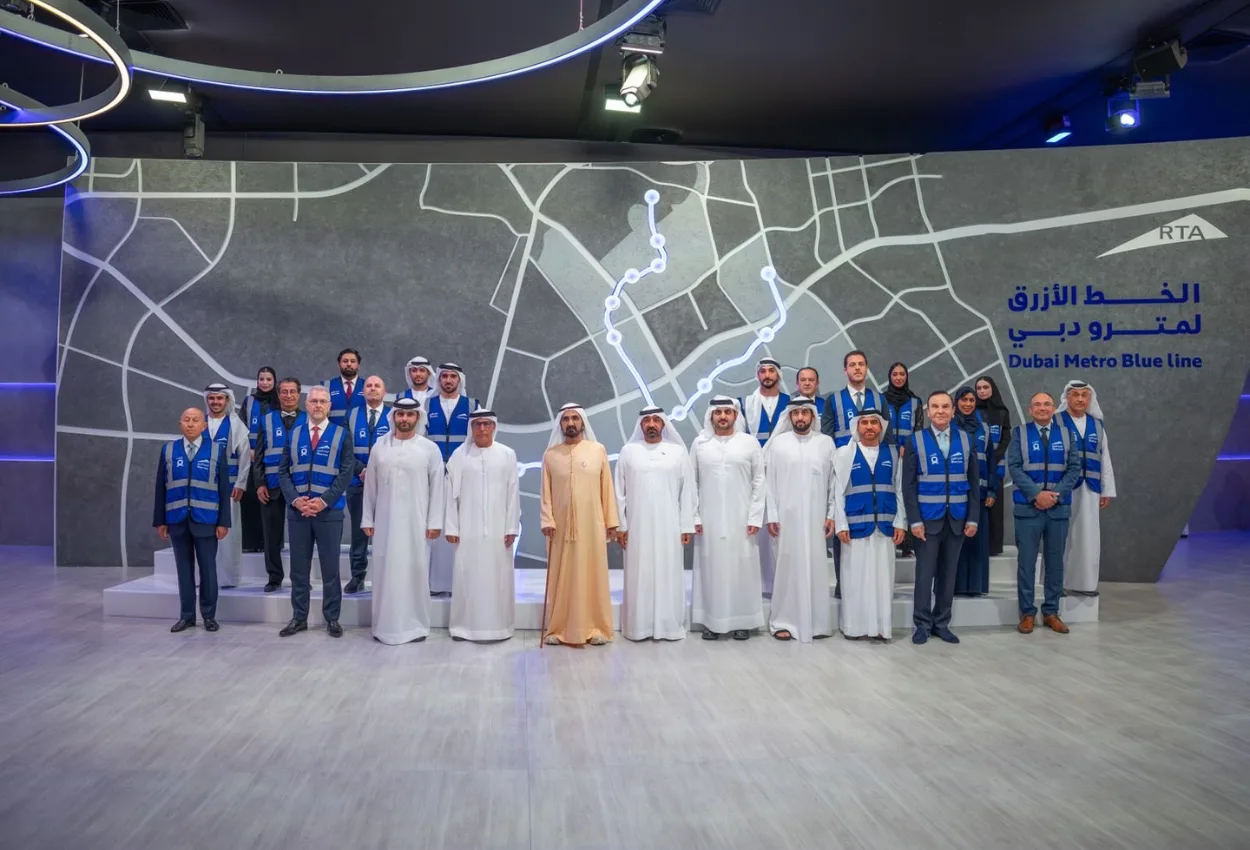
Sheikh Mohammed bin Rashid Al Maktoum, Vice President and Prime Minister of the UAE and Ruler of Dubai, has launched the tunnelling works for the Dubai Metro Blue Line, a project representing an investment of more than AED20.5 billion.
The ceremony to mark the formal start of tunnelling took place at the International City 1 Station site – the largest underground interchange station in the metro network, spanning more than 44,000 square metres.
“10,000 employees and engineers racing against time,” Sheikh Mohammed wrote on his official X account, noting a budget of AED 20 billion allocated to deliver the Blue Line by September 9, 2029.
A further AED 34 billion has been set aside for the Gold Line, bringing the combined investment in Dubai’s metro expansion to AED 54 billion. Sheikh Mohammed described the two lines together as the effort “to complete the world’s newest and most beautiful metro.”
The metro expansion forms part of a broader infrastructure programme that Sheikh Mohammed said would “reshape the new Dubai.” Projects under development include a new global airport, transport lines, a redeveloped International Financial Centre, and digital government infrastructure driven by artificial intelligence and autonomous technologies.
“We will launch many more projects in the coming months,” Sheikh Mohammed said, adding: “We are the world’s most future-ready city. Whoever bets on Dubai bets on the future.”
What is the Dubai Metro Blue Line?
The Dubai Metro Blue Line is a 30-kilometre route comprising a 15.5-kilometre underground section and a 14.5-kilometre stretch above ground. It features 14 stations in total, including three interchange stations, seven stations above ground and four underground stations.
The line will connect with the Green Line at Creek Station and the Red Line at Centrepoint Station, serving nine districts with a projected population of around one million people under the Dubai 2040 Urban Master Plan.
“Our projects in Dubai are delivered to meet the highest international standards, guided by clear plans, precise timelines, and national talent capable of turning vision into tangible achievements in practice. Their delivery is overseen by 180 railway experts and engineers,” Sheikh Mohammed said in a statement.
He affirmed that investing in the transport sector is an investment in the future and a pillar of enhancing Dubai’s position in global competition, adding that the Blue Line represents an extension of a vision aimed at building a more connected and sustainable city.
Dubai Metro Blue Line: Route, stations and connections
The Blue Line extends in two directions. The first begins at Creek Interchange Station on the Green Line in Al Jaddaf and passes through Dubai Festival City, Dubai Creek Harbour and Ras Al Khor Industrial Area before reaching the interchange station at International City 1.
It then continues through International City 2 and 3, Dubai Silicon Oasis and Dubai Academic City – a stretch of 21 kilometres encompassing 10 stations.
The second direction runs from Centrepoint Interchange Station on the Red Line in Al Rashidiya, passing through Mirdif and Al Warqa’a to the interchange station at International City 1. This section is nine kilometres long and includes four stations.
A depot and maintenance facility for trains will also be constructed in Al Ruwayyah 3.
Construction progress and timeline
The ceremony was attended by senior members of the royal family and officials, including Sheikh Maktoum bin Mohammed bin Rashid Al Maktoum, First Deputy Ruler of Dubai, Deputy Prime Minister and Minister of Finance of the UAE; Sheikh Ahmed bin Mohammed bin Rashid Al Maktoum, Second Deputy Ruler of Dubai; Sheikh Ahmed bin Saeed Al Maktoum, President of the Dubai Civil Aviation Authority, Chairman of Dubai Airports, and Chairman and Chief Executive of Emirates Airline and Group; Sheikh Mansoor bin Mohammed bin Rashid Al Maktoum, Chairman of the UAE Olympic Committee.
Sheikh Mohammed was received at the site by Mattar Al Tayer, Director General, Chairman of the Board of Executive Directors of the Roads and Transport Authority (RTA), alongside executives from MAPA, LIMAK and CRRC Hong Kong, the firms delivering the project.
Al Tayer briefed Sheikh Mohammed on the project’s progression – from the approval of the route in November 2023, through the awarding of the contract in December 2024, and the laying of the foundation stone in June 2025.
The project currently stands at 20 per cent completion, with more than 10,000 workers on site and more than 500 engineers and experts overseeing delivery under Emirati leadership.
The consortium has so far completed more than 13 million work hours without recording any lost-time injuries. Construction at stations is progressing ahead of schedule, with bridge foundations and piers being installed. Work has also begun on the piers of the bridge crossing Dubai Creek – the first metro bridge to span the Creek – which will extend 1.3 kilometres. The bridge structures are expected to begin taking shape in June.
Completion is expected to reach 30 per cent by the end of 2026, with the line set to open on September 09, 2029.
Sheikh Mohammed gave the signal to start operating the Tunnel Boring Machine (TBM), which RTA has named Al Wugeisha, marking the formal launch of tunnelling operations.
Tunnelling will proceed in three directions from International City 1 Station: the first TBM heading towards Mirdif, the second towards the Auto Market, and the third towards Al Warsan (International City 2).
Al Wugeisha is 163 metres in length, weighs more than 2,000 tonnes, and operates around the clock. Its average excavation rate ranges from 13 to 17 metres per day.
The machine is equipped with digital guidance systems, monitoring and control systems, and a logistics system for transporting excavated material. It is designed to break through rock formations, bore through sandy strata, and navigate other obstacles encountered during excavation. It incorporates a metal shield supported by a mechanical tail section, with a cutterhead at the front followed by a chamber whose configuration varies according to the geological conditions being bored. Behind the chamber, hydraulic jacks generate the thrust to propel the machine forward.
Al Wugeisha also includes a spoil removal system, slurry discharge pipelines and a control cabin.
RTA describes it as an environmentally friendly machine that does not adversely affect the ground layers adjacent to the excavation zone, and that bores tunnels with consistent profiles – reducing tunnel wall installation costs and facilitating subsequent construction works.
Dubai Metro Blue Line to feature the world’s tallest metro station
During his visit, Sheikh Mohammed reviewed the architectural designs for stations along the line, including the interior of the International City 1 interchange station, which has an estimated capacity of 350,000 riders per day.
He also reviewed the design of the Emaar Properties Station – at 74 metres, it will be the world’s tallest metro station. Covering 11,000 square metres, the station was designed by the American firm Skidmore, Owings & Merrill, which also designed the Burj Khalifa, the Olympic Tower in New York, and the Sears Tower in Chicago.
Its capacity is estimated at 160,000 riders per day, with daily ridership expected to exceed 70,000 passengers by 2040. The station will serve the residents of Dubai Creek Harbour, where the population is estimated at 40,000, as well as visitors to the area.
Station designs: Air, Water, Earth and Fire
The interior designs of the remaining stations adopt a character drawing on four themes from nature. Three stations take inspiration from air, with open spaces and light. T
wo stations are themed around water, with forms reflecting the city’s maritime history through flowing designs and colours. Four stations are themed around earth, with tones reflecting Dubai’s surroundings.
Two stations are themed around fire, with colour gradations that convey movement and energy.
The Blue Line will provide journeys from its service areas to Dubai International Airport in 20 minutes and is expected to reduce traffic congestion by 20 per cent along the corridors it serves.
The line will also serve Dubai Silicon Oasis, a hub for innovation identified in the Dubai 2040 Urban Master Plan as one of the key urban centres supporting the growth of the knowledge and technology economy.
Al Tayer noted that the combined Dubai Metro and Tram network currently extends 101 kilometres and comprises 140 trains. Since the launch of Dubai Metro in September 2009 through to the end of 2025, the network has served nearly 2.8 billion passengers, including 295 million in 2025 alone – a 7 per cent increase on the previous year. Average daily metro ridership is estimated at around one million, with Dubai Metro accounting for 40 per cent of total public transport use in the emirate.
The Blue Line is the first rail project undertaken by RTA to include two ready-mix concrete batching plants and two precast concrete storage sites – located in Al Ruwayyah 3 and International City – giving RTA full control over manufacturing and supply chains.
The plant in Al Ruwayyah produces 200 cubic metres of ready-mix concrete, while its precast viaduct factory produces 10 to 12 viaduct segments per day. The International City plant produces 120 cubic metres of ready-mix concrete, and its precast tunnel ring factory produces 12 rings per day.