Salik and Dubai Airports have signed a 10-year agreement to introduce E-Wallet parking payments at Dubai International Airport, starting January 22, 2026.
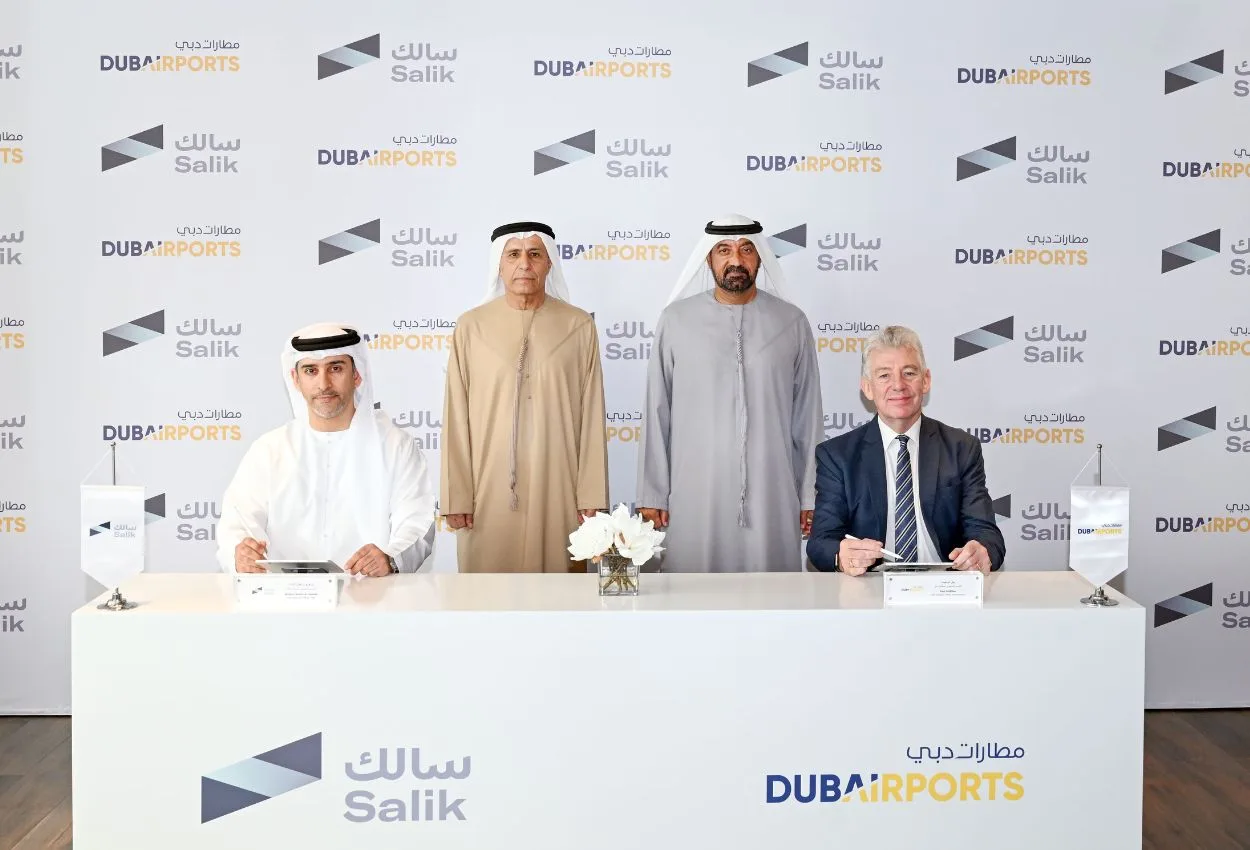
Sheikh Ahmed bin Saeed Al Maktoum, President of the Dubai Civil Aviation Authority, Chairman of Dubai Airports, and Chairman and Chief Executive of Emirates Airline and Group, together with Mattar Al Tayer, Chairman of the Board of Directors of Salik, witnessed the signing.
Ibrahim Sultan Al Haddad, Chief Executive Officer of Salik, and Paul Griffiths, Chief Executive Officer of Dubai Airports, signed the agreement in the presence of officials from both parties.
Salik E-Wallet integration at Dubai International Airport (DXB)
The agreement will introduce Salik’s E-Wallet payment solution across all paid car parks at DXB, covering 7,400 parking spaces at Terminals 1, 2, 3 and the Cargo Mega Terminal.
Under the MoU, Salik will integrate its Salik E-Wallet System with the car park management systems used by Dubai Airports’ appointed car park concessionaire. The integration enables visitors to pay from their Salik E-Wallet accounts.
“Dubai International is one of the world’s leading gateways, continually setting new benchmarks with aviation driving tourism, trade, and investment. We are proud to support Dubai’s position as a global economic hub through our shared vision for smart, sustainable infrastructure. By integrating Salik’s E-Wallet at DXB, we are delivering a seamless, efficient experience for road users and advancing state-of-the-art mobility solutions for the emirate,” Ibrahim Sultan Al Haddad, Chief Executive Officer of Salik said in a statement.
“This agreement is fully aligned with our strategy to expand Salik’s role in smart and sustainable mobility while accelerating growth beyond our core tolling business. It builds on the momentum we’ve created in seamless parking through our presence across UAE’s key destinations and reinforces our position as a trusted digital payments partner for leading destinations and infrastructure operators in the UAE,” Al Haddad added.
Salik expands beyond tolling with Dubai International Airport parking deal
The collaboration is designed to support Dubai Airports’ ambition to implement entry and exit at car parks, increase vehicle throughput and improve traffic flow around the terminals, while delivering a digital parking experience.
“Dubai Airports is committed to delivering exceptional guest experiences with human-centred hospitality, ensuring that every journey reflects Dubai’s ambition and forward-thinking spirit. Parking is often the first and last touchpoint for our guests, and it plays a vital role in shaping the overall airport experience,” Paul Griffiths, Chief Executive Officer of Dubai Airports added.
“Our collaboration with Salik introduces a fast, reliable and widely adopted digital payment option that simplifies parking, reduces queuing at exits, and supports our long-term vision for seamless access across our car parks. With more than 4.7 million vehicles in UAE already linked to Salik accounts, this partnership offers a familiar and convenient solution for a large share of our customers while advancing Dubai’s wider smart city ambitions. It also complements Dubai Airports’ commitment to smart, sustainable operations and frictionless journeys, building on recent digital payment innovations and digitalisation milestones,” he added.
Under the terms of the agreement, Salik will be responsible for integrating, operating and maintaining the Salik E-Wallet System. Dubai Airports will ensure the availability of payment channels, with Salik E-Wallet introduced as a payment solution provider, working with its car park concessionaire to complete the integration and promote the payment solution within airport premises.
Salik’s E-Wallet solution will service all parking spaces covering Terminals 1, 2, 3 and the Cargo Mega Terminal.
By partnering with Dubai Airports, Salik is extending this model to one of the region’s aviation assets. DXB recorded its quarterly traffic in 65 years during Q3 2025, welcoming 24.2 million guests between July and September, bringing traffic for the first nine months to 70.1 million guests.