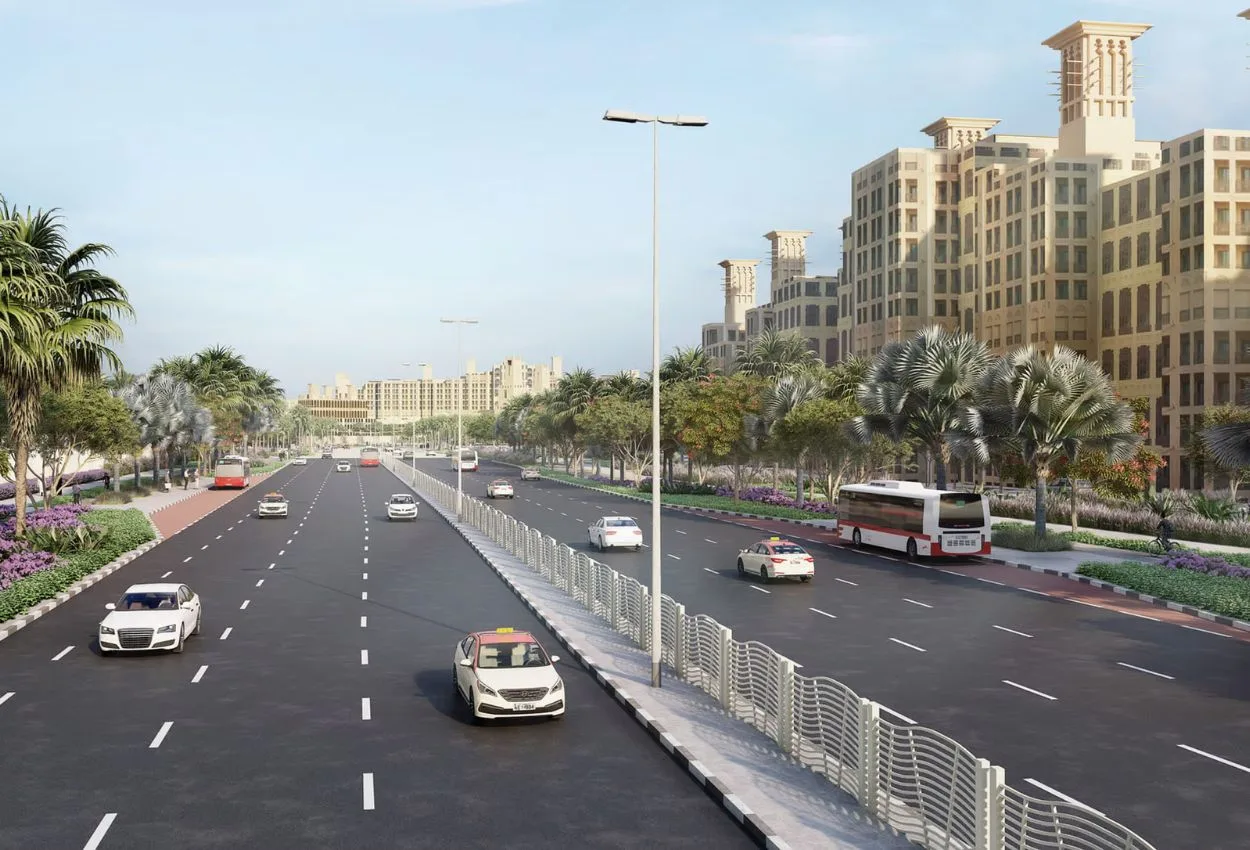
Dubai’s Roads and Transport Authority (RTA) has awarded a contract for the development of Umm Suqeim Street, Al Wasl Road, Al Safa Street and seven intersections along Jumeirah Street, as part of an effort to expand road network capacity and improve traffic flow across the emirate.
The project includes the construction of bridges and tunnels extending approximately 11,000 metres in total, alongside at-grade road widening works.
It covers the upgrade of Umm Suqeim Street from its intersection with Jumeirah Street to Al Khail Road; Al Wasl Road from its intersection with Umm Suqeim Street to its intersection with 2nd December Street; Al Safa Street from its intersection with Sheikh Zayed Road to Al Wasl Road; and seven intersections along Jumeirah Street.
11,000 metres of bridges, tunnels planned for Dubai’s Jumeirah corridor
Upon completion, the project will increase the capacity of Umm Suqeim Street to 16,000 vehicles per hour in both directions and raise the capacity of Al Wasl and Al Safa Streets to 12,000 vehicles per hour in both directions for each street.
Beyond road widening, the project includes improvements to pedestrian walkways and a cycling track, alongside public boulevard plazas and urban spaces.
Mattar Al Tayer, Director General, Chairman of the Board of Executive Directors, of the Roads and Transport Authority, said the project forms part of an integrated plan to upgrade roads across Jumeirah, Umm Suqeim, Al Wasl and Al Safa streets, serving areas with an estimated population of more than two million.
“Developing roads and transport infrastructure is a key driver of the economy and a fundamental pillar supporting urban growth, while further strengthening Dubai’s appeal as a destination for investment and business. The development of vital corridors enhances the efficiency of the traffic network, reduces journey times and improves traffic flow, with a positive impact on individual productivity and the efficiency of various economic sectors,” he said in a statement.
“Achieving smooth traffic flow across the emirate requires the continuous and integrated development of the road network, alongside the expansion of public transport and the adoption of smart solutions. RTA is moving ahead with a comprehensive plan to upgrade several vital corridors across the area, keeping pace with population growth and urban expansion, enhancing daily mobility for Dubai’s residents and visitors, and reinforcing the emirate’s global leadership in infrastructure,” he added.
Al Tayer described Umm Suqeim Street Development as part of the broader Umm Suqeim–Al Qudra corridor plan, which extends from Jumeirah Street to Emirates Road and onward to Al Qudra Street.
“The project will enhance connectivity across 4 strategic corridors in Dubai, namely Sheikh Zayed Road, Al Khail Road, Sheikh Mohammed bin Zayed Road and Emirates Road. It will also increase the street’s capacity to 16,000 vehicles per hour in both directions, improve traffic flow, and reduce journey time on the section between Jumeirah Street and Al Khail Road from 20 minutes to 6 minutes. The project serves several residential and development areas, most notably Jumeirah, Umm Suqeim, Al Manara, Al Sufouh, Umm Al Sheif, Al Barsha and Al Quoz, with an estimated population of more than 2 million,” he explained.
The Umm Suqeim Street works include the development of six Dubai intersections with Jumeirah Street, Al Wasl Road, Sheikh Zayed Road and Al Khail Road.
Four bridges and two tunnels extending 4,100 metres in total will be constructed. A tunnel with two lanes in each direction will be built at the intersection of Umm Suqeim Street and Jumeirah Street, alongside a signalised at-grade junction.
A further tunnel will be constructed at the intersection of Umm Suqeim Street and Al Wasl Road, providing two lanes from Sheikh Zayed Road towards Jumeirah Street and ensuring direct at-grade traffic flow towards Sheikh Zayed Road.
Two bridges will be constructed at the intersection of Umm Suqeim Street and Sheikh Zayed Road to remove traffic overlap at the junction. One additional lane will be added on Umm Suqeim Street from its intersection with First Al Khail Street to Al Asayel Street, bringing the total to five lanes in each direction.
At the intersection of Umm Suqeim Street and Al Khail Road, two elevated links will be constructed and widened – one connecting Al Khail Road to Al Quoz Industrial Area, and the other serving traffic from Umm Suqeim Street to Al Khail Road towards Deira.
Al Wasl Road Development extends 15 kilometres from its intersection with Umm Suqeim Street to 2nd December Street. The works include widening the road from two to three lanes in each direction and upgrading seven intersections at Al Thanya Street, Al Manara Street, Umm Al Sheif Street, Umm Amara Street, Al Urouba Street, Al Hudaiba Street and 2nd December Street.
RTA contract targets 12,000 vehicles per hour on Al Wasl, Al Safa streets
Five tunnels extending 3,850 metres will be constructed. The project will cut journey time along Al Wasl Road by 50 per cent and increase capacity from 8,000 to 12,000 vehicles per hour in both directions.
Works include at-grade improvements at the intersection of Al Wasl Street and Al Thanya Street, and a unidirectional tunnel at the intersection with Al Manara Street. That tunnel will have three lanes branching into two routes: two lanes from Sheikh Zayed Road towards Jumeirah Street, and two lanes from Sheikh Zayed Road towards Umm Suqeim Street, with a capacity of 4,800 vehicles per hour.
A 650-metre tunnel on Umm Al Sheif Street will provide two lanes from Sheikh Zayed Road towards Jumeirah Street, with a capacity of 3,200 vehicles per hour. A 605-metre unidirectional tunnel at the intersection of Al Wasl Road and Umm Amara Street will serve traffic towards 2nd December Street, with two lanes and a capacity of 3,200 vehicles per hour.
A further 565-metre unidirectional tunnel at the intersection with Al Urouba Street will serve traffic towards Jumeirah Street, with two lanes and a capacity of 1,400 vehicles per hour.
Al Safa Street Development extends 1,500 metres from Sheikh Zayed Road to its intersection with Al Wasl Road. The project includes the construction of two bridges and two tunnels extending 3,120 metres in total, along with at-grade road widening, junction improvements and traffic signal upgrades. Upon completion, journey time on Al Safa Street will fall from 12 minutes to three minutes, and capacity will increase from 6,000 to 12,000 vehicles per hour in both directions.
The first bridge will serve traffic from Al Wasl Road towards Sheikh Zayed Road and Financial Centre Street, featuring four lanes, extending 1,005 metres, with a capacity of 6,400 vehicles per hour.
The second bridge will serve traffic from Al Satwa Street towards Sheikh Zayed Road and Financial Centre Street, with two lanes, extending 360 metres and a capacity of 2,800 vehicles per hour.
The first tunnel will serve traffic from Sheikh Zayed Road and Financial Centre Street towards Al Wasl Road, with two lanes, extending 1,005 metres and a capacity of 3,200 vehicles per hour.
The second tunnel, at the intersection of Al Wasl Road and Al Safa Street, will extend 750 metres, with two lanes in each direction and a capacity of 6,400 vehicles per hour in both directions.
The street will be widened from three signal-controlled lanes to four lanes in each direction. Pedestrian and cycling paths, urban spaces and landscaping will also be upgraded.
The project includes at-grade improvements at seven intersections along Jumeirah Street – at Al Thanya Street, Al Manara Street, Umm Al Sheif Street, Al Urouba Street, 39B Street, Al Hudaiba Street and 2nd December Street – aimed at increasing capacity, improving traffic flow and reducing congestion at intersections.