Dubai’s Roads and Transport Authority (RTA) has unveiled three initiatives – a rapid intervention vehicle, a smart bus station and soft mobility parking facilities – as part of efforts to modernise the emirate’s mobility infrastructure.
Sheikh Hamdan bin Mohammed bin Rashid Al Maktoum, Crown Prince of Dubai, Deputy Prime Minister, Minister of Defence, and Chairman of the Executive Council of Dubai, has reviewed a series of projects being implemented by Dubai’s RTA, receiving a briefing from Mattar Al Tayer, Director General, Chairman of the Board of Executive Directors of the RTA, on each initiative and its role within the emirate’s transport network.
Sheikh Hamdan was accompanied during the visit by Sheikh Ahmed bin Saeed Al Maktoum, President of the Dubai Civil Aviation Authority, Chairman of Dubai Airports, and Chairman and Chief Executive of Emirates Airline and Group.
The visit reflects what the leadership describes as a commitment to direct oversight of government projects, assessing their readiness against operational targets and timelines.
“The variety of futuristic mass transit projects we witness today is not the outcome of infrastructure development priorities alone, but a comprehensive redefinition of the concept of urban mobility in keeping with the highest international standards, reflecting Dubai’s ambition to be the city that is quickest to anticipate the future and most capable of turning it into tangible reality.
“We operate with a clear vision based on innovation as a core principle and advanced technologies as a key tool for transforming lives and achieving leadership. We are committed to supporting and accelerating the adoption of smart and sustainable solutions, enhancing systemic efficiency, amplifying its developmental impact, and ensuring the highest quality of life for citizens, residents, and visitors,” he said in a statement.
Sheikh Hamdan also stated that Dubai is “keen to ensure” it “remains a leading global model in designing future cities and a pioneering platform for testing and implementing the latest technologies advancing mobility solutions.”
Dubai RTA unveils vehicle that can pump 60,000 litres per minute in flood emergencies
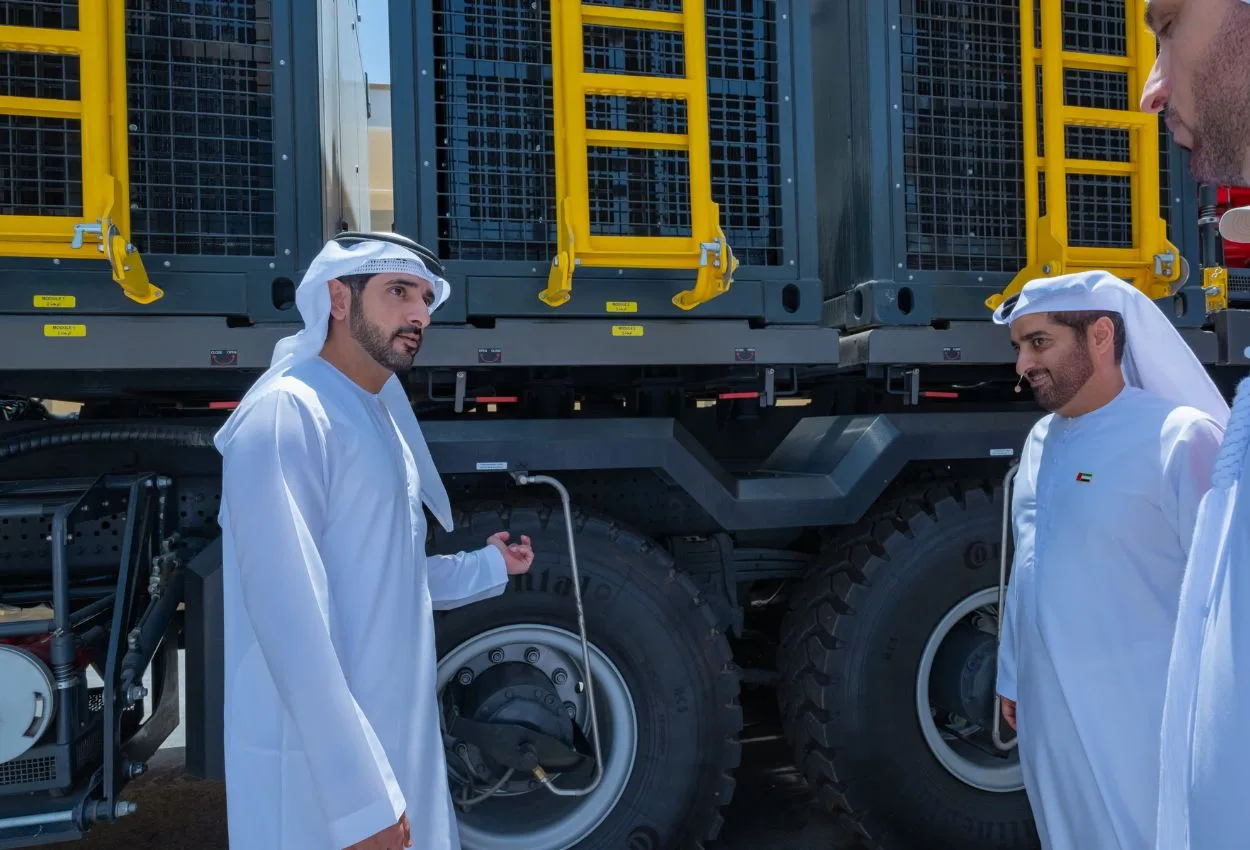
The first initiative reviewed was the RTA’s rapid intervention vehicle, developed to manage water accumulation during heavy rainfall while maintaining traffic flow.
The vehicle is fitted with four pumps with a combined capacity of approximately 60,000 litres per minute – equivalent to the operating efficiency of ten conventional pumps or 25 water suction tankers. It is capable of pumping water at a rate of around 1,000 litres per second and operating in depths of up to 1.8 metres.
The vehicle carries a main pump operated from inside via a hydraulic system, three pump engines, four primary pumps, rainwater suction hoses, a hose reel trailer, a rescue boat for evacuation operations, and a thermal drone for field monitoring. A backup generator and a lighting tower allow the vehicle to operate under varied conditions.
The RTA says the vehicle reduces response times for water-related emergencies by more than 75 per cent, addressing a gap left by conventional equipment, which requires prior preparation or cannot access areas with deep water accumulation.
The second project is a smart bus station on Sheikh Zayed Road in Al Barsha 2, near Mall of the Emirates, which the RTA reports is 90% complete, with full completion expected by the end of the current month.
The station converts all customer services to contactless, paperless formats, integrated with the nol card and S’hail app. It is equipped with solar panels to reduce energy consumption, cameras powered by artificial intelligence for crowd management and violation detection, and sensors to monitor air quality. The station has been designed to meet Leadership in Energy and Environmental Design Platinum standards (LEED Platinum).
Electric scooter parking facilities to launch at five Dubai locations in July 2026
The third initiative covers parking facilities for bicycles and electric scooters, introduced at public transport stations and destinations to support first and last-mile journeys.
The facilities include shade structures, scooter-charging capability, usage monitoring systems, and spaces for advertising. The project has been developed against a backdrop of a 23 per cent rise in bicycle usage, with the total number of trips reaching 57.6 million in 2025.
A phased rollout is planned, beginning with pilot operations at five locations in July 2026 and progressing to permanent operation in 2028.
Mattar Al Tayer said all three initiatives “reflect RTA’s commitment to keeping pace with the latest global developments and harnessing advanced technologies to deliver an integrated and sustainable transport system that enhances quality of life, promotes the well-being of residents and visitors, and reinforces Dubai’s position as a leading global model in smart mobility.”
He added that the RTA “continues to develop specialised solutions that strengthen the emirate’s readiness to address future challenges and further consolidate its leadership in sustainability and advanced technologies.”