
International visitor spending in the Middle East is forecast to grow by $116 billion, a 57 per cent increase, between 2025 and 2030, according to the ATM Travel Trends Report 2026, produced by Arabian Travel Market in association with Tourism Economics, an Oxford Economics company. The findings were presented at Arabian Travel Market 2026, running at Dubai World Trade Centre through Thursday.
The backdrop is already strong. Global travel hit record levels in 2025, with total visitor nights reaching 24 billion, 16 per cent above 2019 levels, and in-destination spending rising 26 per cent to $7.2 trillion. International arrivals exceeded 1.5 billion for the first time.
The Middle East, North Africa and South Asia region has been driving an outsized share of that growth. Total travel volumes across MENASA in 2025 were almost 50 per cent above 2019 levels, three times the global rate, and the region accounted for more than half of the worldwide increase in international travel over the same period.
Tourism Economics expects geopolitical disruption to weigh on Middle East travel in 2026, but forecasts a sharp rebound in 2027, when international travel in MENASA is expected to grow 17 per cent, against 8 per cent globally. Recovery timelines have also shortened considerably, from roughly 24 months following major disruptions in the early 2000s to around 10–12 months in recent years.
By 2030, MENASA is projected to reach 316 million international arrivals and 2.3 billion visitor nights, generating $408 billion in spending, representing increases of 36 per cent, 46 per cent and 55 per cent respectively against 2025 figures.
Dave Goodger, Managing Director EMEA at Tourism Economics, framed the growth as durable rather than post-pandemic bounce. “We are indeed optimistic about growth. Over the next five years we see travel expanding on a structural basis rather than just a cyclical rebound. International travel has never mattered more, 2026 is building on a record 2025, and MENASA is outpacing the world. “This year is disrupted by an uncertain economic and geopolitical backdrop, but consumers are treating travel as essential. People are prioritising experiences over things, and that, combined with favourable demographics, rising wealth and sustained investment in capacity, underpins our confidence in the region’s long-term momentum,” he said,
Technology is becoming a larger factor. The report cites research showing 91 per cent of Middle East travel businesses are piloting or operating AI, with 85 per cent reporting measurable cost savings.
Prospective visitors to the region are more than twice as likely to have used an AI chatbot in trip planning, at 28 per cent compared with 12 per cent for travellers considering other destinations.
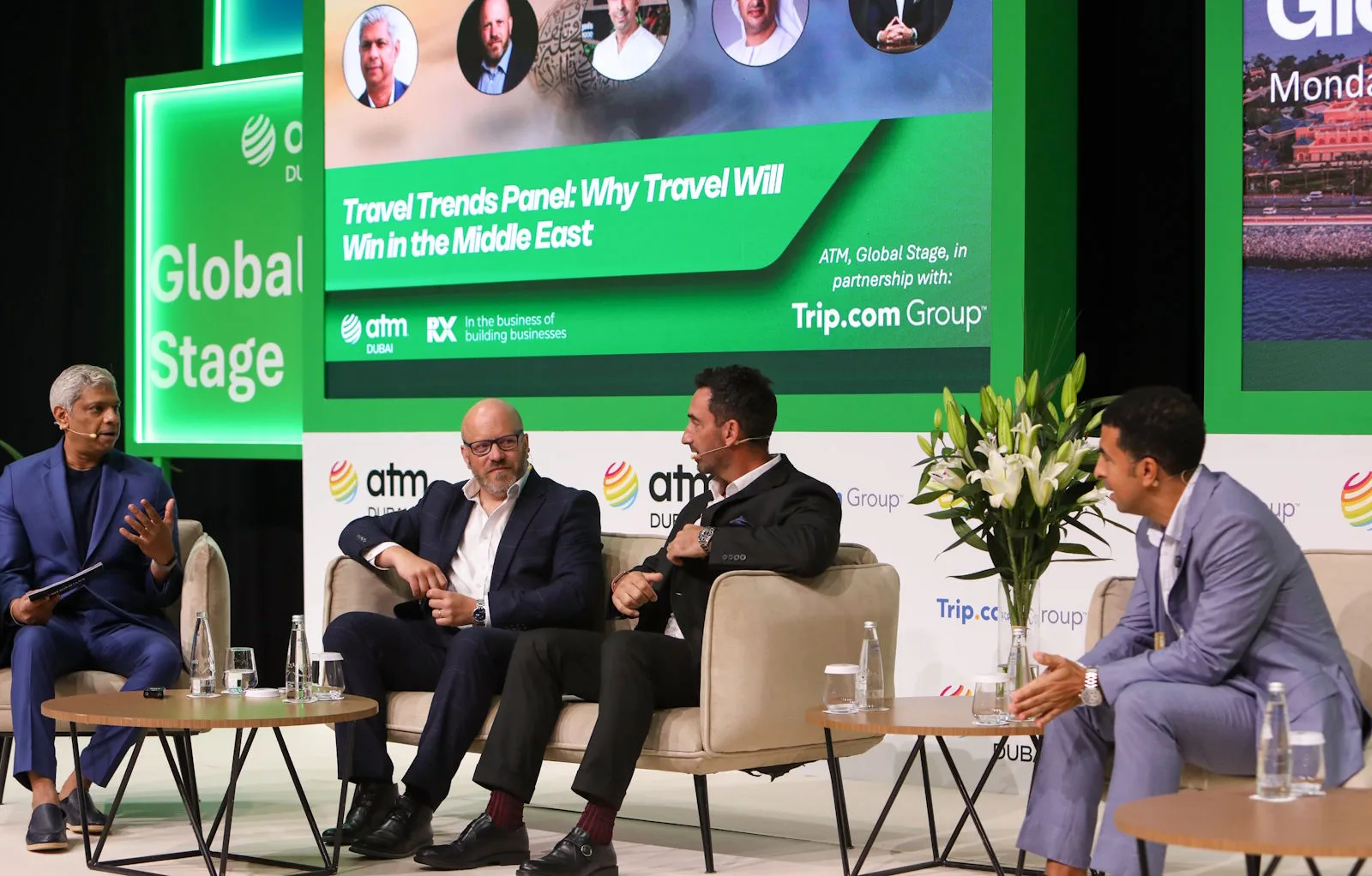
A panel discussion following the presentation featured Eddy Tannous, Chief Operating Officer at Rotana Hotel Management Corporation, and Tarik Fadil, Vice President of Supply at Agoda.
Tannous pushed back on the idea that the region is nearing capacity, drawing on the trajectory of Dubai’s hotel stock. “In 2008, Dubai had around 45,000 keys; today it’s closer to 160–170,000 keys. I prefer to compare the Middle East to major cities around the world. The region’s potential is still far bigger than we think.”
Fadil pointed to the region’s dual function as both destination and transit hub. “The Middle East is two things at once: a destination in its own right and a hub connecting Asia, Europe and Africa. Serving it well comes down to leveraging AI and deepening localisation,” he said.