
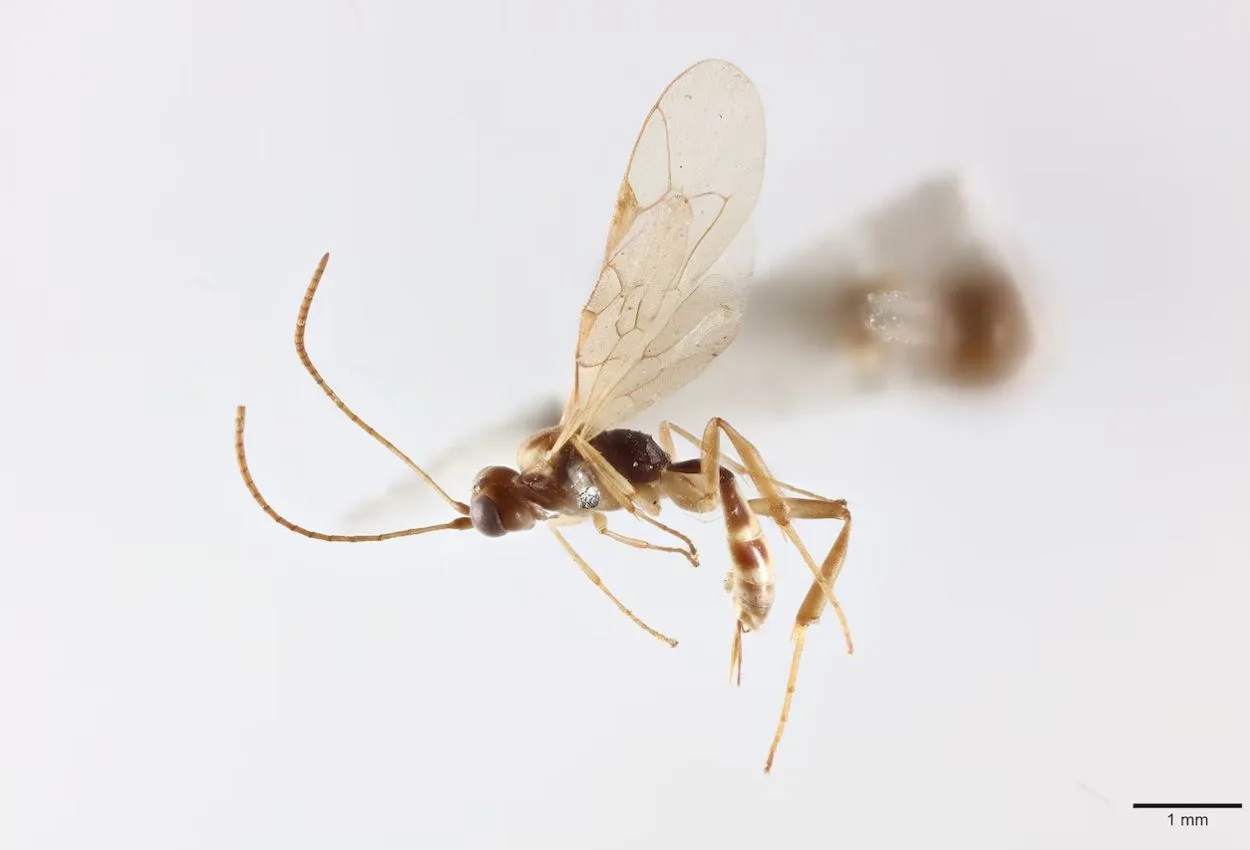
Sir David Attenborough turns 100 on May 8, 2026, and the scientific community has marked the occasion in characteristically unusual fashion: by naming a parasitic wasp after him.
The new genus, Attenboroughnculus tau, was formally announced in the Journal of Natural History ahead of his birthday.
The specimen, just 3.5 millimetres long, was collected in Chile in 1983 and spent decades in the London Natural History Museum’s collection of unidentified insects before a museum volunteer flagged it as something worth a closer look.
New wasp species named after David Attenborough on his 100th birthday
Gavin Broad, Principal Curator of Insects at the Natural History Museum and lead author of the study, knew at once it was something new. Examining it under a microscope, he noted a T-shaped marking on its abdomen, a polished groove on its hind legs, and distinctive toothlike structures on its egg-laying organ.
“It’s just a weird and wonderful new thing that we couldn’t classify in any of the existing genera,” Broad said. When the team considered who deserved to have an entirely new genus carry their name, the answer was straightforward. “We thought, well, who’s important enough to have a genus named after them? Surely, David Attenborough.”
Broad also noted that Attenborough himself introduced him to the word ‘taxonomy’ when he was young. The honoree, for his part, responded graciously. “He sent a very nice handwritten note, actually, saying he’s very complimented,” Broad said.
The wasp is far from alone. More than 50 organisms now bear Attenborough’s name in some form, from a zombie-inducing fungus that parasitises spiders, to a Tasmanian semi-slug whose shell is too small for it to retreat inside, to a rare Amazonian butterfly and a tiny Peruvian frog that hatches as a fully formed froglet, skipping the tadpole stage entirely.
A polar research vessel also carries his name, after the British public’s preferred choice of “Boaty McBoatface” was politely set aside.
Among the creatures that carry Attenborough’s name at genus level is the Attenborosaurus, a long-necked marine reptile from 190 million years ago.
The plesiosaur was originally classified under a different name until American palaeontologist Bob Bakker reexamined it in the 1990s and determined it distinct enough to warrant its own genus.
Attenborough has said he was rather pleased with that one. “Attenborosaurus is really something isn’t it?” he told the Washington Post in 2015.
Attenboroughnculus tau, by contrast, is a creature that most people would overlook entirely. “Everyone’s classic idea of a wasp is the yellow and black friend of picnics,” Broad said.
“But that’s just a tiny part of waspness. Most of the things that we call wasps are rather small, little things that parasitize other insects.”