Imagine an Abu Dhabi where four-tusked elephants roamed landscapes that bore little resemblance to the desert we know today. Millions of years before the city’s skyline took shape, the region was home to animals whose fossils now offer clues about its past.
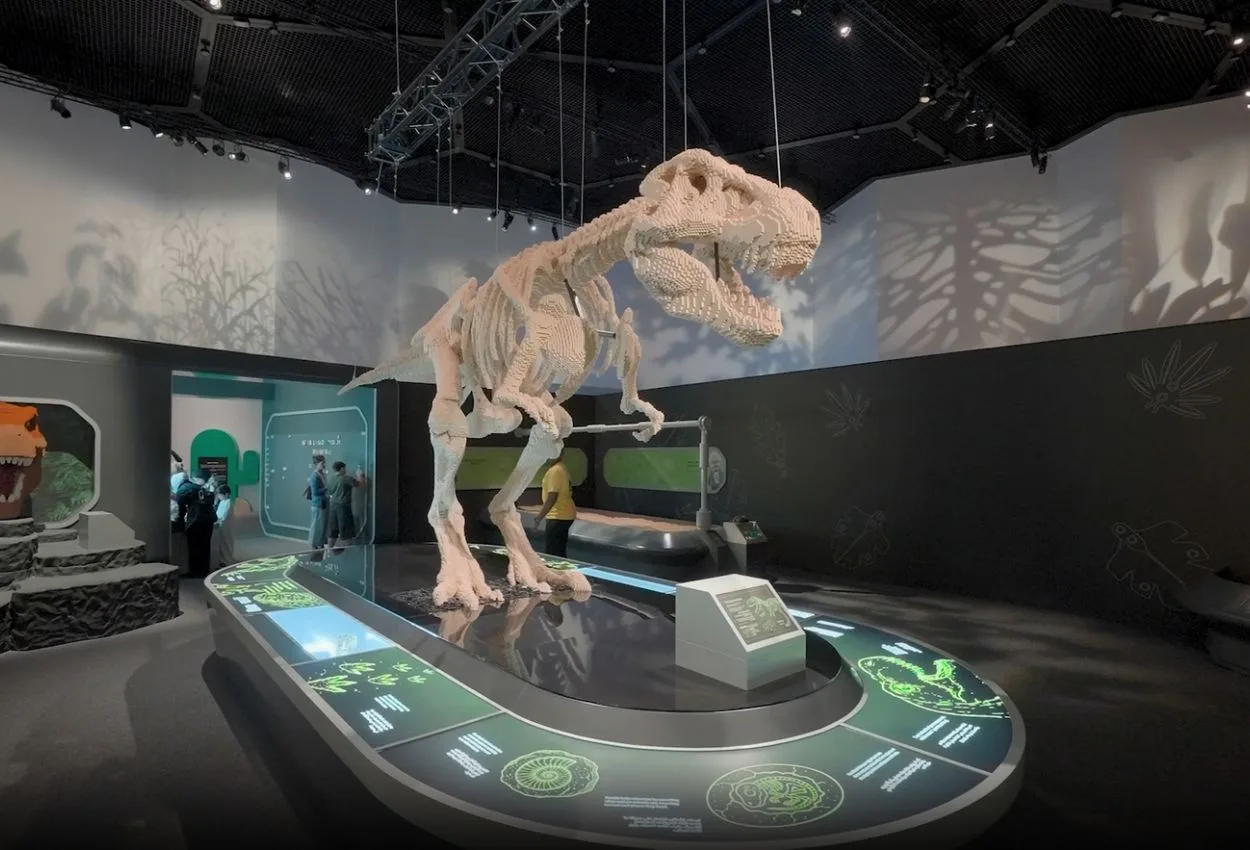
One of those animals, Stegotetrabelodon emiratus, is returning to the spotlight at Natural History Museum Abu Dhabi. This time, however, it is being recreated using LEGO bricks, with visitors invited to help build a model that could enter the Guinness World Records.
The project forms part of LEGO SHOWS® Natural Brickstory, an exhibition that takes visitors through 13.8 billion years of natural history, from the origins of the universe and the formation of Earth to prehistoric creatures, wildlife, plants, minerals and the cosmos.
At the heart of the exhibition is an attempt to secure the Guinness World Records title for the world’s largest LEGO brick prehistoric mammal, with families and visitors contributing to a structure inspired by the four-tusked elephant that once lived in the region.
For Alia Al Hammadi, Acting Partnership and Commercial Department Director at Natural History Museum Abu Dhabi, the aim extends beyond setting a record. “The world record attempt is not simply about building something very large. It is also about celebrating a piece of the UAE’s prehistoric heritage and introducing more people to a species that they may never have heard of before,” she told Lana in an exclusive interview.
Abu Dhabi’s four-tusked elephant reveals the UAE’s prehistoric past
Long before the landscapes of the UAE took their present form, Stegotetrabelodon emiratus inhabited the region during the Late Miocene period. Unlike elephants living today, the species possessed four tusks, with a pair extending from its upper jaw and another from its lower jaw.
Its scientific name honours the Emirates, creating a link between the animal’s fossil history and the country where its LEGO recreation is taking shape. “Stegotetrabelodon emiratus gives us a fascinating window into a very different Abu Dhabi,” Al Hammadi said.
“The animal lived millions of years ago, when the environment and landscapes of the region were very different from what we see today. Its fossils and other evidence from the region help scientists understand the animals and environments that existed in the Arabian Peninsula at that time.”
The fossil record provides evidence of the changes that have shaped the Arabian Peninsula over millions of years. For a region now associated with desert landscapes, Stegotetrabelodon emiratus offers a way to understand the life and environments that existed long before the present day.
“One of the most fascinating things about this species is its four tusks. It was an early member of the elephant family and retained long lower tusks as well as upper tusks, something we do not see in modern elephants,” Al Hammadi explained, adding that choosing the animal for the record attempt was also about placing Abu Dhabi’s history at the centre of the experience.
“There was something very meaningful about choosing a creature that is directly connected to Abu Dhabi’s own natural history.”
“When people think about Abu Dhabi, they naturally think about the desert landscapes we know today. But the geological and fossil record tells us that this region has experienced extraordinary environmental change over millions of years and has been home to a remarkable diversity of life.”
By recreating the elephant through LEGO, the museum hopes to connect visitors with a chapter of the UAE’s past that they may not have encountered before.
How visitors can help build a LEGO prehistoric mammal for a world record attempt
Visitors are invited to add LEGO bricks to the model of Stegotetrabelodon emiratus, turning the construction process into an activity involving the community rather than something visitors can only watch.
“We are attempting the Guinness World Record title for the world’s largest LEGO brick prehistoric mammal,” Al Hammadi said. “The record attempt is designed as a genuine community experience. Visitors are invited to contribute to the build, adding their own Lego bricks as part of the larger creation inspired by Stegotetrabelodon emiratus.”
For Al Hammadi, the significance lies in how contributions from different visitors come together. “What I particularly like about this is that no single visitor is creating the record on their own. It is something that grows through collective participation,” she said.
“One person adds a brick, a visitor adds another, and gradually those individual contributions become part of something much bigger.”
The activity is also intended to connect visitors with Abu Dhabi’s prehistoric heritage by allowing them to participate in recreating an animal known through fossil evidence.
“It also creates a lovely connection between the individual experience and the museum’s wider mission. Visitors are not simply looking at a prehistoric animal behind glass or reading about it on a panel, they are helping to recreate a piece of Abu Dhabi’s natural history themselves,” she said.
And while the model may draw attention for its size, the museum hopes participants will remember their involvement. “The record attempt is one of the ways we wanted to make the exhibition feel genuinely participatory. It gives families and visitors the opportunity to say, ‘I was part of that.’”
LEGO exhibition explores 13.8 billion years of natural history in Abu Dhabi
The four-tusked elephant may be at the centre of the world record attempt, but the exhibition reaches considerably further into the history of the universe.
LEGO SHOWS® Natural Brickstory, described by the museum as a world-first exhibition available only at Natural History Museum Abu Dhabi, explores 13.8 billion years of natural history through themed zones, workshops, trails and building activities.
Visitors move between subjects covering ancient life, dinosaurs, prehistoric creatures, animals, minerals, plants, UAE wildlife and space.
“LEGO SHOWS® Natural Brickstory brings together play with natural history and scientific storytelling on a whole new scale. It is a world-first exhibition that can only be experienced at the Natural History Museum Abu Dhabi,” Al Hammadi said.
“The exhibition takes visitors on a journey across 13.8 billion years of natural history, from the origins of the universe and the formation of our planet to prehistoric life, wildlife, plants, minerals and the cosmos.”
The museum’s challenge was to present subjects that span billions of years in a way that visitors across age groups could understand and explore.
“We also wanted to find a way of making an enormous subject feel approachable. 13.8 billion years is almost impossible to comprehend as a number. But when you can physically build something, see it taking shape and interact with it, those huge scientific concepts become much more tangible,” she said.
Rather than relying only on displays and explanations, the exhibition encourages visitors to experiment with ideas through construction. A child who is interested in dinosaurs may be drawn to prehistoric creatures, while another visitor may focus on minerals, plants or the universe.
“We were also very conscious of creating moments that work for different ages and interests. Some visitors may be fascinated by prehistoric animals, others by minerals, plants or space,” Al Hammadi said, adding “by bringing these subjects together, we hope every visitor finds something that sparks a personal connection.”
The exhibition also connects visitors to subjects beyond the distant past, including the species, environments and geological processes that shape the world today.
“Natural history is not simply something that happened millions or billions of years ago. It is the story of the world we live in today, including the landscapes, species and geological history of this region.”
How LEGO helps children and families explore science through play
“There is a wonderful moment when a child realises that they can build something, take it apart, change it and try again. That is very close to the spirit of scientific discovery, observing, experimenting, making mistakes and trying another approach,” she said.
This idea is central to the exhibition’s approach to learning.
Through collaborative building, workshops, trails and themed activities, visitors are encouraged to investigate how things work rather than simply receive information.
For younger children, this may begin with exploring how an animal moves or what makes one species different from another. For older children and adults, the same activities can lead to questions about evolution, geology, biodiversity, extinction and the history of the planet.
“At its heart, Natural History is about curiosity. It is about asking questions, making connections and trying to understand how the world around us came to be,” Al Hammadi said, adding that collaborating with LEGO “naturally lends itself to that way of thinking because building encourages people to experiment, solve problems, imagine possibilities and, importantly, learn through doing.”
The exhibition is also designed to give different generations an opportunity to learn together. A parent and child may complete the same building activity but leave interested in different aspects of the science behind it.
“That means families can experience the exhibition together, but each person can take something different from it. A child might remember the LEGO model they helped build, while a parent might leave fascinated by a scientific discovery they had never encountered before,” she said.
The museum hopes the experience encourages visitors to keep asking questions about the origins of animals, the evolution of Earth, species that once inhabited the region and what the planet might look like in the future.
“Parents may not know the answer to every question their children ask, and that is perfectly fine. Sometimes the best museum experience is when everyone leaves with a new question they want to explore,” she said.
How LEGO Natural Brickstory connects with Natural History Museum Abu Dhabi’s collections
The exhibition is not intended to stand apart from Natural History Museum Abu Dhabi’s permanent galleries. Instead, it serves as a starting point for visitors to explore the museum’s specimens, fossils, scientific stories and displays.
Someone who encounters a prehistoric animal through a LEGO model, for example, may want to learn how scientists know the creature existed, what fossils reveal about its anatomy and what evidence can tell us about the environment in which it lived.
The same applies to subjects such as minerals, plants, biodiversity and space.
“Natural Brickstory was designed to complement the wider museum experience rather than exist separately from it,” Al Hammadi said. “The exhibition introduces natural history through LEGO, but the museum itself allows visitors to continue exploring those ideas through real specimens, fossils, scientific stories and immersive galleries.”
The museum hopes visitors will connect the building activities to the scientific evidence behind the subjects they encounter.
“For example, a visitor might encounter a prehistoric animal through a LEGO build and then become curious about the actual fossil evidence and the science behind understanding ancient life,” she explained.
“Similarly, the exhibition’s themes around animals, minerals, botanicals and space can encourage visitors to continue exploring those subjects elsewhere in the museum.”
For Al Hammadi, both experiences serve the museum’s aim of helping visitors understand the natural world. “LEGO gives visitors a playful and creative entry point, while the museum provides the deeper scientific context. Ultimately, both experiences are about the same thing: helping people explore the natural world and our place within it.”
How LEGO partnerships could shape future exhibitions at Natural History Museum Abu Dhabi
The exhibition also raises questions about how museums can engage visitors beyond the display of objects. While collections, specimens and scientific expertise remain central to the museum experience, Al Hammadi said audiences are seeking opportunities to participate, create and interact.
“Museums have traditionally been places where people come to see objects and learn from experts, but audiences today are also looking for opportunities to participate, create and interact,” she said. “We want to continue exploring ways of making natural history feel relevant and accessible to different communities.”
The collaboration behind LEGO SHOWS® Natural Brickstory reflects the museum’s interest in exploring how organisations outside the museum sector can contribute to communicating science.
“One of the things we value about a partnership like this is the opportunity to look at our collections and stories from a completely different perspective,” Al Hammadi said, adding that she believes the exhibition shows how museums can work with creative organisations while keeping science at the centre of the experience.
“LEGO SHOWS® Natural Brickstory is a great example of what can happen when you combine scientific storytelling with creativity and play,” she said.
“It also demonstrates that a natural history museum can collaborate with organisations and creative partners in unexpected ways while still remaining firmly rooted in its scientific mission.”
As for whether visitors can expect similar collaborations in the future, Al Hammadi said the experience has opened the door to further discussions. “Yes, we think this experience opens the door to more conversations around interactive learning, creative partnerships and new ways of connecting audiences with science. We are always interested in finding new ways to tell the stories within our museum.”
Why Abu Dhabi’s prehistoric elephant is at the heart of the LEGO world record attempt
For visitors adding a brick to the model of Stegotetrabelodon emiratus, the act may take only a moment. Yet the structure they are helping create represents an animal that lived in the region millions of years ago, long before the landscapes and communities of the UAE took their present form.
The world record attempt connects that past with the people visiting the museum today. It is also one part of an exhibition that stretches from the origins of the universe to the natural world around us, encouraging visitors to consider their place within that history.
“I would simply encourage people to come and experience the Natural History Museum Abu Dhabi and the LEGO SHOWS® Natural Brickstory exhibition for themselves. This is an experience you really have to see, and touch for yourself, to be fully appreciated,” Al Hammadi said.
The museum’s broader aim is to show how the history of the universe and the history of Abu Dhabi are connected.
“We are telling a global story that stretches across 13.8 billion years, but we are doing it here in Abu Dhabi and bringing the region’s own natural history into that story, including the remarkable Stegotetrabelodon emiratus,” Al Hammadi said.
“LEGO SHOWS® Natural Brickstory is about building more than LEGO models. It is about building curiosity, imagination and a deeper connection with the natural world, one brick at a time,” she concluded.