Airports across the Middle East, Africa and South Asia (MEASA) are committing millions of dollars to the transformation of Air Traffic Management (ATM) and Air Traffic Control (ATC) systems, as Artificial Intelligence (AI), Machine Learning (ML) and Big Data reshape the foundations of aviation operations.
The drive comes as global passenger numbers are forecast to reach 5.2 billion in 2026 and 17.7 billion by 2043, the year in which total aircraft movements are projected to reach 149 million. In the Middle East region alone, passenger traffic in 2026 is expected to exceed 240 million.
The volume of air traffic has prompted airports across the three regions to invest in the integration of AI technologies and Big Data into their ATM systems. These systems are used to analyse air traffic patterns, aircraft spacing and airspace safety on a continuous basis.
Middle East Home to 110 airports as region modernises ATM infrastructure
The Middle East, which is home to 110 airports, has been modernising its ATM and ATC infrastructure through the acquisition of digital solutions. The region is one of the world’s corridors for air travel growth and the modernisation effort is being driven by competition as much as necessity.
The global ATM market is projected to reach US$10.96 billion in 2026, rising to US$21.24 billion by 2034. Global air traffic is expected to reach 9.7 billion passengers annually by 2030, placing pressure on ATM infrastructure worldwide.
The global commercial aviation fleet will consist of more than 36,000 aircraft by 2033, according to an Oliver Wyman analysis, up from more than 22,000 currently. By the mid-2030s, the International Civil Aviation Organisation (ICAO) predicts that over 200,000 flights will take off and land daily across the world.
By 2040, global revenue passenger kilometres (RPK) are projected to reach 14.8 trillion in the IATA baseline scenario, equivalent to 178 per cent of 2019 volume.
Airport Show 2026: 150 Exhibitors from over 30 countries to gather in Dubai
The 25th edition of the Airport Show at the Dubai World Trade Centre (DWTC) will take place from May 12-14, and will serve as the platform where solutions for Air Navigation Services Providers (ANSPs) and airport operators are presented to the market.
More than 150 exhibitors from over 30 countries are set to participate in the event, which is expected to attract more than 7,000 visitors from over 30 countries across its three-day run, along with 120 hosted buyers.
The show will be held under the patronage of Sheikh Ahmed bin Saeed Al Maktoum, President of Dubai Civil Aviation Authority, Chairman of Dubai Airports, Chairman and Chief Executive of Emirates Airline and Group.
Co-located conferences will include the Global Airport Leaders’ Forum (GALF), Airport Security Middle East, the Air Traffic Control (ATC) Forum, and the Women in Aviation (WIA) Middle East Conference. The ATC Forum will be in its 9th successive edition.
“New technologies are being utilized in the ATM domain to enhance safety, efficiency, and capacity. Their AI and Big Data integration will improve the safety and reliability, and transform the ATM into an intelligent, adaptive, smarter, and safer system. The Airport Show-2026 will showcase the best of ATM/ATC offerings from across the world, for the Middle East and other nearby regions to benefit,” May Ismail, Event Manager at RX Middle East, organisers of the Airport Show said in a statement.
dans and Emirates Aviation University collaborate on AI research at DXB
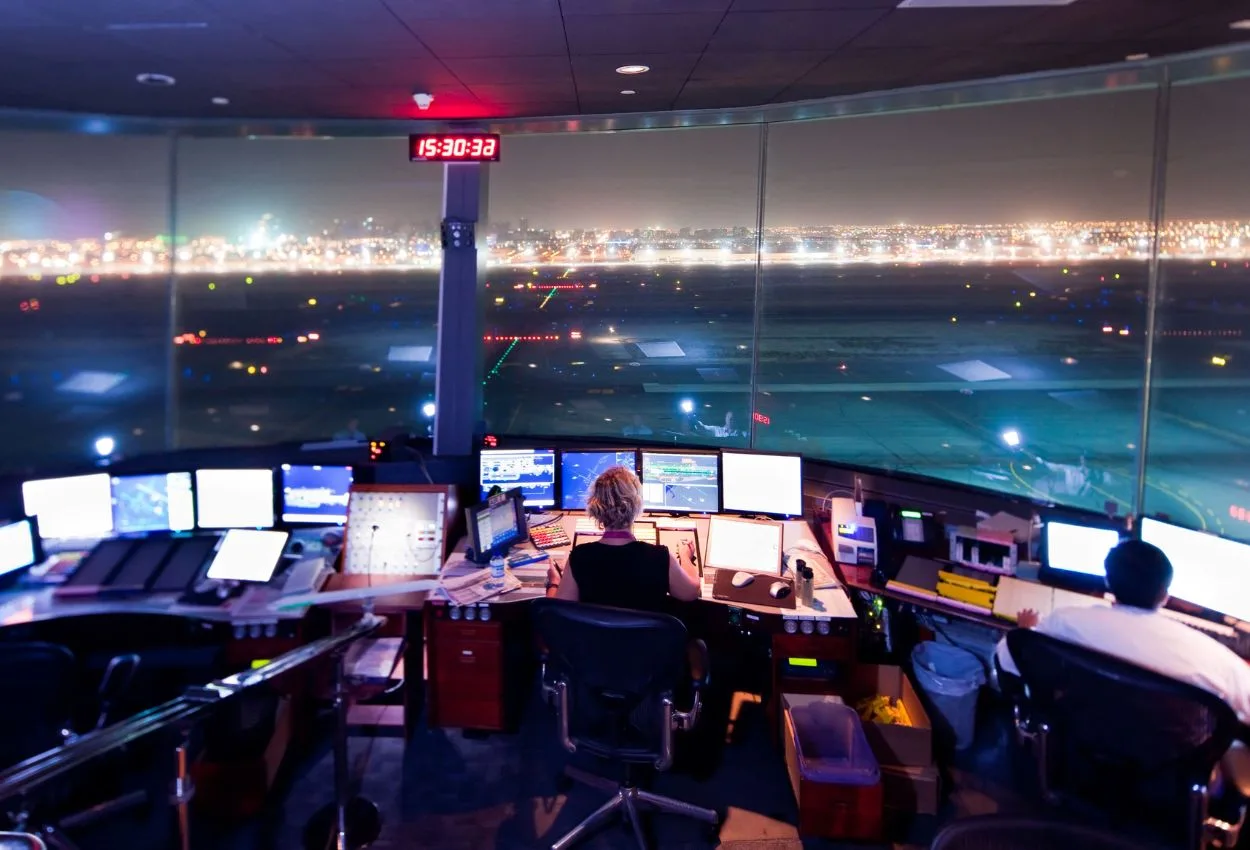
Dubai Air Navigation Services (dans), the ANSP at the UAE’s four airports including DXB – the world’s busiest airport for international passengers since 2014 – will exhibit at the Airport Show. dans also operates the world’s 360-degree tower simulator.
The organisation has signed an agreement for research aimed at reducing holding patterns for all flights arriving at DXB, with the goal of ensuring airspace management becomes safer and more efficient. In partnership with Emirates Aviation University (EAU), it is conducting research into AI applications within ATM and developing AI concepts and prototypes.
dans has also been working on upgrading Communication, Navigation, Surveillance (CNS) systems, implementing runway capacity concepts including Dependent Diagonals, and scaling up capacities to handle traffic at Al Maktoum International Airport, which is undergoing a US$35 billion expansion to accommodate 260 million passengers by the mid-2030s.
“The rapid evolution of the aviation landscape – driven by fleet modernization, airport expansion, and the surge in global connectivity – places unprecedented demand on Air Navigation Service Providers (ANSPs). To navigate the complexities of limited runway capacity and airspace congestion, we at Dubai Air Navigation Services (dans) are revolutionizing our Air Traffic Management capabilities. By synchronising our strategic roadmap with the aggressive growth of Dubai’s aviation sector, we leverage state-of-the-art technology to deliver a service that is not only proficient and cost-effective but truly unrivalled,” Ibrahim Ahli, Chief Executive Officer at dans added.
AI cuts delays, improves response times and reduces system failures
The evidence base for AI’s role in ATM is growing. A study found that AI models have reduced air traffic delays by 18 per cent in European airspace.
In the United States, AI-based decision support tools have improved controller response times by 22 per cent, contributing to safety margins. ICAO noted that AI analytics have decreased unexpected system failures by 25 per cent, enhancing operational continuity.
The digitalisation of airport operations is also reducing flight delays, enabling travel to flow more smoothly, and improving the experience of passengers.
Supported by cloud architecture and cybersecurity measures, AI has been transforming ATC in the areas of maintenance and resource allocation. AI and ML are also playing a role in the development of ATM and Unmanned Traffic Management (UTM) systems. AI systems are helping optimise flight paths in real-time, adjusting routes to avoid congestion, reduce delays, and ensure airspace usage is more efficient.