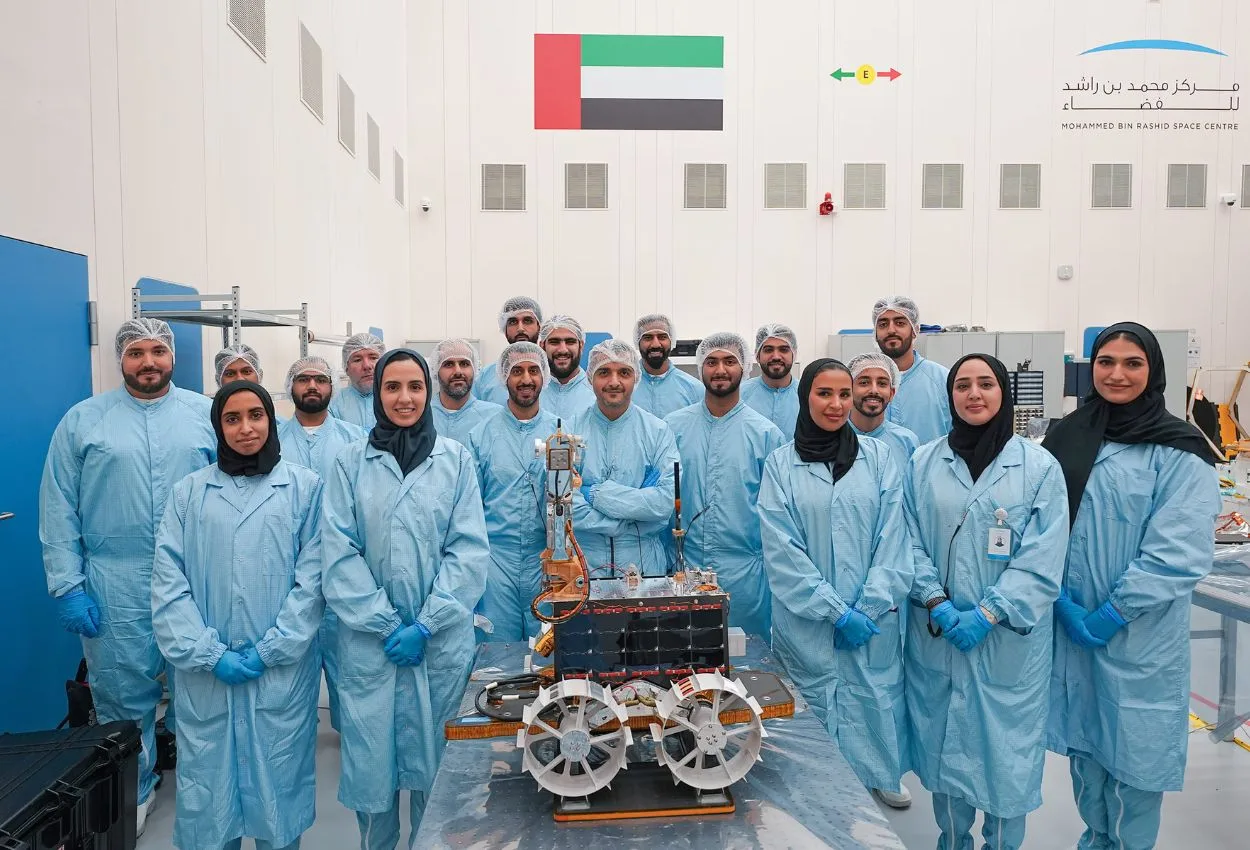
The Mohammed Bin Rashid Space Centre (MBRSC) has announced the completion of Rashid Rover 2’s development following environmental and functional tests in the UAE.
The rover has been sent to the United States, where it will undergo preparations with Firefly Aerospace for its 2026 launch to the far side of the Moon.
Sheikh Hamdan bin Mohammed bin Rashid Al Maktoum, Crown Prince of Dubai, Deputy Prime Minister, Minister of Defence, and President of MBRSC, witnessed the signing of an agreement between MBRSC and Firefly Aerospace earlier this year.
Under the agreement, Firefly Aerospace will provide the lunar lander to deploy Rashid Rover 2 to the far side of the Moon.
UAE lunar mission: Rashid Rover 2 passes environmental tests before moon journey
“The completion of the development of Rashid Rover 2 in the UAE stands as a testament to our nation’s advancing capabilities in space science and technology. This achievement is the outcome of the exceptional capabilities of our national talent and the UAE’s steadfast vision to lead meaningful exploration beyond Earth. As the mission advances toward its historic objective on the far side of the Moon, it reinforces our commitment to fostering international collaboration, driving innovation, and contributing to humanity’s scientific progress. Each milestone brings us closer to shaping a sustainable and knowledge-driven space future for generations to come,” Hamad Obaid AlMansoori, Chairman, MBRSC said in a statement.
After Thermal Vacuum testing at the French space agency CNES in Toulouse, France, MBRSC conducted verification and validation tests in the UAE. The tests included solar panel testing and deployment tests at MBRSC, and vibration testing at EARTH, a subsidiary of EDGE Group.
Engineers at MBRSC tested the rover’s solar panels to ensure operations during different times of the lunar day. The deployment of the antenna and the robotic arm holding the main camera was tested at simulated lunar gravity conditions.
The vibration test subjected the rover to the conditions it will experience during launch and landing. Rashid Rover 2 was shaken to simulate the stresses of launch atop a rocket, the deceleration phases in the lunar environment, and the shock loads associated with separation and touchdown on the lunar surface.
“The completion of Rashid Rover 2 represents a decisive step in advancing the UAE’s ambitions for lunar exploration. With a mission set for the far side of the Moon, we are entering a domain few have explored, driven by the pursuit of new science and the desire to push the limits of what is possible. The progress we have made so far reflects the UAE’s belief in advancing space science through collaboration, knowledge-sharing, and the development of technologies that serve the broader progress of humanity,” Salem Humaid AlMarri, Director General, MBRSC added.
“The successful completion of the latest tests marks a crucial step in ensuring Rashid Rover 2’s resilience against the challenging journey ahead and its readiness for the next phase of preparations. As we head towards the next phase, our team remains focused on validating every subsystem and ensuring optimal performance for the mission’s ambitious scientific objectives on the far side of the Moon,” Dr. Hamad AlMarzooqi, Project Manager, Emirates Lunar Mission, MBRSC explained further.
The Emirates Lunar Mission is funded by the ICT Fund of the Telecommunications and Digital Government Regulatory Authority, which supports research and development in the ICT sector in the UAE.