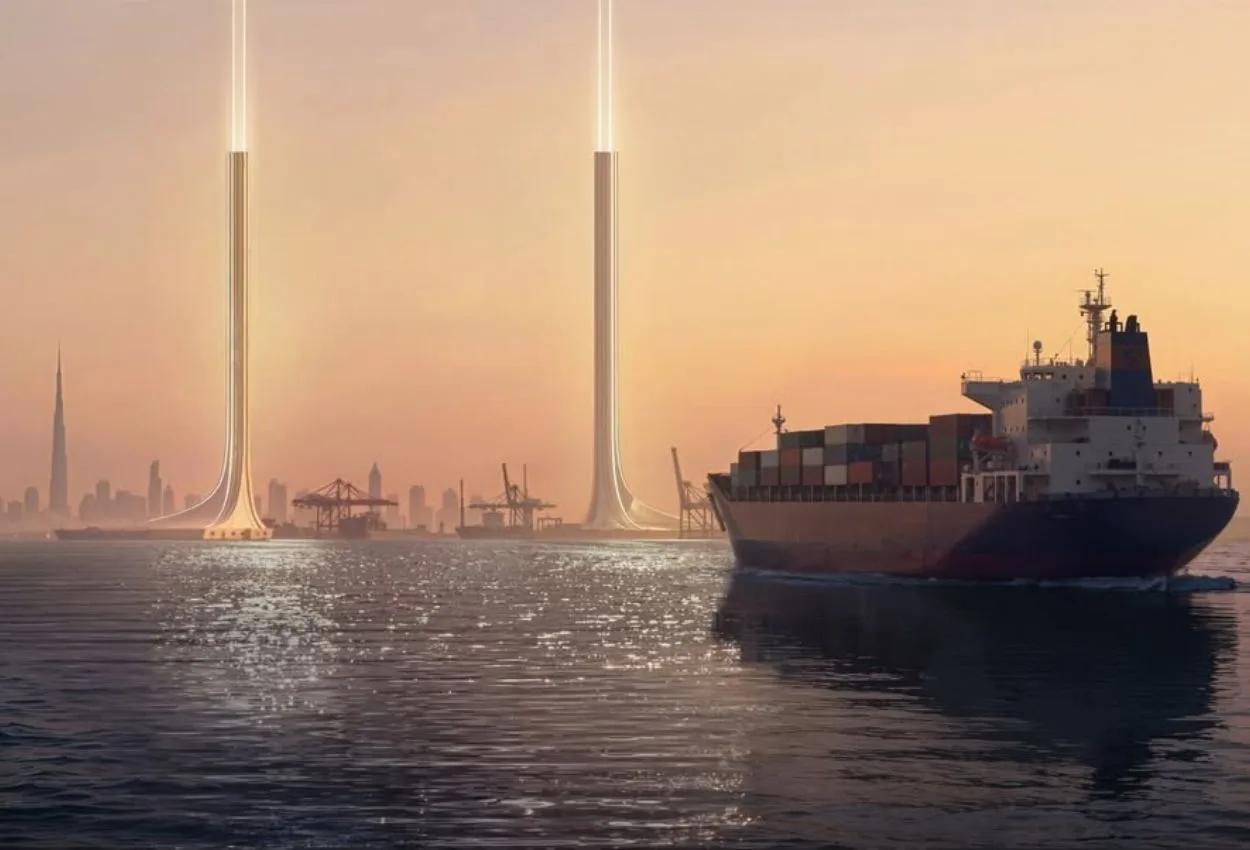
Dubai-based architecture and design practice ZNERA Space has unveiled a speculative study proposing a sovereign inland maritime corridor for the UAE, connecting the Arabian Gulf to the Gulf of Oman.
Named the Strait of Union, the concept has been developed over the course of a month and is described by the firm not as a conventional project, but as a framework for national strategy.
The study reimagines infrastructure at a scale that extends well beyond construction. “Architecture must extend beyond buildings – towards shaping frameworks that define the future of nations,” the firm stated in its presentation of the concept.
Inside Strait of Union: ZNERA’s blueprint for a UAE national spine
At its foundation, the Strait of Union addresses what ZNERA describes as a shift in the priorities of nations in an era of global uncertainty.
The corridor is conceived to enable trade resilience and economic diversification, offering the UAE an alternative and controlled maritime route that operates independently of the Strait of Hormuz – one of the world’s most critical chokepoints.
The Strait of Union is envisioned not merely as a passage for the movement of goods and vessels, but as a linear urban system. Along the length of the corridor, the framework proposes a series of districts, including logistics hubs, financial centres, and tourism zones.
These settlements would form what ZNERA calls a “national spine” – a continuous network of activity and purpose that ties infrastructure to urban growth and positions the waterway as a driver of development rather than a passive channel of movement.
Among the concepts explored within the broader framework is a residential living district in which interior space is said to flow into the water, the city, and the horizon. The design language features terraces, curves, and glazing to frame an environment defined by openness.
ZNERA described this component as a reflection of “how architecture can engage with infrastructure at a human scale – connecting space, landscape, and long-term thinking.”
Beyond its logistical and urban dimensions, the Strait of Union draws on the ecological legacy of the Nile as a point of reference. The firm envisions the corridor contributing to the transformation of the desert regions through which it passes, supporting new microclimates and the regeneration of landscapes along its path.
This dimension positions the waterway as an instrument of environmental change as well as an engine of economic activity – an ambition that parallels the role the Nile has historically played in sustaining agriculture and civilisation across arid terrain.