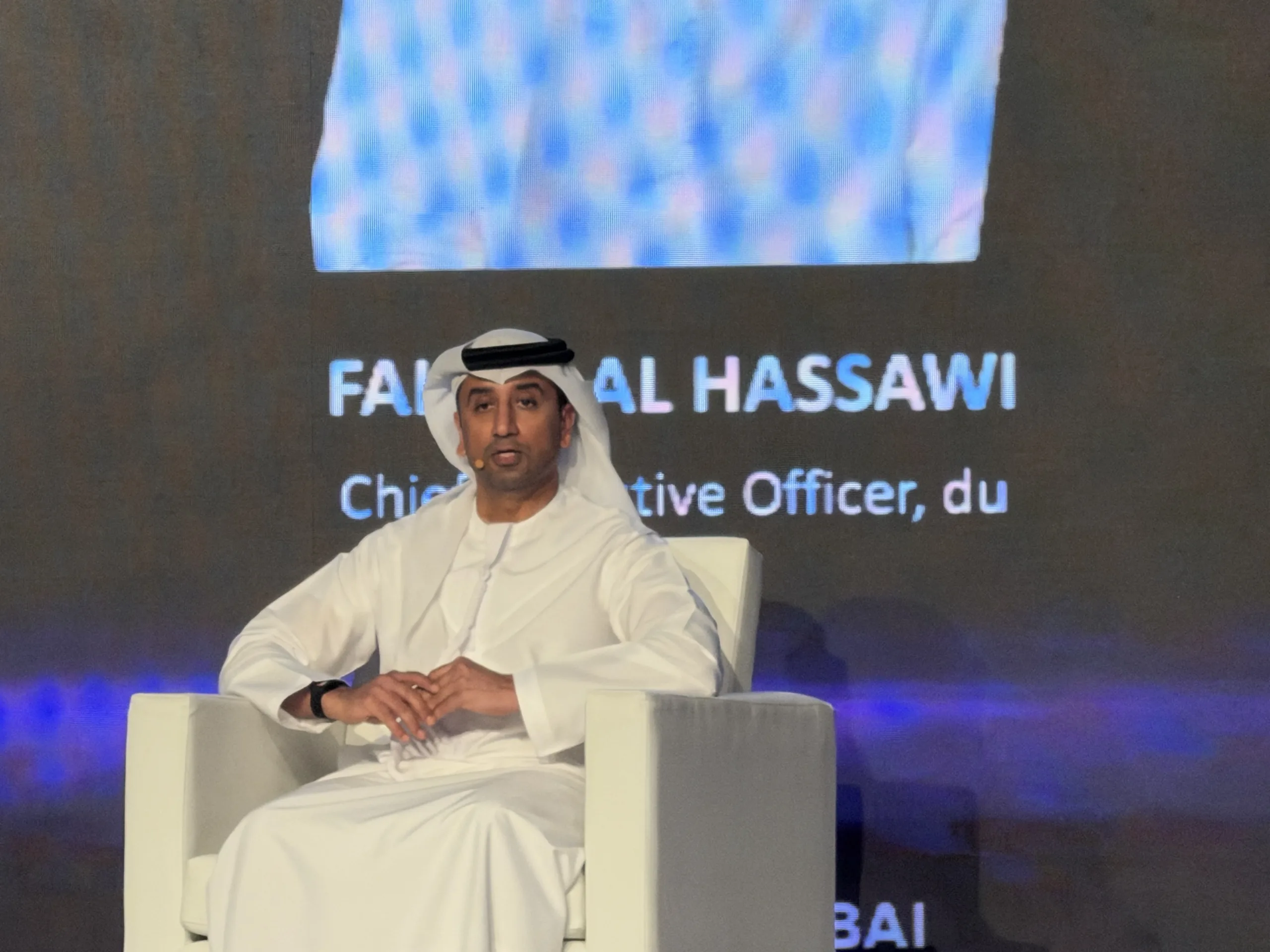
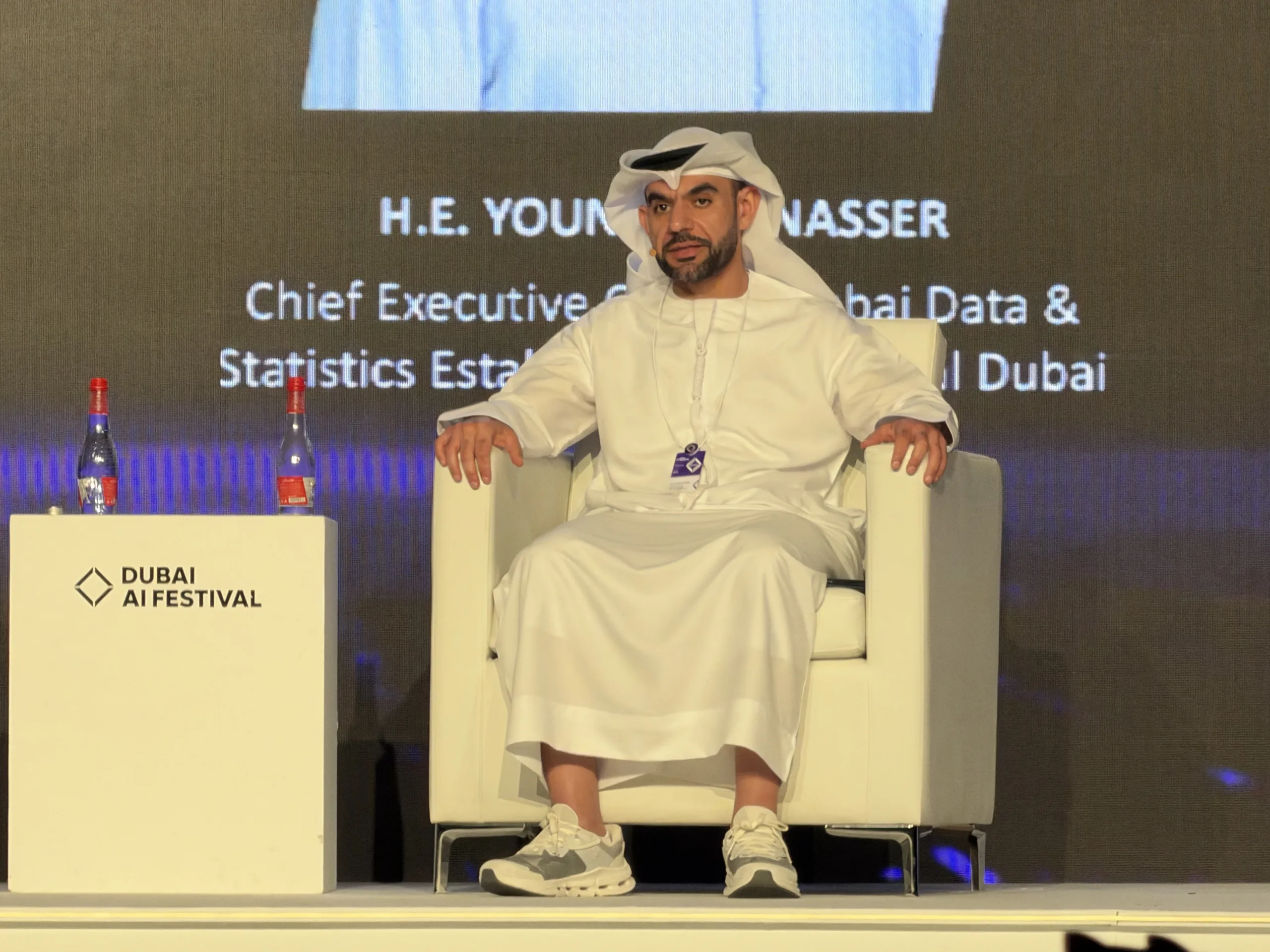
Dubai is using artificial intelligence (AI) to track population movements, forecast growth, process more than 20,000 financial statements and support government decision-making, according to H.E. Younus Al Nasser, Chief Executive Officer of the Dubai Data and Statistics Establishment at Digital Dubai.
Speaking at Dubai AI Festival 2026, Al Nasser said Dubai was moving beyond collecting and storing information to using data to support decisions affecting residents, businesses and government entities.
“I think we are moving from cities that are simply collecting information into something that is much more ambitious,” he said. “I think there is a big difference between collecting information, for the sake of processing and storing, into a way of how do you act with data,” he added, explaining that the ability to act on information can generate value for cities.
During a discussion, Al Nasser outlined how Dubai is connecting information across population, housing, transport, economic activity and infrastructure to improve planning and service delivery.
Data acts as the ‘glue’ connecting Dubai’s economy, housing and mobility
Al Nasser said governments must understand the relationships between sectors rather than examine each area of urban development separately.
Population growth influences housing demand, housing patterns affect mobility requirements, transport supports economic activity, and economic growth creates demand for infrastructure.
“When we look at cities today, we do have population dynamics that lives within our cities,” he said, before explaining the relationship between population, housing, mobility and economic growth.
He said examining each aspect separately only provides a view of one part of the city, while connecting information across sectors allows authorities to understand how the city functions as a whole. “Data acts as the glue of our cities,” Al Nasser said.
He added that combining information from different sectors to understand “how our city is performing” is what Digital Dubai is seeking to achieve through the Dubai Data and Statistics Establishment.
Al Nasser stressed that collecting information was not sufficient unless government entities could trust and exchange it. “Our thinking is not only about the volume of the data,” he said.
He explained that data must be supported by governance, interoperability, quality and integrity to allow government entities to rely on the information when making decisions.
This becomes more significant with the use of AI, which can analyse information but requires data that can be trusted to generate results that support action.
Al Nasser said Dubai’s investment in data governance, technology and information-sharing capabilities over the past decade had prepared it to use AI in government operations.
“We do have the governance, we do have the data, and we do have the technological capability and AI in our hands,” he said.
The shift, he explained, is towards using these capabilities to improve the speed and reliability of decisions affecting the economy, society, population and sustainability.
Digital Dubai aims to let people interact with city data through AI
Al Nasser said one of Dubai’s objectives is to enable residents, businesses, investors and government decision-makers to ask questions about the city using natural language. “We want individuals, we want businesses, we want decision makers, we want government, to talk to Dubai data,” he said.
The approach would allow users to access information without having to understand the technical systems, databases or processes through which the data is retrieved.
He said AI could help authorities move from collecting information towards responding to questions and making decisions without relying on development cycles for each request.
During the discussion, Awad referred to how data-sharing between service providers can simplify the experience of moving into a property, including completing contracts, accessing utility services and using information already held by government entities.
The example highlighted the role of coordination between organisations in reducing repeated requests for information from residents.
Dubai uses AI and government data to calculate population in real time
Al Nasser identified population statistics as an example of how Dubai is applying data and AI to government operations. He said population figures produced through conventional statistical processes often reflected conditions from the previous year rather than the situation at the time when decisions were being made.
“Whenever we came up with a number, it is something that’s telling you about what happened a year ago. It’s not reflecting what the current moment is,” he said.
He explained that Dubai was using administrative records and information from different government entities to address this gap. These sources include the General Directorate of Residency and Foreigners Affairs (GDRFA), the Roads and Transport Authority (RTA), utility companies, census records and other datasets.
The establishment connects and correlates this information to calculate Dubai’s population in real time.
Al Nasser said the approach allows authorities to observe changes in population movements and examine how those changes affect communities across the city.
Referring to periods when population movement patterns changed because of developments affecting the region, he said the information allowed authorities to see fluctuations as they occurred, including variations from month to month.
He also highlighted the transparency involved in making information available while conditions were changing. The system enables officials and investors to examine population changes at community level and understand where people are moving.
This information can be connected with housing supply, residential developments and the distribution of housing units to support decisions on investment and development.
Al Nasser explained that Dubai had retained the statistical methodologies used to measure population while introducing technology to reduce the time required to produce the information.
He said the aim was to combine the reliability of statistical methods with the speed of administrative data processing.
Dubai moves from population counts to AI-powered forecasts
According to Al Nasser, the next stage in population analysis is to move beyond understanding the present and towards forecasting future changes. He explained that authorities had previously focused on establishing how many people lived in Dubai.
With systems now providing population data as conditions change, attention is shifting towards predicting what comes next.
“What is the population?” he asked while describing the starting point for population statistics. He then outlined the progression towards questions about present population trends and future growth.
“What is population tomorrow?” he said.
Al Nasser explained that answering questions about future population growth creates further requirements for information on housing, transport, infrastructure and services.
He said conventional business-intelligence systems and statistical processes often required development cycles to answer questions arising from datasets.
AI, however, is helping analysts move through questions and examine information without having to develop separate processes for every requirement.
“Thanks to artificial intelligence today, we are able to move faster and have a very natural way of answering those questions,” he said.
Dubai is using these capabilities to develop population forecasts and examine scenarios for the coming periods. The forecasts can inform decisions concerning infrastructure demand, community development, investment and services.
Dubai uses AI to process more than 20,000 financial statements
Al Nasser also highlighted the role of AI in producing economic statistics through Dubai’s economic survey. He said the establishment receives more than 20,000 financial statements as part of the exercise, with documents arriving in different formats.
“Each financial statements is different than the other. It is an unstructured format,” he said.
Previously, statisticians reviewed the documents, extracted the information required and entered it into statistical systems. Al Nasser said each statement required approximately “15 to 20 minutes” of analysis and data entry.
AI is now being used to automate the process, reducing the work required from statisticians and supporting the production of economic indicators.
He said the technology was improving the accuracy and timeliness of information available to decision-makers. The applications extend beyond gross domestic product (GDP) calculations.
“We are also looking beyond GDP,” he said. Al Nasser identified trade in services and cash inflows and outflows as areas where statistical analysis could benefit from AI.
He said these areas had previously been difficult to analyse because of the information involved and the processes required.
The ability to process information with less delay, he explained, can support economic monitoring and improve the quality of statistics used to guide decisions.
He also connected the availability of economic information to Dubai’s position as an investment destination.
Al Nasser said investors compare cities and economies before making decisions, and the availability of accurate information within a shorter period can influence how those locations are assessed.
He argued that Dubai’s ability to make decisions using data, review its performance and plan for developments had contributed to its progress.
Dubai ranks second globally in BCG Intelligent Cities Index
The discussion also addressed Dubai’s performance in the Boston Consulting Group Intelligent Cities Index 2026. According to BCG, Dubai ranked second overall among 61 cities from 39 countries, behind London, while securing first place in the adoption category.
Awad congratulated Dubai on the result and asked how the emirate’s approach to data had contributed to its performance.
Al Nasser linked Dubai’s achievements to its ability to use information to support decisions, assess performance and respond to changing conditions.
He said the availability of data allows decision-makers to understand where the city stands, identify requirements and consider what needs to happen next.
Awad also drew attention to Dubai’s presentation of population information through a live data system, noting that many cities had previously focused on publishing data rather than providing figures reflecting current conditions.
The discussion highlighted how Dubai’s use of data has moved beyond providing access to information towards supporting decisions through analysis and forecasting.
Dubai measures AI impact through happiness and time saved
Al Nasser said the success of AI should not be judged solely by the number of government services using the technology or the number of AI agents developed. “Usually, and especially in this context, when you start a technologist, we usually tend to look into how much we are digitizing,” he said.
He explained that, with AI, organisations may focus on the number of services that have become AI-enabled or the number of agents deployed within departments. However, he questioned whether those indicators demonstrate a benefit to society.
“I think the question we need to ask ourselves is … how do people feel about our city?” he said.
He added that governments should consider how effectively they serve businesses, how much time people save and whether the services provided are meeting their needs.
Al Nasser said Dubai had been measuring people’s happiness for the past decade and that this would remain part of its approach to assessing the impact of government initiatives. He said governments should evaluate how well services fulfil people’s needs, how quickly those needs are addressed and whether processes are being simplified.
He also highlighted the impact of giving people more time through improvements in government services. Using the example of saving one hour during a person’s day, he said this could allow residents to spend more time on business activities, with their families or building relationships.
“I think that is the impact that we be keen for,” he said.
Dubai identifies three areas for measuring the impact of AI
Al Nasser outlined three areas through which Dubai is assessing the benefits of data and artificial intelligence: people, efficiency and future resilience.
The first focuses on the impact on people’s lives, including whether government services fulfil their requirements and how much time they spend completing transactions. “The first impact is on people,” he said.
He said the focus should be on the extent to which services meet people’s needs, the time they take and the ease with which residents can access them. The second area concerns efficiency across government operations and the city.
Al Nasser said cities experience changes in development patterns, population distribution and service requirements. Some communities experience growth, while others require improvements to services and infrastructure. “Efficiency is a continuous story that we need to attend to,” he said.
He explained that governments must examine how they can reduce the time required to deliver services, improve the use of resources and strengthen their position when compared with other cities.
The third area concerns resilience and preparing the city for future developments. Al Nasser said data and AI could help Dubai understand changes, assess scenarios and develop approaches that other cities could use.
“The future resilience, I think, is going to be important,” he said, adding that Dubai had an opportunity to demonstrate how data and AI could support the delivery of services to residents and visitors.
AI adoption must deliver results for residents and businesses
During the discussion, Awad also raised the risks associated with giving AI systems access to data and allowing AI agents to carry out tasks.
He questioned how organisations could ensure that the impact of AI remained positive and that the technology was being used to address the needs of people and businesses. Al Nasser said the focus should remain on outcomes rather than the deployment of technology alone.
He emphasised that trusted information, governance and the ability to exchange data were necessary for AI systems to produce results that decision-makers could use.
He also said the Dubai Data and Statistics Establishment would continue tracking economic, societal and population indicators while placing greater emphasis on measuring the impact of services on people’s lives. The objective, he explained, is to understand not just how the city is performing, but how government decisions and technology affect the people who live, work and do business in Dubai.
Al Nasser concluded that Dubai’s use of data and AI could also offer lessons for cities seeking to improve planning and public services.
For Dubai, he said, the priority is to use data to guide decisions, reduce the time people spend accessing services, improve efficiency and prepare for the future.