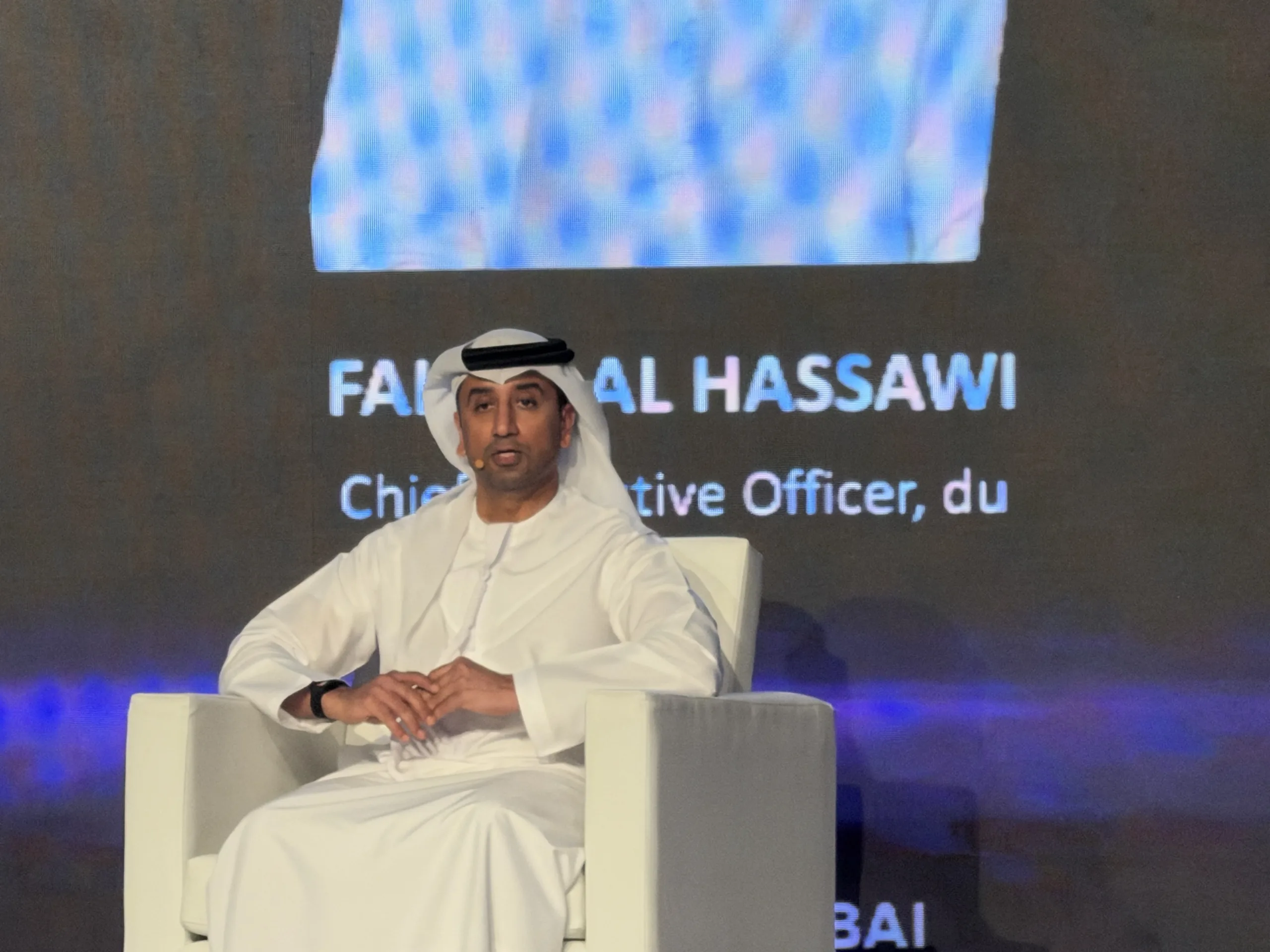
UAE telecom operator du expects 50 per cent of its incremental growth over the next five years to come from businesses beyond connectivity as it expands into artificial intelligence (AI), cloud computing, data centres and cybersecurity, Chief Executive Officer Fahad Al Hassawi said.
Speaking at Dubai AI Festival 2026, Al Hassawi said the company was transitioning from building telecommunications infrastructure to supporting the AI ambitions of businesses and government entities across the UAE.
“We are moving from almost 20 years of building the telecom infrastructure,” he said, explaining that these investments had supported the country’s digital transformation.
The company is now shifting its focus towards understanding customers’ objectives and helping them adopt technologies that deliver business outcomes. Al Hassawi said the transformation was aligned with the UAE government’s focus on AI and the direction of the country’s economy.
He said du was evolving its mission to become a trusted digital and AI ecosystem enabler and partner for customers.
The company has introduced business brands including du Infrastructure, du Tech and du Pay over the past three years to support the transition. “50 per cent of this incremental growth will come from areas which are beyond connectivity,” Al Hassawi said, referring to the company’s growth expectations for the next five years. “We’re quite decided about this,” he added.
du Infra, du Tech to develop AI infrastructure in UAE
Al Hassawi said du was investing in infrastructure and services to enable organisations to adopt AI, with du Infrastructure and du Tech playing roles in the company’s strategy.
Under du Infrastructure, the company is responsible for designing, building and operating connectivity infrastructure, including mobile networks, 5G technology, fibre networks and low-latency capabilities.
“We are responsible for designing, building and operating” connectivity infrastructure, he said, adding that these networks would provide the backbone for AI adoption across the UAE.
The company also intends to adopt 6G technology when it becomes available, with Al Hassawi saying du aimed to be among the first operators to introduce it.
Meanwhile, du Tech, the company’s information and communications technology business, provides services including data centres, cloud computing, the Internet of Things (IoT) and cybersecurity.
Al Hassawi said the company was combining these offerings with advisory services to help customers identify and implement technologies suited to their requirements. He explained that du’s role was no longer limited to providing telecommunications services or selling technology products.
Instead, the company was working with organisations to understand their objectives, identify the technology and vendors required, and structure commercial models that support implementation.
Data sovereignty, cybersecurity and resilience central to AI adoption
Al Hassawi said trust would play a role in AI adoption as the technology becomes embedded in government services and business operations. “I think the word trust is extremely important as we venture forward into AI,” he said.
He identified resilience, data sovereignty, cybersecurity, market knowledge and the ability to manage technology infrastructure as components of trust.
Referring to the geopolitical environment in the region, Al Hassawi said developments had highlighted the importance of infrastructure resilience. As a telecommunications operator, du was accustomed to managing networks where service continuity and redundancy were requirements.
“We adhere to the highest level of uptime,” he said, explaining that businesses and government entities investing in AI needed assurance that the infrastructure supporting their operations would remain available, with redundancy to maintain continuity.
Data sovereignty was another area receiving attention from organisations adopting AI. “It’s not only where the data is sitting,” Al Hassawi said, explaining that organisations also needed to consider where information was processed and how it was analysed.
He said the company’s understanding of the UAE market, customer requirements, regulations and security frameworks helped it address those concerns.
Cybersecurity was also becoming a consideration as organisations integrate AI into their operations. Al Hassawi said discussions with government entities and businesses had reinforced the importance of protecting AI systems and the data they process.
He added that du was positioning itself to manage the technology stack on behalf of customers, from designing and building systems to operating and optimising them. The ability to deliver these services from end to end, he said, was part of the value du intended to provide as an AI partner.
du aims to simplify AI adoption for UAE businesses
Discussing the challenges facing organisations as AI technology evolves, Al Hassawi said the pace of change was creating difficulties even for companies operating in the technology sector. “It’s happening very quickly,” he said, referring to developments in AI and the technologies supporting it.
He said companies were dealing with changes in available technologies, vendors and implementation approaches, making decisions about investment and adoption more complex. “Many customers don’t know where to start,” he said.
Some businesses, he explained, understood what they wanted to achieve but were uncertain about how to implement the required technology or which partners to engage.
“What is the best mix between different technology, different vendors?” he asked. “What is the best commercial model that can serve them?”
Al Hassawi said du was addressing these challenges by simplifying technology decisions and identifying solutions based on customer objectives. “This is where we come and solve this problem for the customer and bring the right solution,” he said.
The company has introduced advisory services to understand the problems customers are trying to solve before recommending infrastructure, technologies and commercial arrangements.
du to upskill 10,000 UAE SMEs in agentic AI
Al Hassawi said small and medium-sized enterprises (SMEs) and entrepreneurs were part of du’s AI adoption strategy, with the company working to make technology available to businesses with different requirements and budgets.
“We serve a lot of segments in the market,” he said, identifying SMEs and startups among the customer groups du supports. He said smaller businesses required solutions that addressed their needs without creating costs they could not sustain.
“We do understand the requirements,” he said, explaining that du was working with technology partners to design products “at the right price.”
Al Hassawi also highlighted a recently launched initiative to upskill 10,000 SMEs in the UAE in agentic AI.
He said the programme was intended to address gaps in knowledge and skills that could prevent businesses from adopting AI and benefiting from its applications.
According to Al Hassawi, addressing those gaps was necessary to ensure smaller companies could participate in the UAE’s transition towards an AI-powered economy. He said supporting SMEs was also part of du’s contribution to the country’s business ecosystem.
du launches $50 million venture capital fund to support startups
Al Hassawi said du’s investment decisions were guided by its responsibilities as both a business and a company contributing to the UAE economy. “We are a commercial company, but we are a national company as well,” he said.
He explained that du considered its contribution to the country’s economic development alongside its own revenue growth.
“We don’t just focus on how can we grow our commercial [model],” he said, emphasising that the company also considered its contribution to the UAE economy. Over the past two decades, du had invested in telecommunications infrastructure and adopted network technologies to support the country’s development.
Al Hassawi said the company had, in some cases, invested before a complete commercial business case had been established. He cited 5G technology as an example of an investment made in anticipation of the country’s requirements.
“We do start investing on certain things, like the latest 5G technology, without having maybe the complete business case,” he said. “Because we have trust that this is the right thing for the country,” he added.
Al Hassawi said the company believed that investment in infrastructure would create opportunities for businesses and support demand for services. “Once you build it, the customers will use it,” he said.
As part of its contribution to the UAE’s technology ecosystem, du has also launched a $50 million venture capital fund, du Ventures, to invest in startups.
Al Hassawi said the fund would help provide capital to companies developing technologies and services, supporting entrepreneurship and the country’s economy. He emphasised the importance of ensuring startups had access to funding to develop their businesses.
AI investment to focus on business outcomes rather than use cases
Looking ahead five years, Al Hassawi said the conversation around AI adoption would shift from the number of use cases businesses were developing towards the measurable outcomes of their investments.
He said organisations would increasingly need to assess whether AI applications were delivering the intended results, how much they cost to operate and whether they could be sustained.
Al Hassawi questioned how businesses would measure the impact of their AI use cases and evaluate the costs associated with implementation. He said these questions would become part of AI investment decisions as adoption increased.
Du’s role, he explained, would involve continuing to develop infrastructure, including data centres, cloud services and connectivity networks, while helping organisations assess the economic impact of their AI investments.
He said commercial models would need to be designed around customers’ requirements to ensure the cost of adopting and operating AI was aligned with the outcomes they expected. “We need to continue focusing on the outcome rather than the technology,” Al Hassawi said.
He explained that du’s approach was to start by understanding the customer’s problem or objective and then work backwards to select the technology required. This, he said, would help organisations avoid adopting technology without first determining what they wanted it to achieve.
AI development demands faster investment and decision-making
Reflecting on how the telecommunications and technology industry had changed during his career, Al Hassawi said the pace of technological development was accelerating. He said companies were now required to respond to changes in AI and other technologies with greater speed.
“I think it requires faster decision-making from our side, quicker investment, bigger investment,” he said, acknowledging that investment decisions could become difficult when technology was evolving rapidly.
He explained that companies could decide to invest in one technology or area before discovering that resources might have been better directed elsewhere.
He said du would need to continue investing in infrastructure while maintaining contact with customers to understand how their requirements were changing. The company’s knowledge of the UAE market, regulatory framework and security requirements would also remain part of its approach.
Al Hassawi said developing employee skills and advisory capabilities was necessary to support the transition. He added that the company was changing how it engaged with customers by focusing first on business problems and then selecting the technology suited to solving them.
UAE government AI ambitions create opportunities for du
Al Hassawi said the UAE’s ambitions in AI, supported by the government’s direction and investment in infrastructure, were creating opportunities for companies developing digital and AI services.
He pointed to the level of interest in AI across government entities, enterprises and SMEs as a factor driving demand for infrastructure and technology services. “There is clearly a huge push,” he said, referring to the direction of AI adoption across the country’s economy.
He explained that this created opportunities for du but also placed responsibility on the company to keep pace with the requirements of government and business customers.
Al Hassawi said du’s position as a national operator meant it needed to balance commercial considerations with its contribution to economic development. “We want sustainability. We want continuity of success,” he said.
He added that the company would continue investing in infrastructure and services while adapting to changes in technology and customer requirements.
Over the next five years, du intends to strengthen its position as an AI and digital partner by expanding its capabilities across connectivity, cloud, data centres and managed technology services.
Al Hassawi said the company’s focus would extend beyond deploying AI infrastructure to ensuring that organisations achieved outcomes from the technology.
He reiterated that du’s role was to help customers understand their objectives, determine which technologies could support them and develop commercial models that made implementation sustainable.
The next phase of AI adoption in the UAE, he indicated, would be defined not only by how widely the technology was deployed, but by its contribution to business operations and the economy.