Qiddiya Investment Company has announced the National Tennis Centre, a venue under construction at Qiddiya City in Saudi Arabia, with a plan to draw tournaments, support talent development and increase participation in tennis across the country.
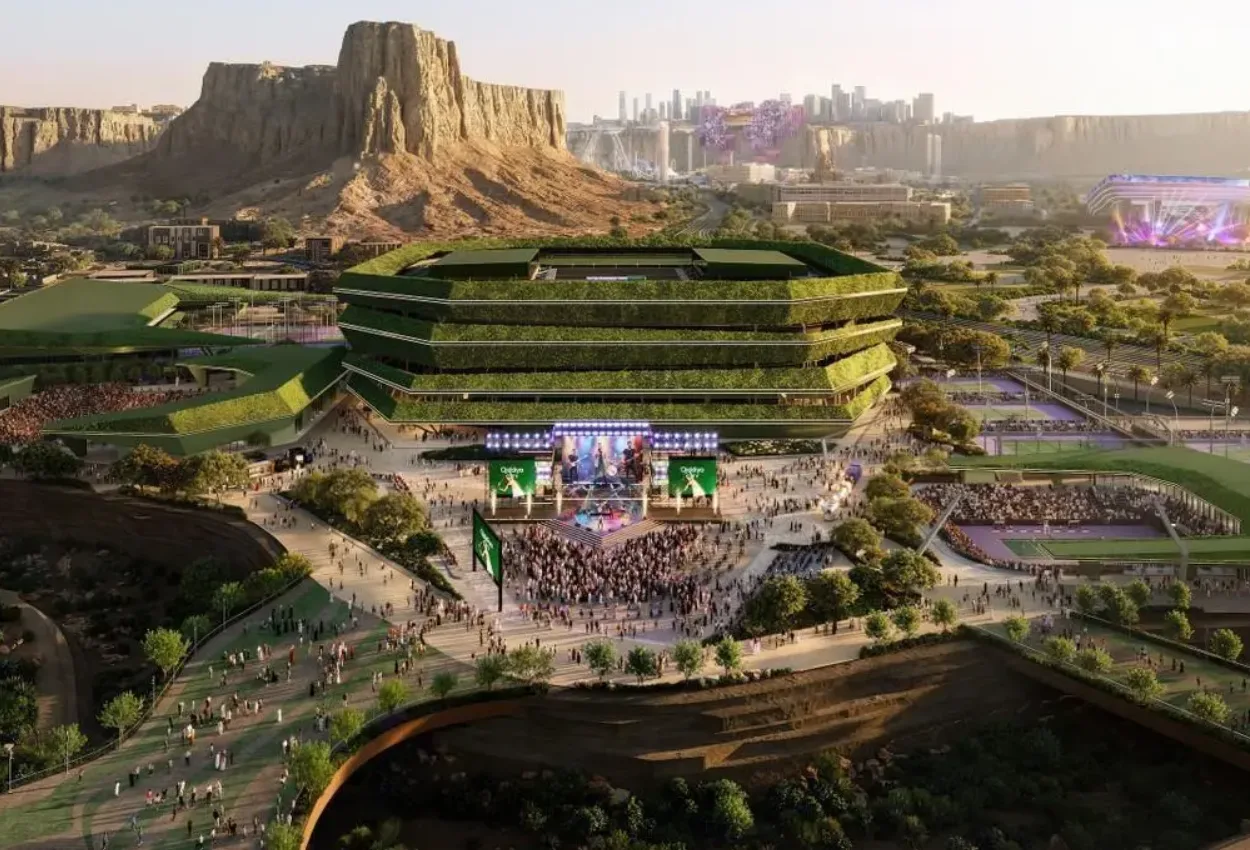
Qiddiya City sits 45km west of Riyadh. The National Tennis Centre will hold 30 courts, more than any other tennis complex in the region, with every court built to ATP, WTA and ITF standards. The firm Populous produced the design, and construction has already begun.
Qiddiya Investment Company lists the centre among its plans to turn Qiddiya City into a destination for entertainment, sport and culture. The announcement follows the opening of Six Flags theme park, Aquarabia water park, and PlayMaker Studios, a film production hub, at Qiddiya City.
Inside the National Tennis Centre
The centre will include 28 hard courts and two clay courts, set within the landscape near the Tuwaiq Mountains, with green facades around several buildings. Training and wellness facilities sit alongside a public realm and two arenas with retractable roofs, which can host concerts and events outside tennis.
A golf course designed by Sir Nick Faldo, spanning 18 holes, sits next to the centre and is due to open later this year. Plans for the surrounding land include homes, offices and retail space, part of a development for Qiddiya City planned to reach three times the size of Paris.
The Ministry of Sport names the National Tennis Centre among its efforts to raise sports participation across Saudi Arabia. The centre will run programmes introducing children to tennis, alongside support for Saudi players who already compete. Organisers point to winter weather at the site as a factor that could draw players from other countries who want to train ahead of each season on the tennis circuit.
National Tennis Centre at Qiddiya City set to hold 30 courts, 33,000 seats
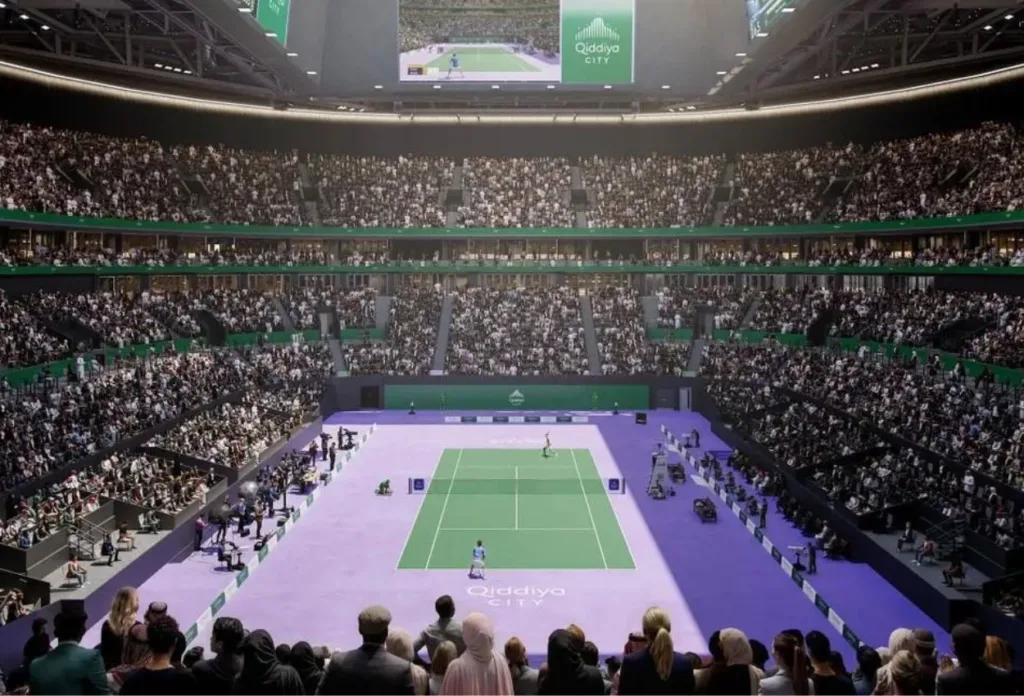
The complex will hold 30 courts in total: 28 hard courts and two clay courts. Centre Court will seat 15,000 people and include a retractable roof; organisers say its capacity compares to other venues that host top matches around the world, and that it can also host events beyond tennis.
Court 1 will seat 5,000, and Court 2 will seat 2,000. Court 3, an arena built for sport, concerts and other events, will seat 8,000 and include a retractable roof. Each outdoor match court will seat 450 spectators.
The complex will contain six competition courts, six indoor courts and 14 practice courts, including clay surfaces. Total seating across the complex will reach 33,000.
Minister of Sport and President of the Saudi Olympic and Paralympic Committee Prince Abdulaziz bin Turki bin Faisal said the launch reflects support from the leadership for the sports sector, and called the complex a pillar in the development of tennis in the Kingdom.
“The complex has the necessary capabilities to host major tournaments and elite players, having been built according to the highest international specifications and standards. This reflects the commitment to developing the tennis ecosystem in the Kingdom, as with other sports, by enhancing infrastructure and programs that support the scouting and development of Saudi talent. These efforts help guide players from the amateur stage to professionalism while contributing to the achievement of the sports objectives of Saudi Vision 2030,” Prince Abdulaziz said.
“At Qiddiya City, we believe in the Power of Play; the idea that play, in all its forms, has the ability to transform lives, build communities and inspire generations. The National Tennis Centre demonstrates this philosophy. We are building a world-class home for tennis at every level, where the world’s best players can compete, the next generation of Saudi talent can reach their potential, and families and communities across Saudi Arabia can experience this great sport. The National Tennis Centre is for Saudi Arabia, supporting Vision 2030 by driving sports participation and tourism, and it is open to the world,” Abdullah Aldawood, Managing Director at Qiddiya Investment Company added.
“The National Tennis Centre at Qiddiya City is precisely the kind of transformative investment that the ITF has long championed as essential to the sustainable growth of our sport around the world. Quality facilities are the cornerstone of every successful national tennis programme – they create pathways for players, empower coaches, and provide opportunities for people who might otherwise never pick up a racket. We look forward to seeing Qiddiya City working alongside the Saudi Tennis Federation to grow the game in Saudi Arabia,” ITF CEO Ross Hutchins said.
“The National Tennis Centre at Qiddiya City is a remarkable addition to the global tennis landscape. As the largest tennis facility of its kind in the region, it reflects a bold vision for the future of tennis and a commitment to creating more opportunities for people to engage with our sport, whether as players, fans or members of the wider community,” CEO of ATP Eno Polo further explained.
“Facilities of this scale and quality play an important role in the continued growth of tennis. By providing a world-class stage for competition alongside opportunities for participation at all levels, the National Tennis Centre has the potential to make a lasting impact on the sport across the region for years to come. The Saudi Tennis Federation welcomes the launch of the National Tennis Centre at Qiddiya City, which represents an important addition to the Kingdom’s sporting infrastructure and a positive step for the continued growth of tennis in Saudi Arabia. The federation hopes that the centre will contribute to increasing participation in the sport, supporting the development of local talent, and inspiring the next generation of Saudi tennis players,” President of the Saudi Tennis Federation Mohammed Al Sarrah added.
Qiddiya City’s National Tennis Centre to meet ATP, WTA and ITF standards
The High Performance Training Centre will work toward development of Saudi tennis talent. It will include a gym, hydrotherapy and physiotherapy suites, recovery and wellness spaces, players’ lounges, changing facilities, and a media centre with rooms for press conferences and interviews.
Community tennis programmes, public spaces, fan zones, a fan plaza, and cultural activations form part of the plan for daily life at Qiddiya City.
Centre Court and the 8,000-seat arena, both fitted with retractable roofs, will host concerts, e-sports, other sports events and cultural programming, as part of Qiddiya City’s approach to sport, entertainment and culture across the year.
Qiddiya City describes itself as Saudi Arabia’s capital of entertainment, sport and culture. Qiddiya Investment Company runs several projects within the city under what it calls the “Power of Play.” Six Flags theme park and Aquarabia water park have opened to visitors.
Other projects at the site include PlayMaker Studios, the Speed Park Track, Prince Mohammed bin Salman Stadium, the Sir Nick Faldo golf course, the Qiddiya City Horse Racing Venue, a Gaming & Esports District, and the Qiddiya Performing Arts Centre.
Plans for Qiddiya City include homes, retail space, offices, hotels, schools and hospitals. Transport links will include the Qiddiya High-Speed Rail, connecting to King Abdullah Financial District in 17 minutes and to the future King Salman International Airport in 30 minutes.