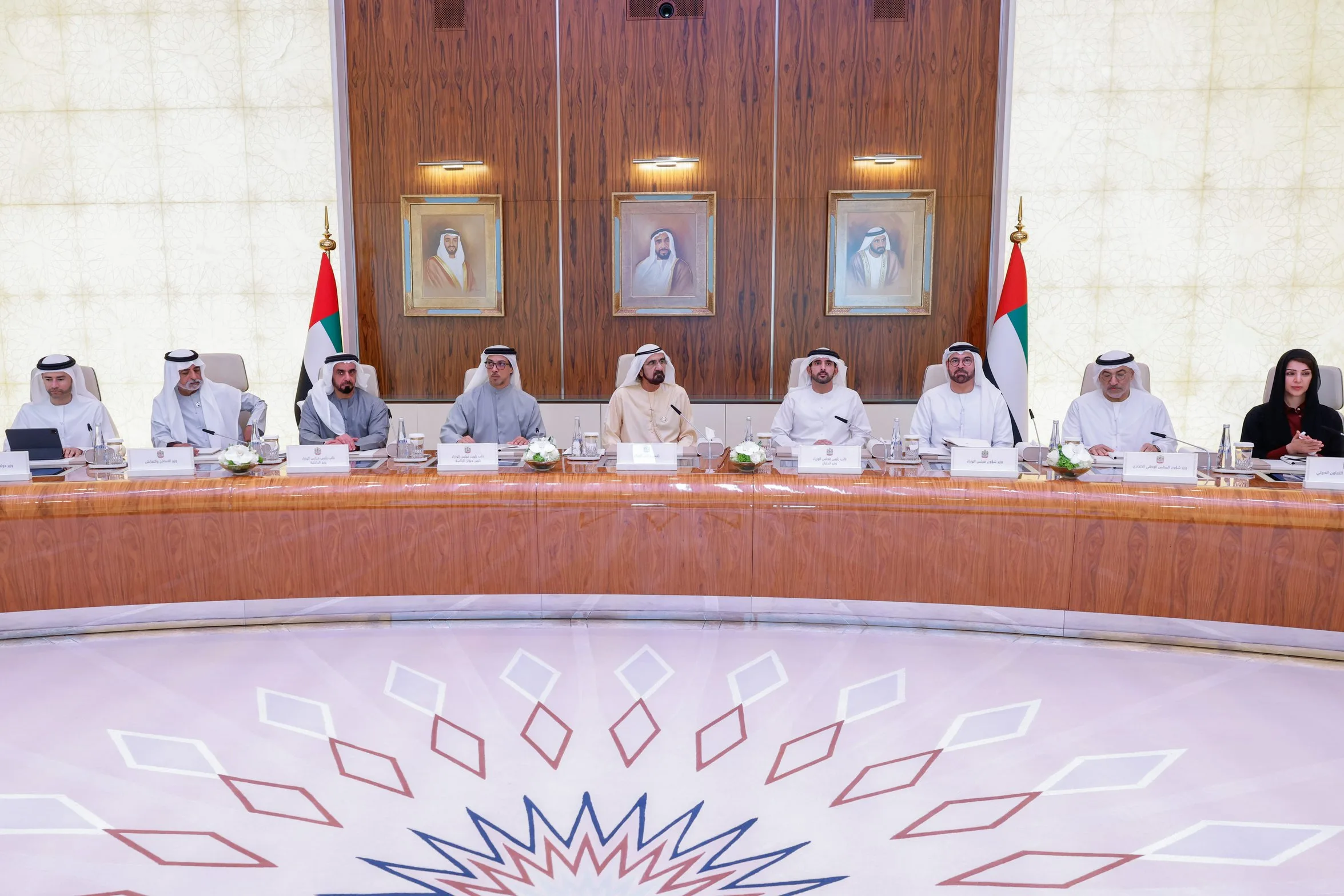
The UAE Cabinet, chaired by Sheikh Mohammed bin Rashid Al Maktoum, Vice President, Prime Minister of the UAE and Ruler of Dubai, has approved a governance framework for deploying Agentic AI across all federal ministries and entities, along with the first package of government services to be converted under Phase One of the project.
“Today I chaired a Cabinet meeting at Qasr Al Watan in Abu Dhabi, where we discussed the national transformation strategy directed by the UAE President to make the UAE the first government in the world to deploy Agentic AI across 50 per cent of its services and operations. During the meeting, we defined the governance framework setting out the roles and responsibilities of all ministries and federal entities in this national project,” Sheikh Mohammed said in a statement.
The framework requires each ministry and federal entity to form a dedicated implementation team, headed by the minister or entity chief, to transition at least half of their services and operations to Agentic AI models. Teams will set measurable targets and assessment indicators to track progress and productivity gains.
Phase One covers four categories of federal services: citizens, residents, the business sector, and the general public.
The Cabinet also approved what Sheikh Mohammed bin Rashid described as the largest training programme in UAE Government history. A total of 80,000 federal employees will be trained in Agentic AI tools across five tiers: leadership, technical, specialist, general workforce, and train-the-trainers.
The programme was developed in partnership with national universities and global technology companies. A dedicated AI-powered digital platform will deliver personalised learning pathways for each employee based on their role and current competency level.
Sheikh Mansour bin Zayed Al Nahyan, Vice President, Deputy Prime Minister, and Chairman of the Presidential Court will lead and oversee the full transformation journey. A national retreat to develop the broader strategy will follow, the Cabinet said.
On healthcare, the Cabinet approved a National Policy for Advancing Digital Healthcare Services and Artificial Intelligence in the Health Sector, built around three priorities: a national AI-driven medical system, an advanced digital health infrastructure, and AI capability-building for the healthcare workforce. The Cabinet also approved the drafting of a Federal Law to govern smart health applications and AI use in the sector, covering data governance, safety standards, legal liability, and patient rights.
The Cabinet additionally reconstituted the UAE Council for Digital Wellbeing, which will now be chaired by Lieutenant General Sheikh Saif bin Zayed Al Nahyan, Deputy Prime Minister and Minister of Interior.
On infrastructure, the Cabinet reviewed progress under the National Electric Vehicles Policy for 2025, which contributed to growing the number of public charging stations from 360 in 2021 to 1,200 in 2025, alongside the introduction of a unified tariff for EV charging.
The meeting also approved the negotiation and signing of 15 international agreements and memoranda of understanding covering trade, investment, diplomacy, finance, and meteorology, with partners including Kazakhstan, Panama, Serbia, Monaco, and Austria, among others.
“The journey to UAE Government 4.0 has begun,” Sheikh Mohammed bin Rashid said. “Our ambition is clear: to be the world’s leading government in adopting Agentic AI.”