The Mohammed bin Rashid Al Maktoum Global Initiatives (MBRGI) has launched an initiative to support efforts to eradicate river blindness, also known as onchocerciasis, in Ghana by 2030, targeting seven million direct beneficiaries and more than 35 million indirect beneficiaries over the next three years.
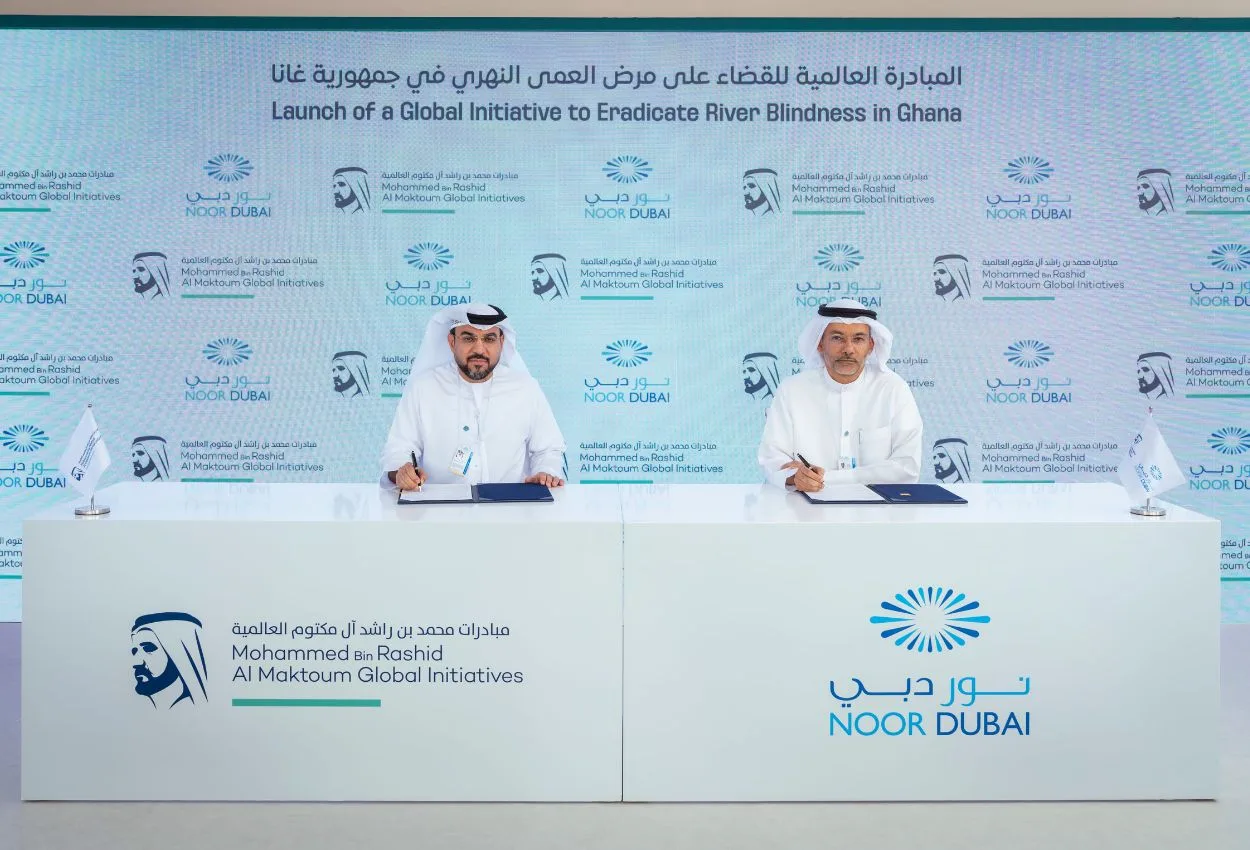
The initiative was announced during the World Governments Summit (WGS) 2026, where a partnership agreement was signed between MBRGI and Noor Dubai.
The initiative aligns with efforts led by the World Health Organisation (WHO) to eliminate neglected tropical diseases by the end of the decade and supports the UAE’s role in humanitarian initiatives.
MBRGI and Noor Dubai sign Ghana river blindness partnership
The agreement was signed by Saeed Al Eter, CEO of Mohammed bin Rashid Al Maktoum Global Initiatives (MBRGI), and Prof. Alawi Alsheikh-Ali, Director General of the Dubai Health Authority and Chairman of Noor Dubai’s Board of Trustees.
The signing took place during WGS 2026, which is held under the theme ‘Shaping Future Governments’ and focuses on partnerships that support development and community advancement.
The 2026 edition of the summit is seeing participation from more than 60 heads of state and government and their deputies, over 500 ministers, representatives from more than 150 governments, and global experts, with more than 6,250 participants attending.
Under the partnership, Noor Dubai will oversee implementation of the project in Ghana. This includes mass drug administration for prevention and treatment, community surveys and assessments to monitor early signs of the disease, and training programmes for local healthcare workers.
Saeed Al Eter said eliminating river blindness is a priority for MBRGI and reflects its mission to support underserved communities, meet healthcare needs, and strengthen health systems.
Ghana programme targets millions through disease prevention
“This global initiative represents a significant step towards supporting Ghana’s national ambitions while accelerating international efforts to eradicate the disease through MBRGI’s funding and Noor Dubai’s extensive expertise in treating neglected tropical diseases,” he said in a statement.
Prof. Alawi Alsheikh-Ali said the agreement reflects the vision of His Highness Sheikh Mohammed bin Rashid Al Maktoum, Vice President and Prime Minister of the UAE and Ruler of Dubai, to reinforce the UAE’s role in humanitarian initiatives.
He said the programme represents a commitment to preventing blindness and strengthening healthcare systems to support communities in the long term.
River blindness is caused by parasitic worms transmitted through subcutaneous tissue and affects the eyes and skin. Symptoms include itching, skin changes and eye lesions, which can lead to vision impairment and blindness. Subcutaneous nodules can form due to adult worms, while early exposure in children can result in epilepsy.
World Neglected Tropical Disease Day is marked annually on 30 January to raise awareness of diseases affecting one in five people worldwide. The designation of the day was supported by UAE diplomatic efforts and announced at the Reaching the Last Mile forum in Abu Dhabi in 2019. It was recognised by the WHO in 2021.
WHO roadmap supports onchocerciasis elimination
The WHO’s 2021–2030 roadmap identifies onchocerciasis as one of the diseases targeted for elimination.
Established in 2015, MBRGI oversees more than 30 initiatives operating across five pillars: Humanitarian Aid and Relief, Healthcare and Disease Control, Spreading Education and Knowledge, Innovation and Entrepreneurship, and Empowering Communities. The organisation has allocated more than AED13.8 billion to humanitarian aid, benefiting 788 million people in 118 countries.
Founded in 2008, Noor Dubai works towards preventing blindness. By the end of 2024, it had supported more than 33 million beneficiaries across Asia and Africa through treatment, prevention, awareness programmes, mobile clinics and capacity-building initiatives, with a focus on neglected tropical diseases, including river blindness.