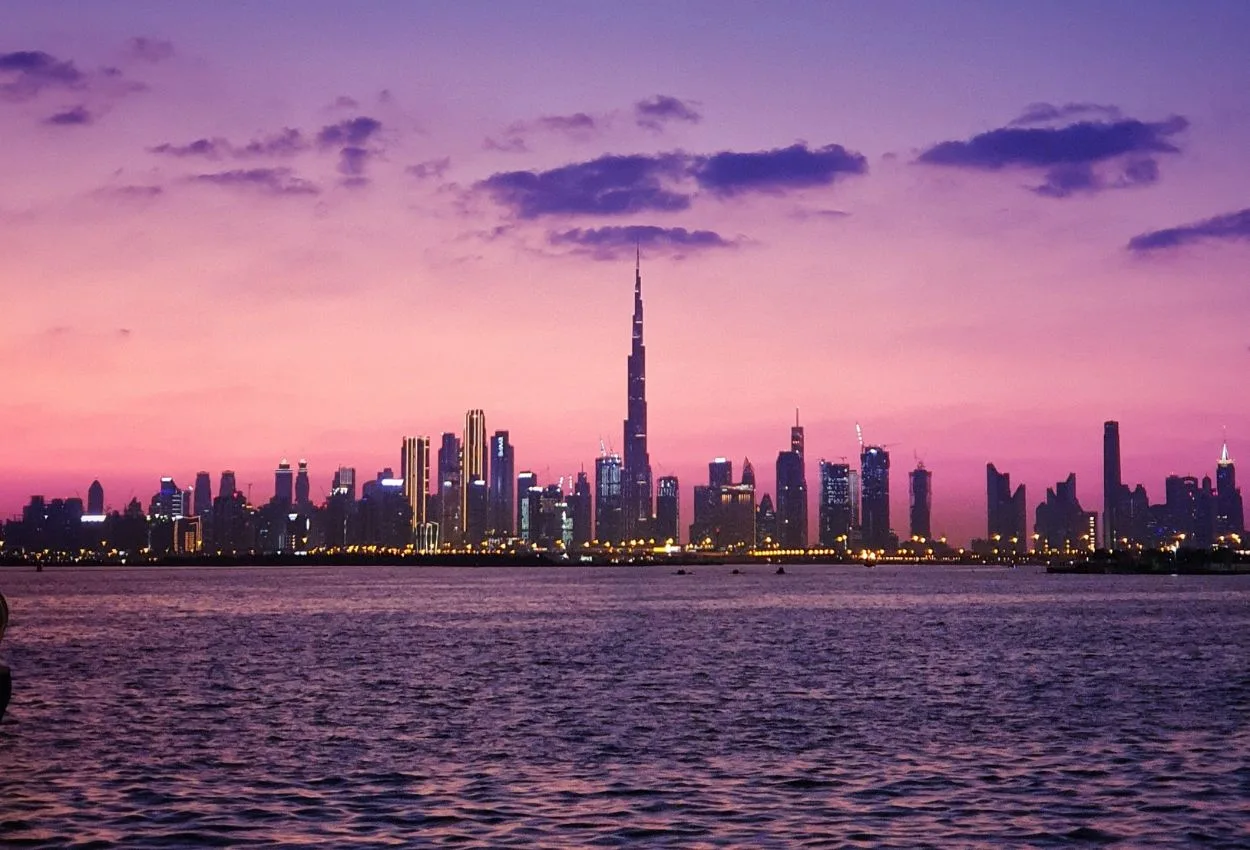
Dubai’s real GDP reached approximately AED473 billion in the first half of 2026, down 2.3 per cent from AED484 billion in the same period of 2025, according to data released by the Dubai Data and Statistics Establishment at Digital Dubai. Nominal GDP, measured at current prices, edged up 0.2 per cent to AED505 billion over the same period.
The Government attributed the gap between real and nominal performance partly to inflation, which weighed on volume-based measures while current-price figures held steadier.
Global economic volatility was cited as a factor affecting several sectors, with the emirate’s diversified base credited for limiting broader damage.
The strongest growth came from financial and insurance activities, which expanded 8.8 per cent in real terms. Value added rose to AED65.9 billion from AED60.6 billion a year earlier, lifting the sector’s share of GDP to 14 per cent from 12.5 per cent.
Human health and social work grew 14.3 per cent in real terms, with value added reaching AED6.2 billion. Information and communication expanded 2.7 per cent, with value added reaching AED24.7 billion, and construction grew 2.4 per cent, generating AED33.2 billion in value added at constant prices.
Wholesale and retail trade remained the largest single contributor at 20.5 per cent of real GDP, though the sector contracted 6 per cent in real terms as inflation eroded volume.
Value added reached AED96.9 billion. Transportation and storage, which contributed 10.7 per cent of real GDP, saw value added fall 7.4 per cent to AED50.6 billion.
Real estate, the third-largest sector at 11.8 per cent of real GDP, declined 2.5 per cent in real terms but grew 5.4 per cent at current prices, with value added reaching AED65.1 billion.
“Dubai’s H1 2026 GDP performance reflects the strength and adaptability of an economy built to navigate periods of significant global uncertainty. Importantly, the continued year-on-year growth achieved across a number of strategic and future-focused sectors demonstrates the strength and depth of Dubai’s economic fundamentals and the effectiveness of our continued focus on the sectors that will shape our long-term growth. We enter the second half of 2026 from a position of strength and with clear momentum. As we continue advancing the objectives of the Dubai Economic Agenda, D33, our focus is firmly on accelerating investment, innovation and talent, strengthening Dubai’s competitiveness and unlocking the next wave of growth. We are confident that the foundations being built today will enable Dubai to emerge from this period with even greater momentum and continue its trajectory of sustainable growth well into the future,” Helal Saeed Almarri, Director General of the Dubai Department of Economy and Tourism said in a statement.
“Diversity and the breadth of the sectoral base are among the key strengths of Dubai’s economy, which is reflected in the continued growth of a range of strategic sectors during H1 2026, amid the transformations taking place in the global economic environment. This diversity is the outcome of a long-term vision that has guided investment in building new sectors, developing existing ones, and strengthening the economy’s capacity to adapt to different changes. The rapid transformations the world is witnessing confirm the importance of continuing to invest in future sectors of high added value, enhancing the integration of the economic ecosystem, and providing an environment that enables businesses, investments and talent to grow and thrive. Guided by the vision of its leadership and the integrated efforts of the government and private sectors, Dubai continues to anticipate transformations and open new pathways for growth, supporting its strategic targets and strengthening the emirate’s competitiveness and future readiness,” Hamad Obaid Al Mansoori, Director General of Digital Dubai added.
He affirmed that digital transformation and AI are today essential drivers for enhancing the competitiveness of the economy and raising efficiency across sectors, noting that Dubai continues to develop an integrated digital ecosystem that accelerates the adoption of advanced technologies and enables economic sectors to benefit from the opportunities of the digital economy, supporting sustainable growth and reinforcing Dubai’s position as a global hub for the new economy.
“The results of H1 2026 reflect a variation in the performance of economic activities, which underlines the importance of assessing indicators within an integrated picture that covers the size of the economy, its sectoral structure, and the contribution and performance trends of each activity. While some activities were affected by the changes witnessed in the global economic environment, other sectors continued to achieve positive growth rates, reflecting the breadth and diversity of Dubai’s economic base. We continue to develop the national accounts and economic data ecosystem in Dubai in line with the best statistical standards and methodologies, and to make use of available sources and data to enhance the accuracy and comprehensiveness of indicators. The value of this data is not limited to measuring economic performance; it extends to enabling government and business to understand transformations more deeply, and to supporting planning, anticipating trends, and evidence-based decision-making,” Younus Al Nasser, Chief Executive of the Dubai Data and Statistics Establishment at Digital Dubai further explained.
“The H1 results demonstrate that appetite to invest, establish and grow in Dubai remains strong, particularly across sectors that are central to the city’s future economy. The 8.8% growth in financial and insurance activities, alongside continued expansion in information and communication, reinforces Dubai’s position as a platform for capital, enterprise and innovation, while growth across other high-value activities reflects the breadth and resilience of the wider economy. Our focus now is on converting this sustained confidence into further tangible growth. We are working closely with partners across the government and industry to continuously enhance the business journey, strengthen market access and deliver the infrastructure, talent and services companies needed to establish, invest and scale. The measures introduced over recent months have further strengthened Dubai’s operating environment and created a solid foundation for investment-led growth through the second half of 2026 and beyond,” Hadi Badri, Chief Executive Officer of the Dubai Economic Development Corporation, the economic development arm of the Dubai Department of Economy and Tourism added.
The H1 2026 data is framed within the Dubai Economic Agenda, D33, which targets broader diversification and positions high-value sectors, including technology, financial services and healthcare, as central to future growth.