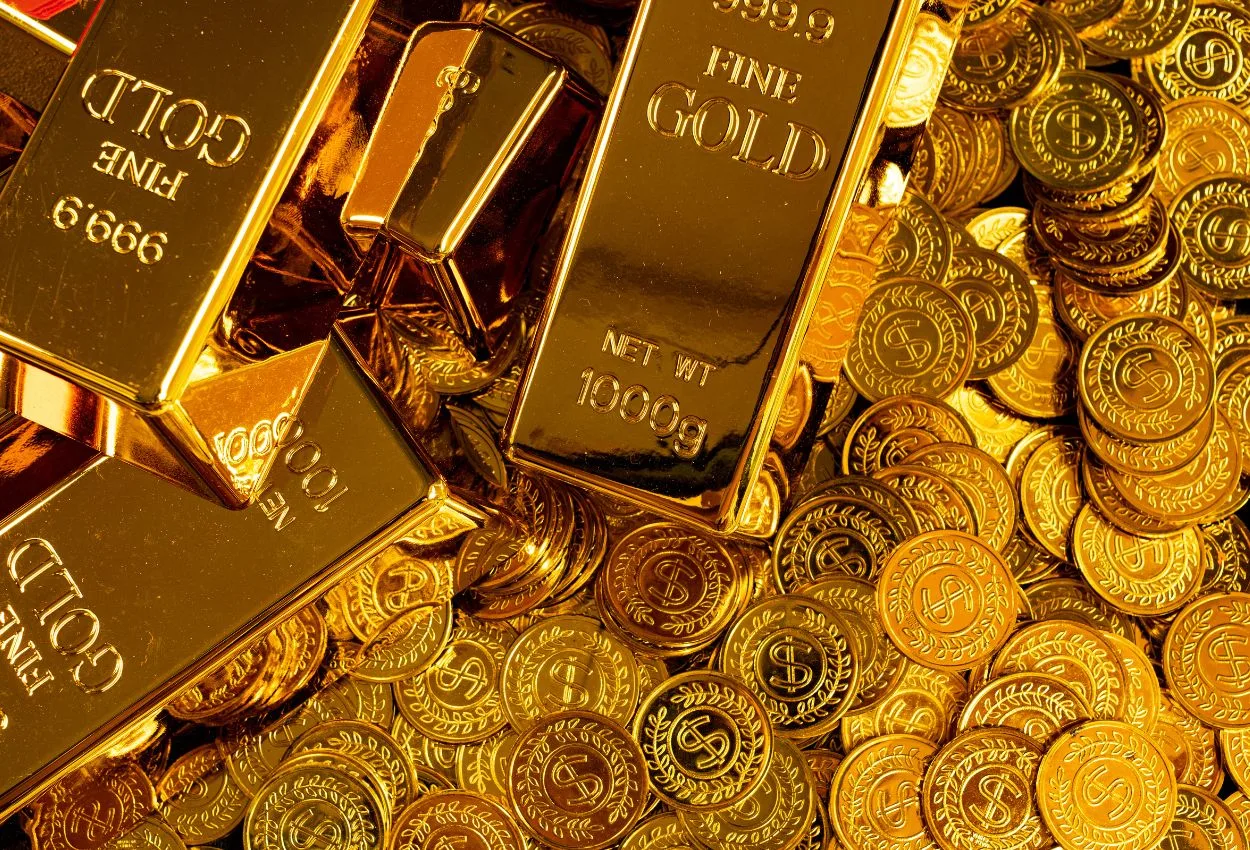
Gold has fallen around 16 per cent since the start of the US-Iran conflict, a move that, on the surface, appears to contradict its status as a crisis hedge. Yet UAE analysts told Lana the decline is not a failure of gold itself, but a reflection of the type of shock now driving markets.
“Gold’s appeal as a safe haven depends on the type of uncertainty that the world is dealing with,” Vijay Valecha, Chief Investment Officer at Century Financial said. “The current sell-off reflects the macro consequences of an oil-driven supply-side shock rather than a breakdown in gold’s safe-haven role.”
The mechanism is well established. When energy prices rise sharply, inflation expectations follow. Those expectations feed into US Treasury yields – both nominal and real – which push the dollar higher, Valecha said.
Why gold is losing its shine

For gold, a non-yielding asset denominated in dollars, that combination is a headwind. Markets are currently pricing in a 40 per cent probability of a 25 basis point Federal Reserve rate hike before the end of 2026, he added.
“Gold and interest rates share a well-documented inverse relationship. When central banks hike rates, gold prices typically fall. Gold is a non-yielding asset. It pays no interest or dividend. When investors are offered higher returns through interest-bearing instruments, the opportunity cost of holding gold rises. Capital rotates away from gold toward yield-generating assets,” he further explained.
The pattern has appeared before. The Russia-Ukraine conflict that began in February 2022 initially sparked a gold rally, only for it to be cut short as the inflationary impact of higher energy prices pushed yields and the dollar higher. “The same dynamic has played out currently, only faster,” Valecha said.
Gold’s record across financial crises is distinct from its record across energy shocks, according to Valecha. During the initial stage of the COVID-19 pandemic, gold rallied 42 per cent between March and August 2020, as the US Federal Reserve shifted to quantitative easing, driving yields and the dollar lower, he said. During the 2008 financial crisis, gold rose around 200 per cent from its low in mid-2007 to mid-2011 as the Fed launched successive rounds of economic support, he added.
“Gold’s safe-haven appeal tends to perform best in a financial crisis or growth shock,” Valecha said. “This is when real yields fall and the dollar weakens.”
Echoing the sentiment, Charu Chanana, Chief Investment Strategist at Saxo Bank, explained that while gold is still “the cleanest crisis hedge”, it is not a “magic safe haven.”

“Its strength is that it does not depend on any government’s promise to pay, which makes it useful when investors worry about currency debasement, central-bank credibility, geopolitical risk or financial-system stress. However, it can struggle when real yields rise or the US dollar strengthens,” she told Lana.
Chanana also flagged a near-term risk that sits outside the usual macro framework, where some central banks or sovereign reserve managers “may need to liquidate part of their reserve assets – including gold or other liquid holdings – if energy import bills rise sharply or if they need to defend their currencies. That does not break the long-term gold story, but it can create bouts of volatility even in a safe-haven asset.”
Central bank demand for gold has nonetheless remained a structural support. According to Valecha, central banks bought around 1,045 tonnes of gold in 2024 and approximately 863 tonnes in 2025 – well above the long-term average, even if below the record pace seen in 2022-2024. In the first quarter of 2026, they added another 244 tonnes.
Despite the conflict in the Middle East, US equity markets have not shown the kind of dislocation that typically pushes investors toward defensive assets.
According to Nick Spencer-Skeen, Senior Executive Officer at Lunaro, the US indices were at or near record highs, as was the FTSE 100 in the UK.

“The conflict doesn’t seem to be knocking investor confidence in the NDX either, with the AI boom counteracting the historical correlation seen between Big Tech and energy,” he said, adding that the strength of the US consumer remained the underlying driver.
“If the conflict in the Middle East raises inflation expectations to a point that does give the US consumer cause to pause, then the knock-on effect on rate expectations may indeed buoy gold, however it returns the argument to the opening point. The current geopolitical crisis in the Middle East is not yet a crisis to the US consumer.”
Treasuries and the dollar face pressure

The status of US Treasuries and the dollar as safe havens has grown more complicated, analysts noted, making it “less reliable that they used to be.” Long-duration Treasuries in particular are under pressure: 10-year yields are testing the 4.60 per cent level, while 30-year yields have climbed to 5.15 per cent, near a two-decade high, Josh Gilbert, Lead Analyst for APAC and the Middle East at eToro told Lana.
Foreign holdings of Treasuries dropped by $138 billion in March, which Gilbert said was “hardly the picture of a flight to safety. The Dollar Index is roughly flat year to date, so the dollar’s premium has compressed even with geopolitical risk elevated.”
With markets pricing in a possible rate hike before year-end, Valecha said long-duration bonds had become” unattractive.”
“With Kevin Warsh as the new Fed chair, the focus is likely to shift to reducing the Fed’s balance sheet and removing excess liquidity from the market. This move could see long-term yields elevated, but the reduced liquidity would benefit the US dollar. The Treasury Secretary Scott Bessent has signalled a gradual reduction in long-term bond issuance and a greater focus on shorter-duration bonds to fund government spending. This is likely to steepen the curve, which doesn’t benefit US Treasuries,” he explained.
“The paradox here is that even when the problems originate in the US, investors still buy US Treasuries and US Dollar, as there are currently few other, or better alternatives,” Spencer-Skeen added.
However, rising US deficits were adding to the pressure on both assets, Gilbert added. “US Treasuries protect against market shock, but not inflation shock,” he said, adding that elevated debt levels had prompted questions about whether Treasuries could still be considered genuinely risk-free.
Madhur Kakkar, Founder and Chief Executive of Elevate Financial Services, however said that the dollar’s role in a genuine liquidity crisis remained intact. “When the global financial system is in a true crisis and liquidity dries up, the dollar is still the one asset everyone rushes to because the whole system is built on it.”

“In a growth scare, US Treasuries may still work well. In an inflation shock, they may not, because bond yields can rise at the same time equities fall.”
Bitcoin continues to feature in debates about safe-haven alternatives, but the picture in the current conflict is more nuanced than in previous crises.
According to Gilbert, Bitcoin had been a standout since the conflict escalated at the end of February, rising around 15 per cent while gold pulled back from its February highs.
“This is a far more mature asset now than what we’ve seen in previous drawdowns and a world away from the one we saw in 2022. Back then, when bitcoin fell 60-70%, there were no spot ETFs, no corporate treasuries with billion-dollar positions, no sovereign wealth funds putting capital to work in digital assets. Today, all three are active. Bitcoin has qualities investors find attractive, but it’s not yet in a position to go up against the world’s largest asset, gold, as a safe haven just yet. Whether that profile evolves as it continues to mature is an open question, though for now it belongs in the risk bucket, not the safe haven bucket,” he said.
“In a true crisis, Bitcoin still behaves more like a high-volatility risk asset than a proven defensive anchor. Gold has centuries of trust, central-bank ownership, and deep crisis history behind it. Bitcoin has scarcity, but not yet the same crisis-tested behaviour,” Chanana added.
However, Spencer-Skeen argued that Bitcoin has not yet been universally tested in a crisis. “Bitcoin may complement gold in modern portfolios, but replacing gold entirely would require greater stability, broader trust, and consistent performance across crises.”
Safe havens can fail in a ‘dash for cash’
Analysts warned that the premise of safe-haven investing – that at least one asset will hold its value during a crisis – breaks down in certain conditions. The term used to describe this is a “Dash for Cash.”
“It has happened, with March 2020 being a good example. Almost nothing was safe, with equities, treasuries, gold, and the yen all selling off briefly as investors sought cash as the scale of the pandemic took shape. Central bank intervention has historically been what breaks the spiral. Liquidity itself is a form of safety, and one that gets overlooked until it is needed,” eToro’s Gilbert explained.
Uday Vikram, Co-Chief Investment Officer at Klay Group, said these episodes were driven less by fundamentals and more by a scramble for liquidity. “Investors are often forced to sell even high-quality defensive assets in order to raise cash, meet margin calls, or reduce leverage. As a result, assets that would typically provide protection such as gold, government bonds, or safe-haven currencies, can temporarily decline alongside risk of assets.

“However, once market functioning stabilises and liquidity conditions improve, traditional safe havens often begin to reassert their defensive characteristics,” he explained.
“When traditional safe havens fail together, it usually means the shock is inflationary or policy-driven. That is the uncomfortable regime where equities fall, bonds fall, the dollar may be strong, and gold may be capped by real yields. In that environment, diversification by asset class is not enough. Investors need diversification by risk driver: liquidity, inflation protection, quality cash flows, real assets, and geopolitical hedges,” Saxo Bank’s Chanana said.
Swiss franc and yen remain key safe-haven currencies, say experts
The Swiss franc and Japanese yen retain roles in defensive portfolios, though their behaviour has diverged, analysts said, adding that the Swiss franc gained almost 13 per cent against the dollar in 2025 and extended those gains into 2026, reaching an 11-year high against the dollar. Its credentials – political neutrality, a strong banking system, low inflation and a sustained current account surplus – have remained intact.
The yen’s position is more fragile, according to Vikram. “The Japanese yen has traditionally been viewed as a safe-haven currency due to the repatriation of Japanese capital during periods of stress, as well as the unwinding of global carry trades. However, in recent years, the yen has not consistently behaved as a safe haven due to changes in monetary policy, rising inflation, and policymakers’ preference for maintaining relatively loose financial conditions to support economic growth.
“As a result, the yen’s traditional safe-haven dynamics have weakened relative to previous cycles. This highlights that safe-haven characteristics are not static and can evolve alongside broader macroeconomic and policy changes,” he said.
However, Kakkar argued that neither currency should be treated as a primary hedge. “Alternative safe haven currencies like the Swiss franc and Japanese yen play a valuable but complementary role in crisis portfolios, filling the niche the dollar once held for non-acute risk off events.
“The Swiss franc remains a robust haven due to Switzerland’s political neutrality, strong banking system, low inflation, and large current account surplus, making it the preferred currency in 2025 2026 appreciating notably against the US dollar. The yen’s safe haven status is more fragile, historically driven by carry-trade unwinds, but it weakened notably in 2025 as policy shifts and domestic shocks undermined its traditional strength.
“Both serve as diversifiers rather than primary hedges. In practice, the Swiss franc acts as high quality crisis insurance, while the yen should be used cautiously until policy dynamics improve. Together, they complement gold and Treasuries in a diversified defensive strategy,” he explained.
Gilbert’s assessment aligned with this framing. The franc, he said, drew on Switzerland’s current account surplus, political neutrality, and the credibility of the Swiss National Bank, while the yen benefited from Japan’s large net foreign asset position – with Japanese investors typically repatriating capital during risk-off episodes. “Neither is bulletproof, and both come with a central bank risk attached,” he said.
Investors advised to look beyond one safe asset
The shift in thinking among analysts was away from identifying a single safe asset and toward constructing portfolios that could withstand multiple types of shock.
“Investors also need to be mindful of “false diversification” – situations where a portfolio appears diversified on the surface, but where assets ultimately become highly correlated during periods of market stress. In many crises, correlations across asset classes tend to rise sharply, reducing the effectiveness of traditional diversification strategies,” Klay’s Vikram advised.
“Good diversification often means that something in the portfolio is always underperforming. A resilient portfolio should diversify not only across asset classes, sectors, and geographies, but also across factor exposures such as growth, value, quality, and different macroeconomic environments including rising inflation, falling inflation, stronger growth, or recessionary conditions. Ultimately, the objective is to optimise the balance between risk, return, liquidity, and investment horizon. A well-constructed portfolio is designed to be more robust across a wide range of outcomes, rather than simply maximising returns in one specific environment,” he added.
“Tech stocks and cryptos may be different asset classes but they quite frequently behave in the same way as both could be dependent on the same risk appetite, growth expectations or simple a “hype”. Therefore, it is essential to consider the drivers behind each asset type as opposed to picking random investments. Driving factors such as economic growth, inflation, interest rates, geopolitics etc. are not to be missed when diversifying your portfolio,” Spencer-Skeen added.
Chanana’s advised investors to build layers of resilience rather than search for one answer. “That could mean cash or short-duration bonds for liquidity, gold for geopolitical and policy credibility risk, selected real assets for inflation, quality equities for earnings resilience, and currency diversification where appropriate. The aim is not to eliminate volatility, but to avoid having every part of the portfolio depend on the same macro outcome.”
“When no asset class offers absolute safety, the objective of portfolio construction shifts from protection to adaptability. Traditional diversification still matters, but it is no longer sufficient on its own. Investors need to think in terms of liquidity, flexibility, and speed of execution,” Kakkar said adding that a resilient portfolio today is built on three core principles:
- Staying solvent
- Maintaining cash flow visibility
- Preserving liquidity, keeping capital accessible to act on opportunities
“What is becoming increasingly relevant is the use of unconventional structures and dynamic allocation strategies. Instead of locking capital into long-term positions, investors are leaning toward shorter-duration opportunities, tactical trades, and structures that allow repositioning as market conditions evolve. Because in this cycle, the advantage is not in predicting the next safe asset, it is in having the ability to move when conditions change,” he concluded.