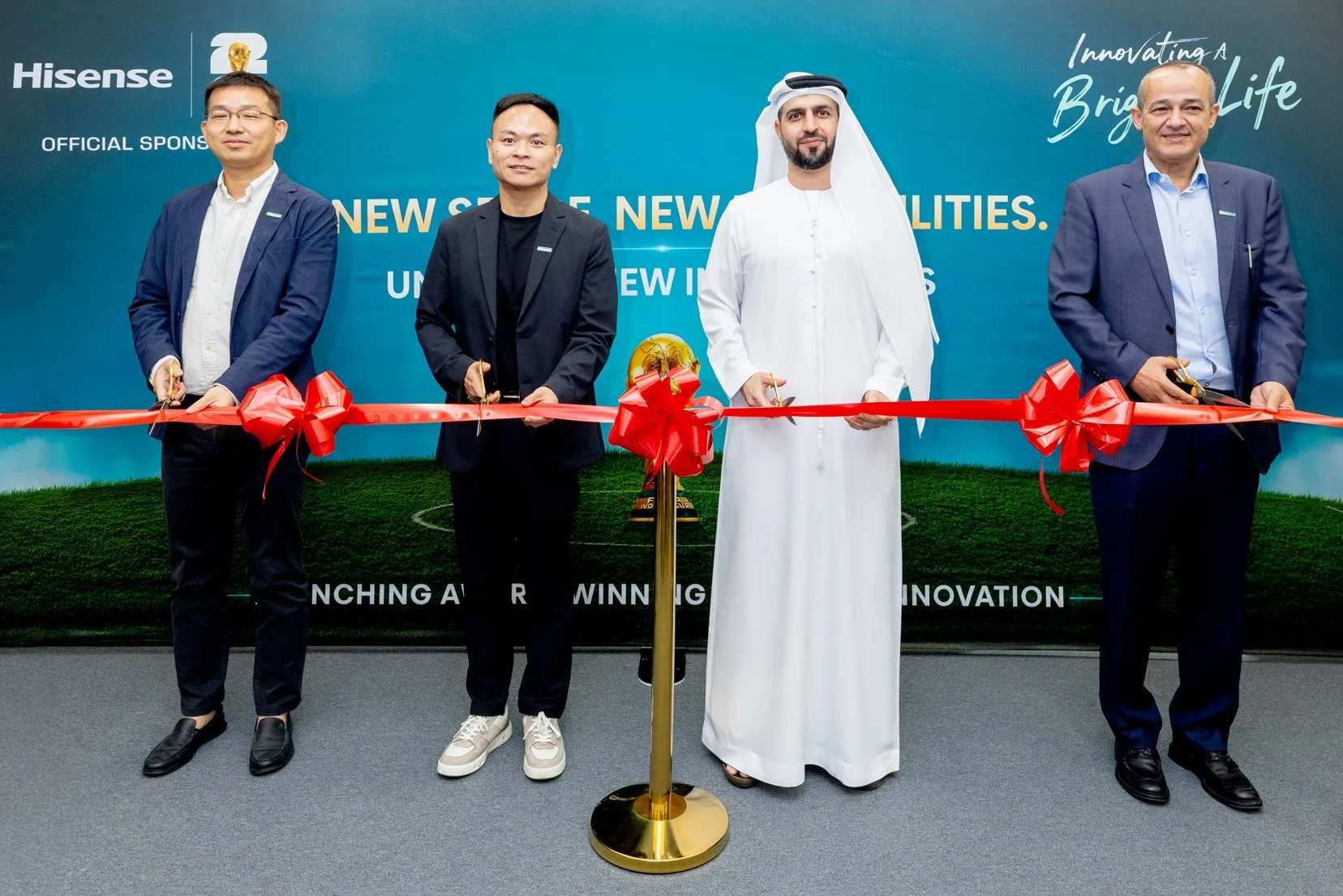
Hisense has inaugurated its Middle East and Africa regional headquarters in Dubai Internet City, consolidating its regional operations at one of the emirate’s main technology clusters.
The new office, in Building 13 of the TECOM Group-managed district, hosted partners, distributors, and key retailers at the opening event on June 16.
“The opening of our new office in Dubai Internet City represents our commitment to the UAE market and the broader Middle East region. With the launch of our new UR9 and UR8 RGB MiniLED Series, we are bringing the most advanced display technology available to consumers here, delivering an unparalleled viewing experience that sets a new benchmark for premium home entertainment,” Jason Ou, President at Hisense Middle East & Africa said in a statement.
“Dubai Internet City is home to a diverse community of global technology companies and more than 31,000 professionals that continue to advance the digital economy in the region and globally. Hisense’s new regional headquarters reflects its long-term commitment to the region and underscores Dubai’s position as a global hub for innovation, in line with the objectives of Dubai Economic Agenda ‘D33’,” Ammar Al Malik, Executive Vice President of Commercial at TECOM Group and Managing Director of Dubai Internet City added.
The inauguration doubled as a product launch. Hisense used the occasion to introduce the UR9 and UR8 RGB MiniLED television series, its latest flagship display range. Both lines use next-generation MiniLED technology the company says delivers higher brightness, deeper contrast, improved colour accuracy, and reduced blue light exposure compared with previous generations.
The UR9 sits at the top of the range, with Hisense positioning it around what it calls “Natural and Real Color” reproduction, including more accurate skin tones for extended viewing comfort. The UR8 Series covers screen sizes from 55 to 100 inches and is aimed at a broader consumer segment seeking large-format premium displays.
The launch comes with Hisense serving as an official sponsor of FIFA World Cup 26, where it is also supporting sensory-inclusive spaces across host stadiums.
Dubai Internet City, which was established in 1999, contributed AED 100 billion to Dubai’s GDP over the 15 years to 2025, according to an impact study the district conducted in partnership with Accenture.