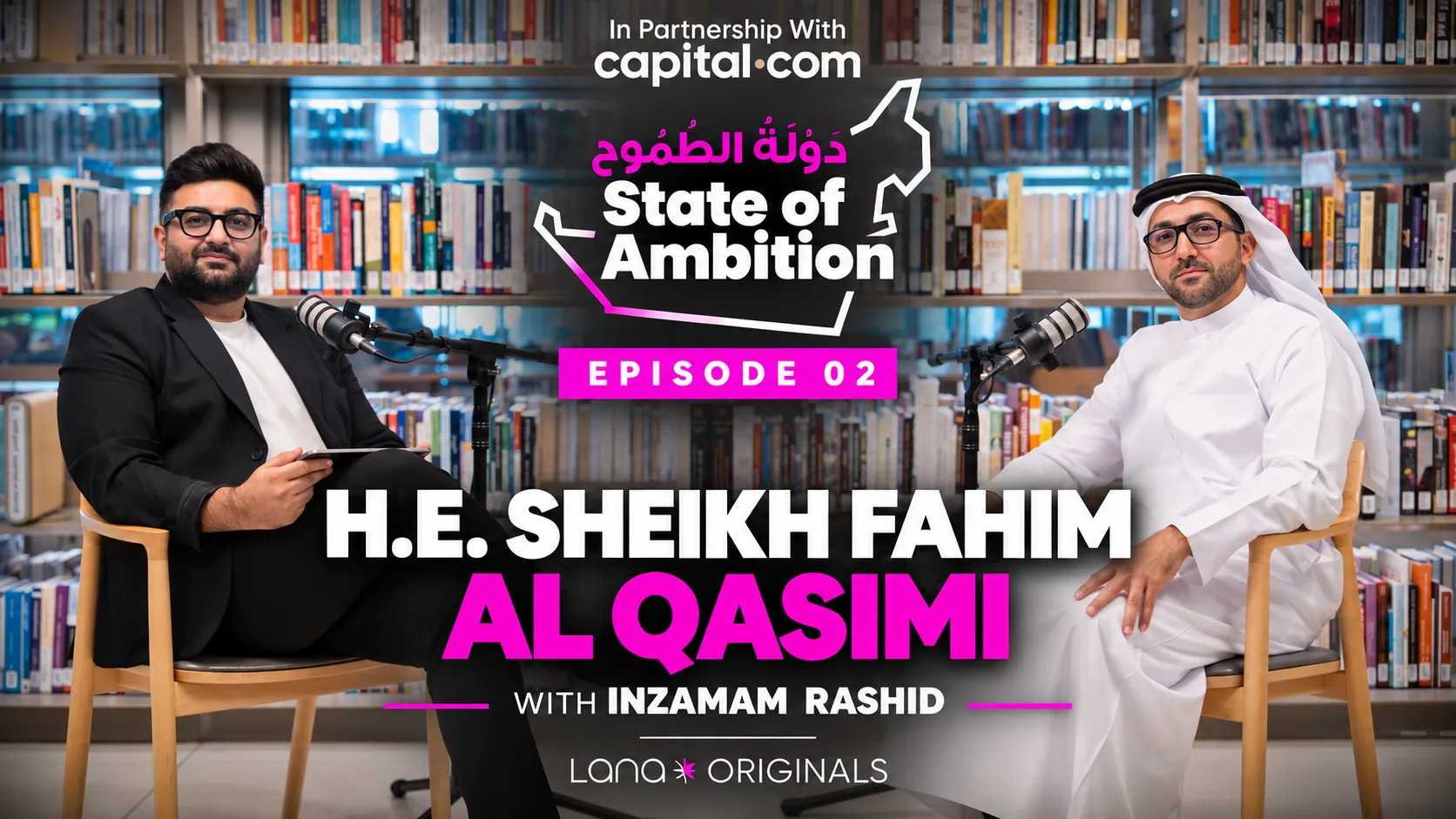
Sharjah is accelerating investment in its ports, roads and logistics infrastructure as the UAE prepares for a prolonged period of instability in the Gulf, according to Sheikh Fahim Al Qasimi, who has warned that the conflict with Iran is unlikely to be resolved quickly.
In an exclusive interview for the second episode of State of Ambition, a new podcast series from Lana hosted by international journalist Inzamam Rashid in partnership with Capital.com, Sheikh Fahim said the attacks on the UAE had fundamentally changed how investors viewed Sharjah’s strategic importance, particularly its access to the Indian Ocean through Khorfakkan. “I think one in three calls after the conflict broke out was specifically about Khorfakkan,” he revealed. “A lot of investors now are questioning why they didn’t invest in Sharjah previously.”
His comments come as the Strait of Hormuz remains vulnerable to further disruption, with commercial shipping still facing attacks despite months of diplomatic efforts to end the conflict.
October saw attacks on 37 vessels in and around the Strait, the highest monthly total since the war began in February. Fresh incidents have continued into November, raising concerns about the security of one of the world’s most important maritime trade routes.
Sheikh Fahim, who chairs Sharjah’s Department of Government Relations and its Supreme Committee for Economic Integration, said the conflict had elevated the emirate’s role in protecting not only the UAE’s economy but also international supply chains.
Khorfakkan becomes a strategic alternative to Hormuz
Located on the UAE’s east coast, outside the Strait of Hormuz, Khorfakkan Port has become an increasingly important gateway for goods entering and leaving the country without passing through the vulnerable waterway.
Before the conflict, the port had an annual capacity of approximately 3.5 million twenty-foot equivalent units (TEUs). A $2 billion expansion programme announced by port operator Gulftainer aims to increase that capacity to five million, with a longer-term target of 10 million.
Sheikh Fahim said the conflict had accelerated existing infrastructure plans and created a greater responsibility to strengthen connections between the country’s east and west coasts. “After the conflict broke out, it was extremely clear that the east coast will play a more important role going forward because of this new geopolitical and geo-economic normal.”
The expansion extends beyond the port itself, with plans to develop logistics and warehousing facilities in Sharjah’s central region, including Al Dhaid, Al Madam and Al Qasimia, alongside improved road and Etihad Rail connections.
The objective is to create alternative routes for goods moving between the Gulf of Oman, the UAE’s industrial centres and ports inside the Arabian Gulf.
For Sheikh Fahim, the importance of those alternatives is unlikely to diminish even if the conflict ends. “If the Strait of Hormuz was open tomorrow, would shipping return back as it did before? I don’t know.”
Sheikh Fahim warns conflict may not end soon
The minister also offered a sobering assessment of the region’s security outlook, warning that the current crisis could become a prolonged feature of the Gulf’s political and economic landscape. “In my humble opinion, this will be a protracted crisis where resolution will not be attained by military means,” he said. “This is not something that will be solved overnight, nor within a few months.”
His assessment comes as negotiations between Washington and Tehran remain uncertain, with disagreements over Iran’s nuclear programme, sanctions and maritime security complicating efforts to achieve a lasting settlement.
Sheikh Fahim said the UAE could no longer make economic decisions on the assumption that the Strait of Hormuz would remain accessible or that international partners would necessarily share the same priorities. “Strategic autonomy means we cannot assume that even our partners will operate with the same interests that we have in terms of keeping that open.”
He also called for greater alignment between Gulf Cooperation Council countries over their shared security and economic interests. “I think the GCC needs to be more aligned on that issue in order for us to have the outcomes that we want.”
‘The world underestimated the importance of the Gulf’
Beyond the immediate threat to shipping, Sheikh Fahim argued that the conflict had exposed how deeply global trade, investment and supply chains depend on the Gulf. “I don’t think leaders across the world fully appreciated how important the Gulf was for the world economy,” he said.
He argued that the region’s importance now extends far beyond oil and gas, encompassing financial investment, manufacturing, aviation and international logistics. The UAE’s response, he said, must therefore focus on building greater economic resilience while maintaining its position as a dependable global trading partner. He also acknowledged that he had personally underestimated the strategic significance of Khorfakkan during his years promoting Sharjah to international investors. “My biggest mistake was not appreciating the importance of that,” he admitted. “Had I had the opportunity to speak to Fahim 12 years ago, I would have spent more time investing my diplomatic capacity and my diplomatic energy in getting investments into there.”
The surge in investor interest has created new opportunities, but also difficult decisions over infrastructure capacity, land use and long-term economic planning. Sheikh Fahim described the next three to five years as potentially the most demanding period of his career.
How Sharjah responded to the Iranian attacks
Reflecting on the initial days of the conflict, Sheikh Fahim described how Sharjah’s government worked with security agencies and businesses to protect residents and maintain the movement of goods.
He revealed that he had returned to military service as part of the UAE’s national service programme during the crisis.
“It was the first year where I really felt the weight of that service,” he said.
He also recounted how a call from Gulftainer’s chief executive over restrictions affecting trucks leaving the port led to a rapid intervention involving Sharjah’s transport authorities and police.
The issue, he said, was resolved within minutes, demonstrating the importance of responsive government decision-making during a national emergency.
The interview marks the second episode of State of Ambition, a Lana Media original series hosted by Rashid in partnership with UAE-regulated global trading platform Capital.com.
Following the inaugural conversation with UAE Minister of State Noura Al Kaabi, the series continues to explore how the Emirates is strengthening its strategic autonomy across diplomacy, defence, trade, technology and infrastructure.
For Sheikh Fahim, the challenges facing the region are also an opportunity to invest in the UAE’s future. “This is not a time to pause and look at being too inward, but it’s a time to be ambitious and invest in the infrastructure.”
The second episode of State of Ambition, featuring H.E. Sheikh Fahim Al Qasimi, launches on November 17 and will be available on YouTube and major podcast platforms.