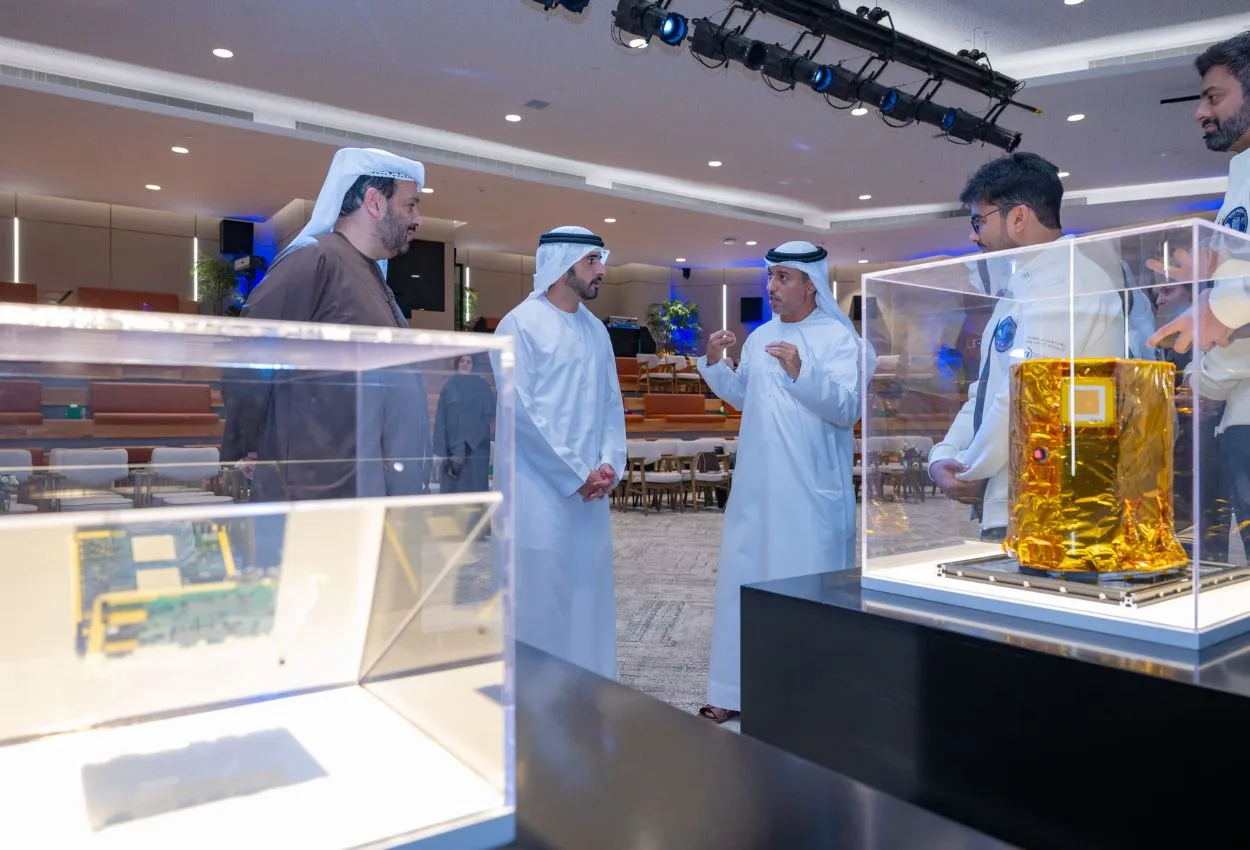
Sheikh Hamdan bin Mohammed bin Rashid Al Maktoum, Crown Prince of Dubai, Deputy Prime Minister and Minister of Defence, witnessed the unveiling of the UAE’s probe for the Emirates Mission to the Asteroid Belt (EMA) – a milestone in what the UAE Space Agency describes as the country’s most ambitious space mission to date.
Developed, assembled and tested entirely in the UAE, the probe reached flight readiness in under two years from the signing of its development agreement in January 2025.
It will travel aboard the MBR Explorer spacecraft on a journey of approximately 5 billion km, visiting seven asteroids before separating from the spacecraft during the mission’s final phase and descending autonomously to the surface of 269 Justitia, the seventh and final destination.
Scientists believe 269 Justitia may have formed in the outer regions of the Solar System before migrating to the main asteroid belt. Studying it could offer new insights into how water and organic materials were distributed during the formation of the planets.
Sheikh Hamdan said the speed of development reflected both the depth of Emirati talent and the strength of the UAE’s research and manufacturing ecosystem.
“Guided by the vision of our leadership, the UAE has progressed in just a few years from aspiring to reach space to actively contributing to shaping its future. Since the establishment of the UAE Space Agency in 2014, the nation has developed an integrated national space ecosystem, launching satellites, placing the Hope Probe into orbit around Mars, and sending Emirati astronauts to the International Space Station. Today, we continue to advance lunar missions and increasingly ambitious exploration projects,” he said in a statement.
“In 2014, His Highness Sheikh Mohammed bin Rashid Al Maktoum, Vice President and Prime Minister of the UAE and Ruler of Dubai, launched the Emirates Mars Mission. In less than two decades, the UAE has established its position among the world’s leading spacefaring nations. Today, we are entering a new phase of advanced scientific missions, space industries and technologies. The UAE’s space sector today exceeds AED44 billion, and our ambitions for the next phase are even greater. By 2031, we aim to double the returns of the space economy, increase its added value by 60%, and position the UAE among the world’s top 10 space economies. We are investing in Emirati talent, knowledge, technology and advanced industries to continue delivering achievements that contribute to our economy, our future and humanity,” he added.
The probe is the product of collaboration between the UAE Space Agency, the Propulsion and Space Research Center at the Technology Innovation Institute (TII), space technology startup HEX20, Khalifa University, and the National Space Science and Technology Center at UAE University. The national team spans more than 150 engineers and scientists.
“The probe reaching flight readiness reflects the advancement and capabilities of the UAE’s national space ecosystem and its ability to leverage ambitious missions to develop advanced technologies, strengthen integration between national institutions and companies, and develop specialised supply chains. Under the National Space Strategy 2031, we will continue to build on these capabilities through an integrated portfolio of projects and missions that enhances the sector’s scientific and economic impact and builds the knowledge and expertise required to advance to new levels in the design and execution of space missions,” Dr. Ahmad Belhoul Al Falasi, Minister of Sports, and Chairman of the UAE Space Agency further explained.
“The EMA probe demonstrates what becomes possible when advanced research is translated into mission-ready engineering. Our teams at TII have developed a system designed to withstand extreme conditions, operate with exceptional precision, and deliver meaningful science billions of kilometres from Earth. It reflects the rigour and systems expertise required to transform research into technology for a demanding interplanetary mission,” Faisal Al Bannai, Advisor to the UAE President for Strategic Research and Advanced Technology, Secretary General of the Advanced Technology Research Council, the Abu Dhabi Government entity overseeing TII, and Member of the Supreme Space Council added.
The next integration phase will take place at the Laboratory for Atmospheric and Space Physics at the University of Colorado Boulder. The mission is scheduled to launch from Japan in the first quarter of 2028.
The EMA mission sits alongside several other active UAE space programmes, including the AED 1 billion International Space Cooperation Programme, Altair-Next Gen – a USD 1 billion UAE-French initiative to manufacture 50 AI-enabled satellites in Abu Dhabi – and preparations for the Rashid Rover 2 mission to explore the far side of the Moon, as well as UAE participation in NASA’s Artemis programme.