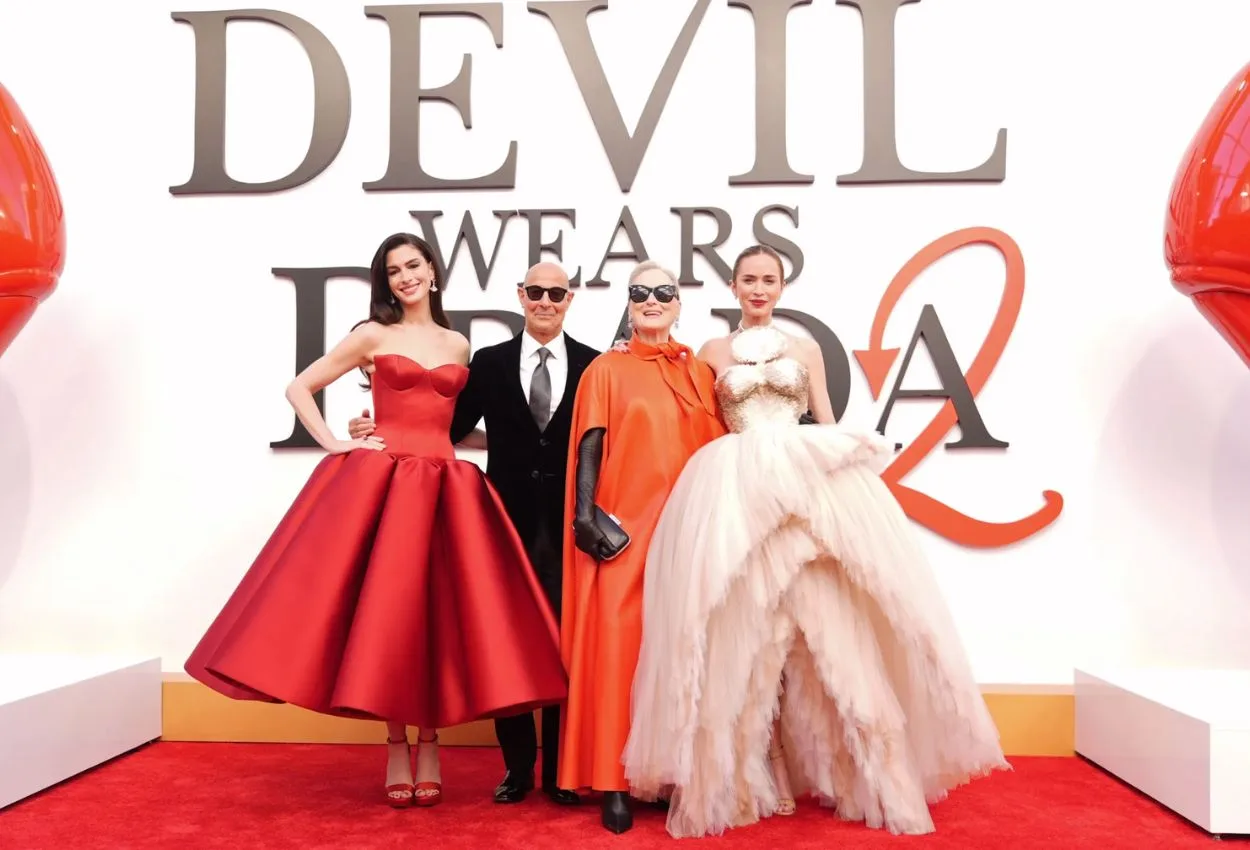
Ahead of the release of The Devil Wears Prada 2, trading and investing platform eToro has constructed a hypothetical ‘Miranda portfolio’ of heritage luxury stocks.
The portfolio, modelled on the selective instincts of Miranda Priestly, the formidable fictional editor at the centre of the franchise, returned 629 per cent from 2006 to April 2026.
The S&P 500 returned 442 per cent over the same period, whilst the S&P Global Luxury Index delivered 297 per cent.
What is the ‘Miranda Portfolio’?
The basket comprises seven heritage luxury names: Hermès, Richemont, L’Oréal, Kering, Burberry, Christian Dior and Ralph Lauren. Share price data was taken at market close on April 22, 2026, with performance calculated in US dollar terms and sourced from Bloomberg.
Hermès stands apart over the 20-year horizon, posting a return of 2,206 per cent. Ralph Lauren follows with 525 per cent, Richemont with 619 per cent, Christian Dior with 467 per cent and L’Oréal with 344 per cent.
At the lower end of the range, Burberry returned 92 per cent and Kering 149 per cent – figures that, whilst positive over two decades, underline that not all luxury names are equal.
| Brand | 1 Year | 3 Years | 5 Years | 10 Years | 20 Years |
|---|---|---|---|---|---|
| Hermès | -26% | -12% | 59% | 459% | 2,206% |
| Richemont | 14% | 16% | 93% | 198% | 619% |
| L’Oréal | -2% | -17% | -2% | 121% | 344% |
| Kering | 46% | -55% | -64% | 78% | 149% |
| Burberry | 77% | -50% | -44% | -11% | 92% |
| Christian Dior | 3% | -44% | -24% | 202% | 467% |
| Ralph Lauren | 85% | 236% | 215% | 311% | 525% |
| Basket Average | 28% | 11% | 33% | 194% | 629% |
| S&P Global Luxury Index | 17% | -2% | -3% | 126% | 297% |
| S&P 500 | 34% | 71% | 72% | 238% | 442% |
“If Miranda had built a portfolio in 2006, she would not have chased novelty or short-term momentum. She would have prioritised heritage, scarcity and brand power that does not depend on the moment. That instinct maps closely to what has driven long term outperformance in luxury equities. The strongest names in the sector operate more like compounders than cyclical plays. They tend to share a very specific set of traits: protected pricing, limited supply and the confidence not to chase the market fads. Hermès has rarely discounted. Ralph Lauren spent years being considered unfashionable by the fashion industry. L’Oréal kept selling the same products through every cycle. These may not be exciting investment stories in the short term, but they have been very resilient over the long run,” Lale Akoner, Global Market Strategist at eToro said in a statement.

The 20-year story is, however, a contrast to shorter-term performance. Over the past decade, the basket returned 194 per cent, compared with 238 per cent for the S&P 500. Over five years, the basket is up 33 per cent, whilst the three-year and one-year returns stand at 11 per cent and 28 per cent respectively.
Luxury stocks have come under renewed pressure in recent weeks, with Middle East tensions weighing on tourism and demand across the sector.
“Luxury is often treated as a single trade, but the reality is far more selective. The performance dispersion, i.e. the gap between the best and worst performers, is substantial and that reflects differences in brand positioning, execution, and exposure to aspirational versus ultra high-end demand. Over shorter timeframes, however, the sector behaves much more like a cyclical trade. Demand is sensitive to global liquidity, consumer confidence, and tourism flows, particularly in key markets such as the US and China. That explains why the recent performance has been volatile, despite the strength of underlying brands,“ she added.
Over two decades, the strongest heritage brands have demonstrated an ability to protect pricing, preserve exclusivity and defend margins through multiple economic cycles. For investors, the data suggests that selection, rather than broad sector exposure, has been the determining factor.