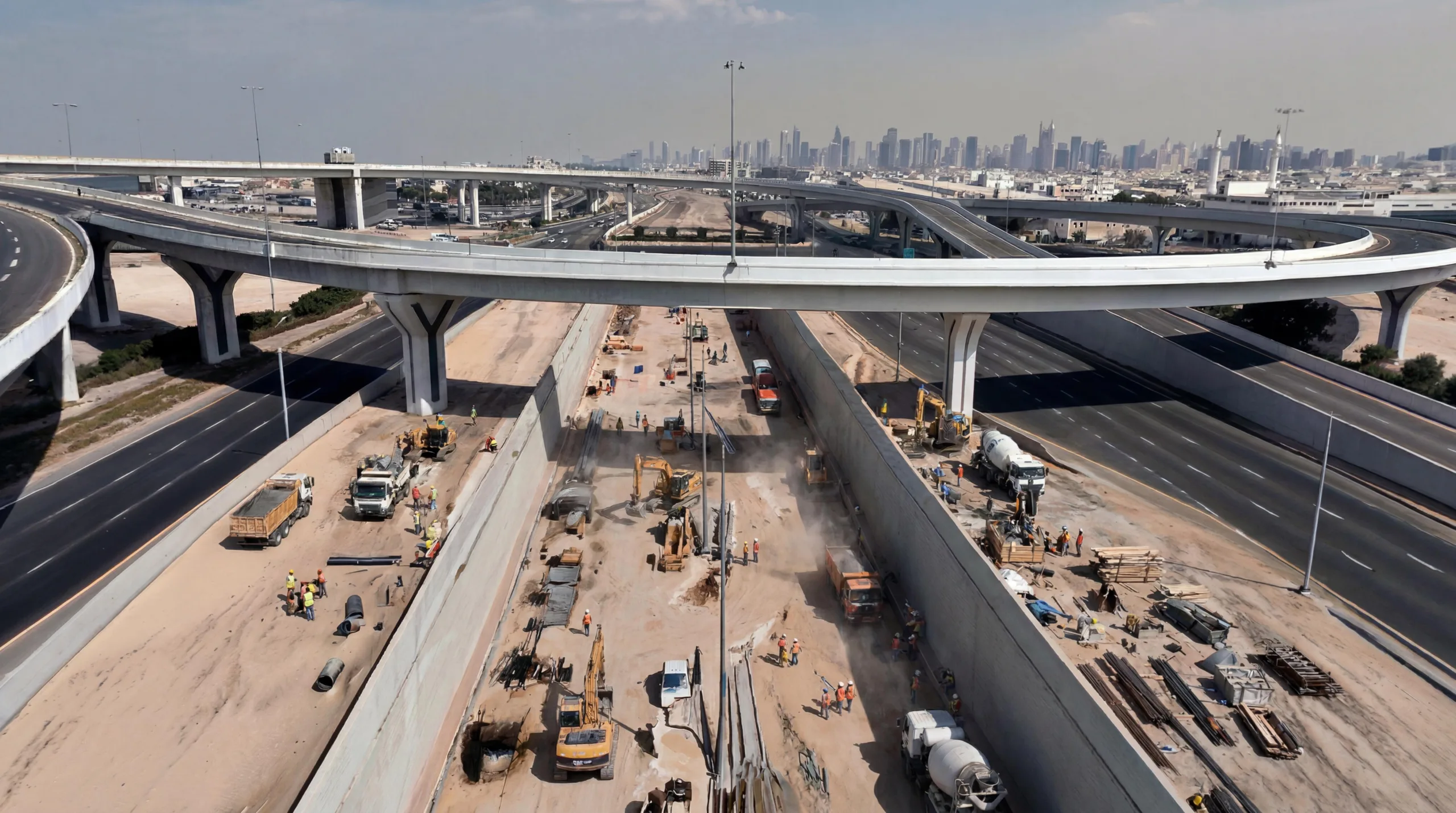
Dubai’s Roads and Transport Authority (RTA) has completed 80 per cent of the Al Khaleej Street Tunnel, a 1,650-metre underground passage running from the end of the Infinity Bridge ramp in Deira to the junction of Al Khaleej Street and Al Wuheida Street. The tunnel carries three lanes in each direction and is designed to handle up to 12,000 vehicles per hour across both carriageways.
The tunnel forms part of the broader Al Shindagha Corridor Improvement Project, which RTA describes as one of its largest active undertakings. The corridor stretches 13 km across Sheikh Rashid Street, Al Mina Street, Al Khaleej Street and Cairo Street, encompassing 15 intersections. It connects several key communities and development areas including Dubai Islands, Waterfront Market, Dubai Maritime City and Port Rashid.
“The construction of Al Khaleej Street Tunnel forms part of Al Shindagha Corridor Improvement Project, one of the largest projects currently being undertaken by RTA. The corridor extends 13 km along Sheikh Rashid Street, Al Mina Street, Al Khaleej Street and Cairo Street, and includes the development of 15 intersections. It serves several key residential communities and development projects, most notably Dubai Islands, Waterfront Market, Dubai Maritime City and Port Rashid. The project is estimated to serve one million people and reduce journey time from 104 minutes to 16 minutes by 2030,” Mattar Al Tayer, Director General, Chairman of the Board of Executive Directors of the Roads and Transport Authority, said in a statement.
“The project includes the construction of a 1,650-metre tunnel with three lanes in each direction, providing free-flow traffic movement between Infinity Bridge and Deira, and vice-versa. It also includes converting roundabouts on Cairo Street and Al Wuheida Street into signalised intersections, carrying out improvements on Cairo Street, and connecting the ramp from Dubai Islands to the new tunnel on Al Khaleej Street towards Al Mamzar. The project serves Abu Hail, Al Wuheida and Al Mamzar, in addition to development projects including Dubai Islands, Waterfront Market and Al Hamriya Port,” he added.
On site, 14 teams are working around the clock on excavation support, including retaining walls built with secant piles for deep sections and sheet piles for medium-depth ones. Four separate teams are advancing tunnel excavation at a daily rate of 5,000 to 6,000 cubic metres, a figure RTA says will increase to 8,500 cubic metres per day in the next phase.
The first phase of structural works covers 890 metres, representing 65% of total tunnel structure works. The second phase, extending 760 metres, is ongoing. Tunnel wall cladding, road paving, lighting, traffic signal installation, drainage networks, and utility diversion works are all running in parallel.
The project has logged nearly 8 million work hours since launch, with no lost-time injuries recorded. A workforce of 1,591 engineers, technicians and workers, supported by 221 pieces of machinery, is deployed across sites.
The tunnel will also carry a public art commission as part of Dubai’s Tunnels initiative. Emirati artist Maryam Hathboor has designed a mosaic mural inspired by banknote illustration, depicting Dubai’s skyline through fine linework. The artwork will span the tunnel’s length, with details revealing themselves progressively as drivers move through, and will include a representation of Infinity Bridge among the city’s newer landmarks.
RTA says it completed Al Shindagha Corridor works on the Bur Dubai side in 2025. A separate bridge project is now underway to provide direct access between Dubai Islands and Bur Dubai, spanning approximately 1,425 metres across Dubai Creek with four lanes in each direction and a capacity of around 16,000 vehicles per hour.
The bridge will rise 18.5 metres above the Creek’s water level with a 75-metre navigational channel, and will include a dedicated pedestrian and cycling track with lift access at both ends. The project is scheduled for completion in the fourth quarter of this year.