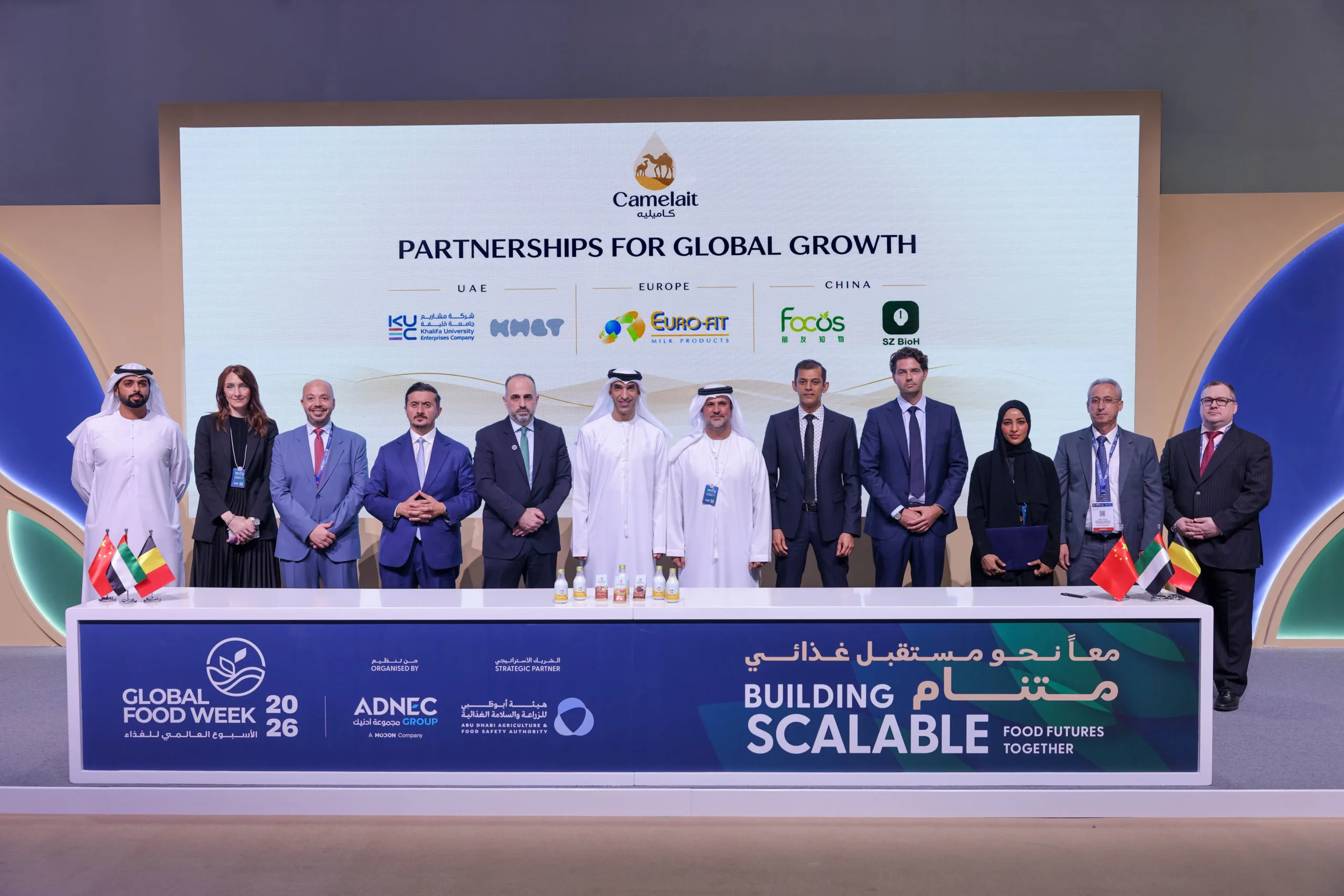
Al Ain Farms Group has unveiled a new identity for Camelait, its camel milk brand, and signed a set of agreements at Global Food Week in Abu Dhabi to expand production into Germany and China, while deepening research ties in the UAE.
The company, which has been producing camel milk since 2001, is building on a model that prioritises manufacturing close to end markets rather than exporting from the UAE. In Europe, the Group is progressing plans with Belgium-based Eurofit to establish a joint venture in Abu Dhabi Global Market, with Germany serving as the regional hub.
Initial production will focus on UHT camel milk in glass bottles, with plans to extend into other value-added formats targeting the nutrition and supplements segment. In China, Zhejiang Hengsheng Holding will act as exclusive distributor, with Suzhou Biology Healthy Technology Co., Ltd handling local manufacturing of long-life camel milk products.
On the research side, a new collaboration with Khalifa University and Khalifa University Enterprises Company will work to translate existing camel milk research and patented food innovations into commercial applications. The partnership is also intended to connect food-science students with industry.
“Under the guidance of our wise leadership, the UAE continues to build a competitive economic model rooted in innovation, knowledge, and openness to global markets. This model transforms our national strengths and resources into Emirati products and brands that create added value and compete on the global stage. By aligning research and development with the capabilities of our private sector and our international partners, we are enabling Emirati companies to refine their products, enhance their competitiveness, and access new markets,” Dr. Thani bin Ahmed Al Zeyoudi, UAE Minister of Foreign Trade said in a statement.
“Camelait is a compelling example of how Emirati companies can combine authenticity with innovation, taking a product rooted in our heritage and building it into a brand with genuine global potential. Its new production and marketing partnerships in Germany and China demonstrate the value of quality international partnerships in opening new avenues for Emirati products and strengthening our private sector’s contribution to global trade. Success stories such as this reinforce the UAE’s position as a global hub for trade and business, and a launchpad for Emirati brands in markets worldwide,” he added.
“Some of the greatest opportunities in food come from recognising new potential in what has long been valued. Camel milk extends well beyond what the category represents today, and we believe the time has come to develop it at a much greater scale. Through investment, science and international collaboration, our ambition is to unlock new value from camel milk and establish it as a modern functional nutrition category with global relevance. With Camelait, we intend to lead that development,” His Excellency Tareq Abdulraheem Al Hosani, Chairman of the Board at Al Ain Farms Group said.
The announcements follow Codex Alimentarius Commission approval of a UAE-led initiative to develop the first international standard for pasteurised camel milk, a move intended to harmonise quality criteria and support confidence in the category as cross-border trade develops.
Al Ain Farms Group points to Grand View Research forecasts placing the global camel milk market at approximately $24 billion by 2030, growing at a compound annual growth rate of 9.4 percent.
Camelait’s product pipeline beyond fresh milk includes long-life formats, value-added powders for different age groups, and applications across confectionery and personal care. The Group said it is open to further partnerships in the GCC and internationally.