
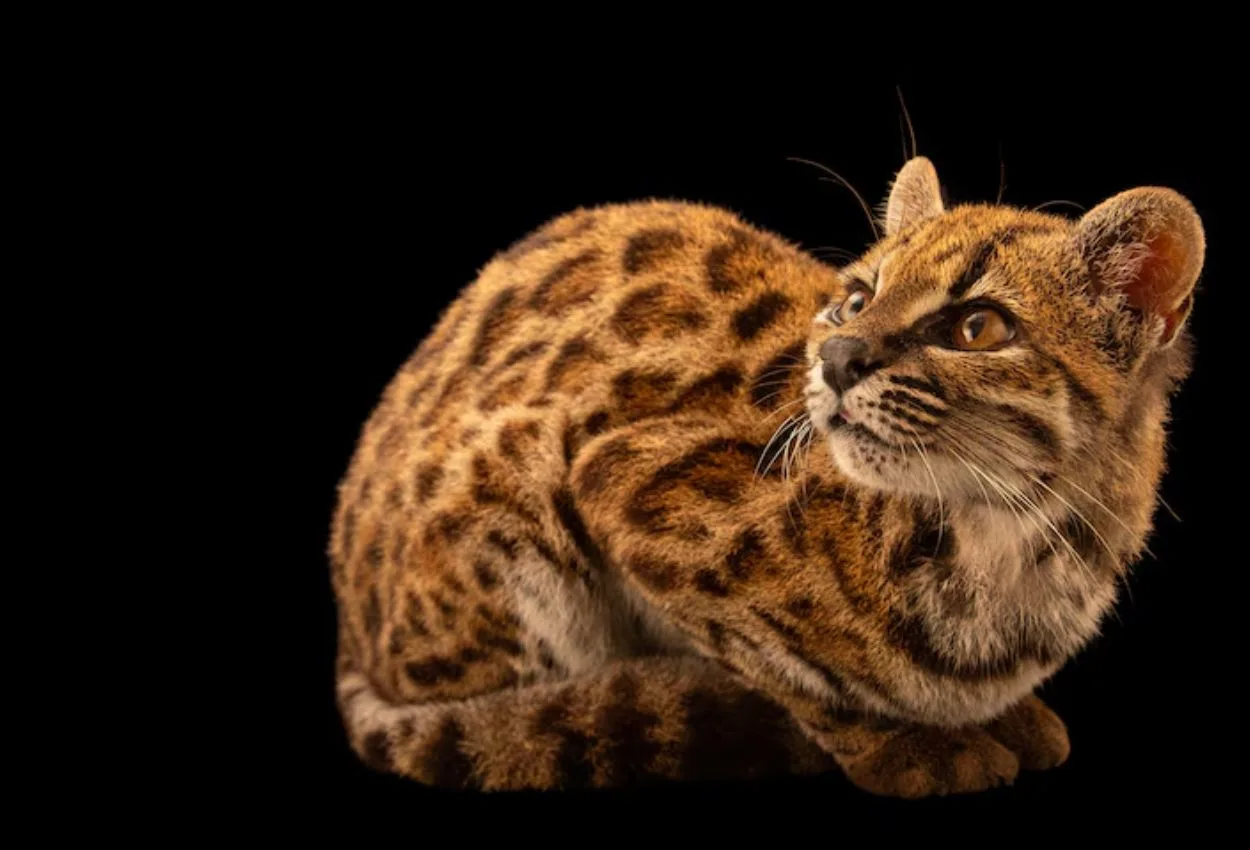
A wild cat discovered at a Bolivian sanctuary a decade ago has been formally identified as a new species, according to a study published in the journal Current Biology on September 17. Named Leopardus tilcayo, it is the first new cat species described by science in over 100 years.
The story begins in 2016, when Paola Nogales-Ascarrunz, a biologist and founder of the Bolivian Felids Research Program, was called in to look at an unusual animal at the Senda Verde wildlife sanctuary.
A local man had found it as a kitten on a road, assumed it was a domestic breed, and kept it for roughly a year before recognising it was plainly wild. The cat had a small, scrunched face, short round ears, long whiskers, and large leopard-like rosettes that didn’t match known species in the region.
“I took a hundred pictures of it,” Nogales-Ascarrunz recalled. “I was so fascinated.”
She initially assumed the cat belonged to Leopardus tigrinus, a spotted species known across parts of Central and South America. The doubts set in years later, when she noticed the rosettes were far larger than those of tiger cats documented across the border in Brazil.
Genomic analysis, carried out with Eduardo Eizirik of the Pontifical Catholic University of Rio Grande do Sul and Jonas Lescroart of the University of Antwerp, confirmed the animal was not only a distinct species but had diverged from its closest relatives approximately 1.4 million years ago, an evolutionary distance comparable to the gap between modern lions and extinct cave lions.
The species takes its name from the local word for the animal. Nogales-Ascarrunz asked community members why they called it tilcayo. “They said, ‘I don’t know! My grandpa called it tilcayo, so I call it tilcayo,’” she said.
The discovery reshapes more than just the scientific record. What researchers once classified as a single widespread species has now been split five ways. A 2013 study divided L. tigrinus into two distinct species; a 2024 paper peeled off a third; this latest work adds a fourth and fifth, with the study also proposing a new tiger cat subspecies in Peru, Leopardus tigrinus antisuyо.
The methods used may now point toward further discoveries: James Sanderson, founder of the Small Wild Cat Conservation Foundation and a member of the IUCN Cat Specialist Group, said the findings also hint that the margay, long assumed to be one species ranging from Mexico to Argentina, may in fact be four.
“What we once thought to be a single species, we’ve started to see that it was actually a species complex,” said Eizirik.
The conservation implications are direct. When a single far-ranging species is reclassified as five smaller, geographically distinct ones, each population must be assessed for endangerment separately.
“Once three species become five species, each population is reduced,” Sanderson said. “Therefore conservation efforts must increase, perhaps urgently, depending on estimated population sizes.” Scientists do not yet know how many L. tilcayo individuals exist in the wild, or much else about how they live, what they eat, or what threatens them.
Nogales-Ascarrunz, who is co-lead author of the paper, is careful not to lose the larger point. “Our world is extremely complex,” she said. “Sometimes we think that most of it is known, that there’s not a whole lot to discover, but in fact, it’s the other way around.”