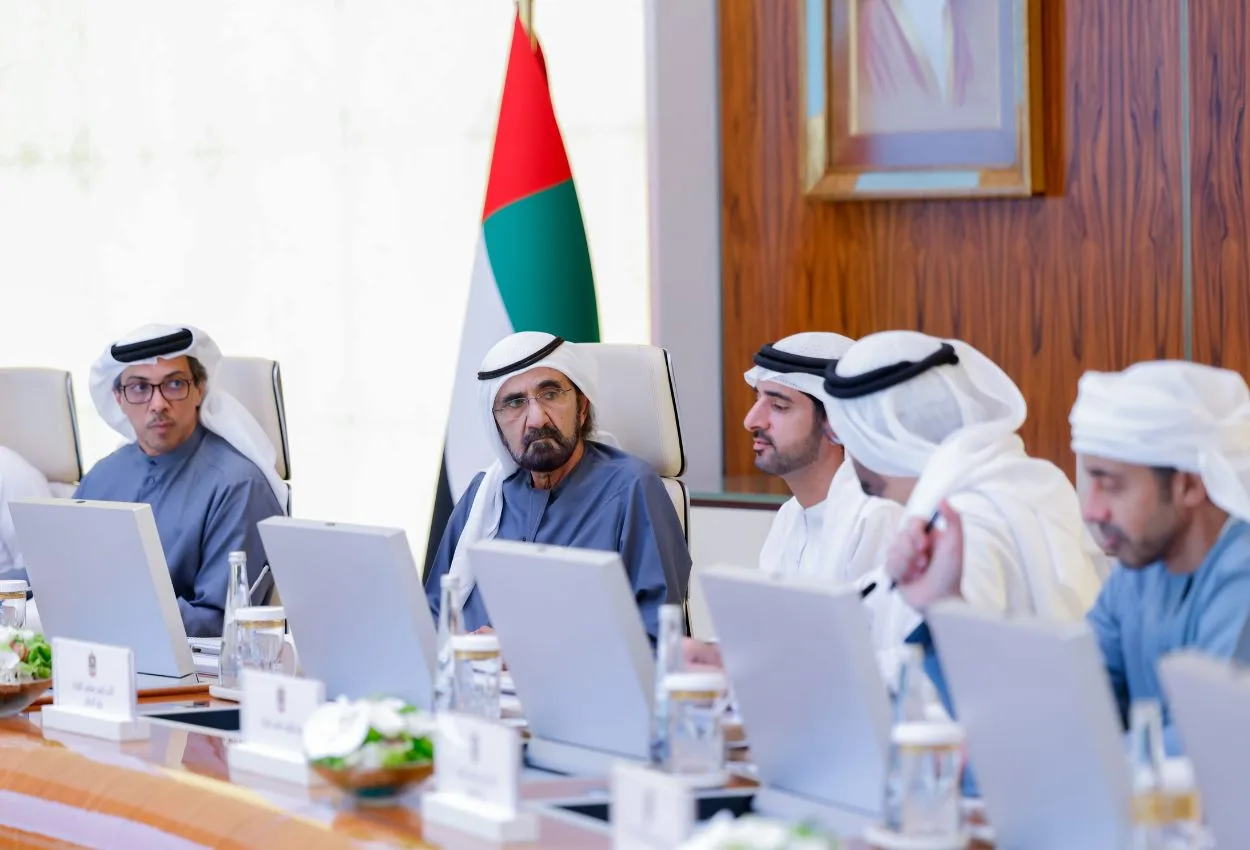
The UAE Cabinet, chaired by Sheikh Mohammed bin Rashid Al Maktoum, Vice President, Prime Minister and Ruler of Dubai, has announced a framework to deploy Agentic AI across 50 per cent of government sectors, services, and operations within two years.
The announcement was made during a Cabinet meeting attended by Sheikh Mansour bin Zayed Al Nahyan, Vice President, Deputy Prime Minister, and Chairman of the Presidential Court; Sheikh Hamdan bin Mohammed bin Rashid Al Maktoum, Crown Prince of Dubai, Deputy Prime Minister and Minister of Defence; Sheikh Maktoum bin Mohammed bin Rashid Al Maktoum, First Deputy Ruler of Dubai, Deputy Prime Minister, and Minister of Finance; and Sheikh Abdullah bin Zayed Al Nahyan, Deputy Prime Minister and Minister of Foreign Affairs.
“Under the directives of President His Highness Sheikh Mohamed bin Zayed Al Nahyan, we announce today a new UAE government framework aiming to transform 50% of UAE Government sectors and services within two years to Agentic AI for autonomous execution and decision-making. Our government will be the first government in the world to largely deploy Agentic AI models across its government sectors and operations,” Sheikh Mohammed bin Rashid Al Maktoum said in a statement.
Sheikh Mohammed bin Rashid unveils UAE agentic AI government framework
”Today, AI models can monitor changes, provide analyses, offer recommendations, manage operations, and run an independent series of actions without human intervention… AI will be our government executive partner to support decisions, enhance services, boost the efficiency of operations, and even evaluate results and introduce improvements in real time,” he added.
The transformation carries a defined two-year timeline, and the performance of ministers, directors general, and government entities will be assessed against their capacity to adopt and implement the change.
“As per the directives of His Highness President of the UAE, this transformation’s defined timeline is two years. During that period, the performance of ministers, directors general, and entities will be assessed based on their ability to adopt this transformation, their speed in implementing the new standards… their understanding of the world new technological reality, and their mastery of artificial intelligence tools to create new work mechanisms for future government,” he further explained.
The project will be rolled out in phases across ministries and federal entities, with continuous performance and impact assessments to guide the wider rollout.
A taskforce has been formed to drive execution of the framework. It will be overseen by Sheikh Mansour bin Zayed and chaired by Mohammad Abdullah Al Gergawi, Minister of Cabinet Affairs.
“Sheikh Mansour bin Zayed will oversee the implementation of the UAE President’s vision of this major governmental transformation. We have formed a dedicated taskforce, chaired by Mohammad Al Gergawi, to drive execution. The world is changing. Technology is advancing and accelerating. But one principle remains unchanged. People come first. Our goal is to create the best environment to unlock their potential, improve their lives, and build a better government, a government that is faster, more responsive, and more impactful,” Sheikh Mohammed said.
The initiative places emphasis on developing national capabilities. Sheikh Mohammed bin Rashid said: “We will support all federal government employees to master AI tools through continuous specialized training… Our goal is to fully engage them in this transformation… As a result, we will have the best experts in the world in government transformation towards artificial intelligence technologies… Our government is proud of all its employees… It will train them and further build their capabilities to manage the largest transformative government project during the next two years.”
The move to Agentic AI builds on 20 years of digital transformation in the UAE, spanning eGovernment, service digitalisation, mobile government, and integrated systems such as the UAE Pass identity verification system, as well as programmes such as Government Services 2.0, which introduced data-driven service delivery.
In 2017, the UAE became the first country in the world to appoint a Minister of State for Artificial Intelligence and launched the UAE Artificial Intelligence Strategy 2031 under the UAE Centennial 2071 vision. The Ministry of Artificial Intelligence, Digital Economy and Remote Work Applications was established in 2020 to further advance this direction.
During the meeting, the Cabinet approved a series of resolutions to strengthen the government services ecosystem. These included the UAE Code for Government Services and Zero Bureaucracy, which establishes unified national policies and standards to improve service quality, simplify procedures, and accelerate digital transformation across the federal government, replacing fragmented approaches with a single federal reference model.
The Cabinet also approved a government services digital records policy to establish a national framework for managing government services data, defining digital records as the official source of core data and ensuring continuous data quality.
A government services data sharing policy was also approved, based on the principle of collecting data once and using it securely across entities. It sets governance rules, ensures integration across federal and local entities and the private sector, and supports economic growth while safeguarding privacy.
In addition, the Cabinet approved a federal guide to aligning digital government projects with national priorities, promoting the efficient use of resources, encouraging the reuse of capabilities such as digital identity and digital wallets, and introducing governance mechanisms to strengthen planning and execution.
The Cabinet approved a series of further initiatives, including a Geographical Indication framework to protect and promote national products and a Digital Postal Addressing System to support logistics, geospatial capabilities, and smart city development.
The Higher Committee for Free Trade Negotiations was reconstituted, chaired by Dr. Thani bin Ahmed Al Zeyoudi, Minister of Foreign Trade, with members including Suhail bin Mohammed Al Mazrouei, Minister of Energy and Infrastructure; Mohamed bin Hadi Al Hussaini, Minister of State for Financial Affairs; Dr. Sultan bin Ahmed Al Jaber, Minister of Industry and Advanced Technology; Abdulla bin Touq Al Marri, Minister of Economy and Tourism; Mohamed bin Hassan Al Suwaidi, Minister of Investment; Ahmed Al Sayegh, Minister of Health and Prevention; Saeed Mubarak Al Hajeri, Minister of State; Khaled Mohamed Balama, Governor of the Central Bank of the UAE; Khaldoon Khalifa Al Mubarak, Member of Abu Dhabi Executive Council, and Chairman of the Executive Affairs Authority of Abu Dhabi; Abdulla Al Basti, Secretary-General of The Executive Council of Dubai; and Ahmed bin Lahej Al Falasi, Director-General of Customs at the Federal Authority for Identity, Citizenship, Customs and Port Security.
The Board of Emirates Development Bank was also reconstituted, chaired by Dr. Sultan bin Ahmed Al Jaber, with members including Abdulla bin Touq Al Marri, Minister of Economy and Tourism; Ahmed Tamim Al Kuttab, Chairman of the Department of Government Enablement in Abu Dhabi; Younis Haji Al Khoori, Under-Secretary of the Ministry of Finance; Hassan Jassim Al Nowais, Under-Secretary at the Ministry of Industry and Advanced Technology; Mohamed Saif Al Suwaidi, Director-General of Abu Dhabi Fund for Development; Abdulwahed Al Fahim, Chairman of Nasdaq Dubai; Khalfan Belhoul, Chief Executive Officer of Dubai Future Foundation; Najla Al Midfa, Chief Executive Officer of Sharjah Entrepreneurship Center; and Mariam Saeed Ghobash, Director of International Affairs at Abu Dhabi Investment Company.
Biofuel, energy efficiency and conservation on the Agenda
On sustainability, the Cabinet reviewed progress under the National Biofuel Policy 2025, including projects to convert approximately 500,000 tonnes of waste into sustainable aviation fuel, a biodiesel plant with an annual production capacity of 20 million litres, and a facility planned for Fujairah with an investment of $300 million.
The Cabinet launched a global alliance for energy efficiency as an international initiative led by the UAE to accelerate climate action and support sustainable development goals.
It also approved a national plan for the conservation of ivory and rhinoceros, reflecting the UAE’s commitment to biodiversity protection, and approved the UAE’s accession to the International Accreditation Organisation to strengthen alignment with global standards and support international trade.
The Cabinet approved the ratification and signing of 16 international agreements and memoranda of understanding covering economic partnerships, humanitarian cooperation, visa facilitation, scientific research, labour, intellectual property, and marine sustainability.
The UAE will host World Mathematics Day events in 2026, as well as global conferences on biodiversity, food security, and the digital economy.