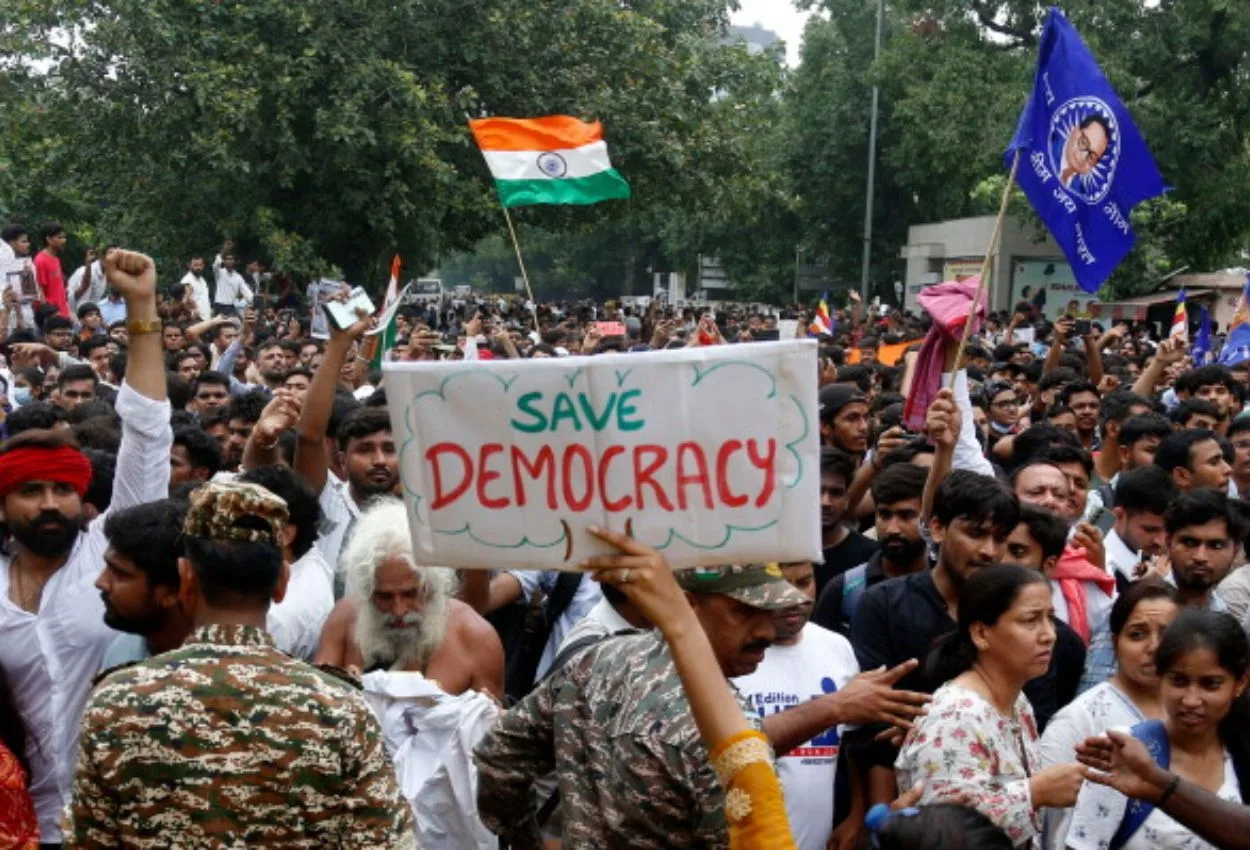
India’s Cockroach Janta Party (CJP) has kept its protest alive at Delhi’s Jantar Mantar, two days after police used tear gas and batons to block supporters marching towards Parliament.
The protesters are demanding the resignation of Education Minister Dharmendra Pradhan over the cancellation of India’s undergraduate medical entrance examination following a question-paper leak.
The government has promised to discuss the examination and consider reforms, but movement leaders have said they will remain at the protest site until their demands are met.
How the Cockroach Janta Party began
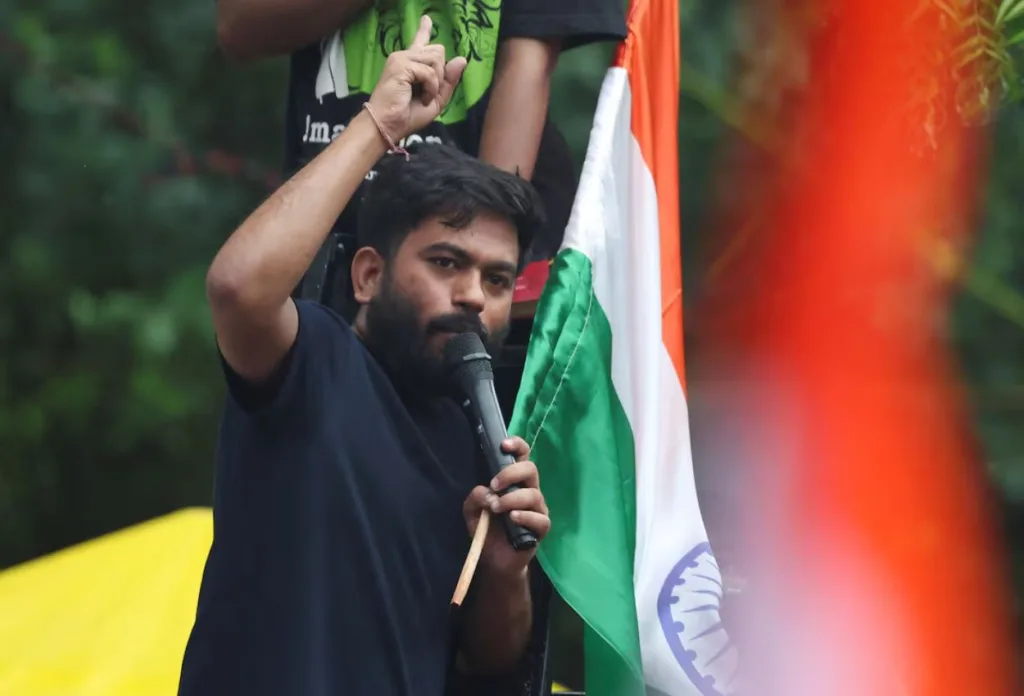
The Cockroach Janta Party, known as the CJP, appeared on social media on May 16, 2026.
Its founder, Abhijeet Dipke, said the idea began as an impulsive response to remarks by India’s chief justice Surya Kant, who had referred to unemployed young people as “parasites” and “cockroaches” during a Supreme Court hearing.
He then posted a question on social media: “What if all cockroaches came together?”
Kant later said he had not intended to criticise young people. He said he had been referring to people with “fake and bogus degrees”, whom he described as being “like parasites”.
The CJP describes itself as the “Voice of the Lazy and Unemployed”. Its social media content discussed unemployment, inflation, politics, media independence, women’s representation and failures in the examination system.
By May 21, five days after its formation, the group had nearly 15 million followers on Instagram. Dipke said more than 400,000 people had submitted a membership form and that more than 70 per cent were aged between 19 and 25.
Dipke, who was 30 and based in Boston, told Reuters: “This is a movement to change the political discourse of India. The youth of India has largely vanished from the mainstream political discourse. Nobody is talking about us. Nobody is listening to our issues or even trying to acknowledge our existence.”
Why the NEET cancellation became the focus
The immediate cause of the protests was the cancellation of the National Eligibility cum Entrance Test, or NEET, after examination questions were found to have been leaked.
About two million candidates took the examination on May 3, 2026. Authorities later cancelled it and held another examination in June.
Reuters reported that about a dozen deaths by suicide had been linked to the cancellation. The examination is the route into undergraduate medical courses in India, with candidates competing for fewer than 150,000 places.
Leaks have also affected other examinations in India, including tests for police and teaching posts. NEET questions were leaked in parts of the country in 2024, although authorities did not order another examination that year.
By June 1, the CJP had more than 22 million Instagram followers. Dipke said nearly 800,000 people had signed a petition calling for Pradhan to resign.
The first Cockroach Movement street protest
The CJP held its first street protest in New Delhi on June 6. A few hundred people gathered near Jantar Mantar and called for Pradhan’s resignation over examination leaks and marking errors.
“Cockroach Janta Party is not a planned party,” Dipke told the gathering. “This is a voice of those students that are angry with the government.”
By that date, the movement’s X account had been blocked in India. The CJP challenged the block in a Delhi court. Unknown men slapped Dipke during a protest in Jaipur on June 15.
Dipke said the attack was an attempt to frighten him and the movement. The identities and motives of the men had not been established in the Reuters report.
Sonam Wangchuk begins hunger strike
Education reformer and activist Sonam Wangchuk began a hunger strike on June 28 in support of the movement. Police removed the 59-year-old from the Jantar Mantar protest site on July 18 and took him to a government hospital against his wishes.
Police said they were acting under a court order that required them to monitor his health and intervene if it worsened. Wangchuk’s wife petitioned the Delhi High Court, alleging that he was being held in “illegal detention.” On July 21, the court allowed him to be transferred to a private hospital.
Protesters march towards Parliament
Police had denied permission for a CJP march towards Parliament on July 20, the opening day of Parliament’s monsoon session. Thousands of supporters gathered at Jantar Mantar and attempted to march towards Parliament. Police used tear gas and batons to stop them.
Protests also took place in Bengaluru, Mumbai and Goa. Police detained protesters in Mumbai, while demonstrators held a candlelight vigil in Goa. Delhi Police said 118 members of the police and security services and 60 protesters were injured during the confrontation.
Dipke said more than 150 protesters were receiving hospital treatment. Reuters said it could not independently verify the injury totals.
Delhi Police accused protesters of aggressive and violent behaviour and of violating restrictions in force. The CJP said police had beaten protesters and apologised to supporters who were injured.
What the Cockroach Movement is demanding
Currently, there are three demands presented by the movement to the government:
- The resignation of Education Minister Dharmendra Pradhan.
- The release of Sonam Wangchuk.
- Compensation of ₹10 million for each of about a dozen students whose deaths by suicide followed the examination leak.
The Delhi High Court order allowing Wangchuk’s transfer to a private hospital fulfilled one of the three demands, Reuters reported.
The movement has also raised concerns about examination leaks, marking errors and unemployment. These are issues associated with its campaign, but Reuters did not list each of them as a separate formal demand in the memorandum presented to the government.
Government holds talks with CJP leaders
Health Minister J.P. Nadda met two CJP representatives on July 20. CJP spokesperson Ashutosh Ranka said Nadda had asked for time to discuss the demands within the government. Nadda said the representatives had submitted a memorandum after the meeting.
The government had not agreed to Pradhan’s resignation by July 22.
More than 5,000 protesters gathered at Jantar Mantar on July 21, one day after the Parliament march. The CJP said it would continue its protest but would not attempt another march towards Parliament because it feared further police action.
Congress leader Rahul Gandhi, his sister Priyanka Gandhi Vadra and other Congress members held a sit-in outside the gates leading to Prime Minister Narendra Modi’s residence.
Police detained them after they refused to end the protest. They were released later on 21 July.
Modi responds to the examination leak
Modi addressed the examination issue calling it a “grave sin” on July 21 through comments reported by Parliamentary Affairs Minister Kiren Rijiju.
Rijiju said Modi had told members of the governing alliance that the authorities had acted after receiving reports of examination irregularities.
He said 13 people had been arrested and jailed, another examination had been held and those responsible for leaks would face punishment. Modi also called for an examination system designed to prevent further leaks, according to Rijiju.
Dharmendra Pradhan promises debate and reform
Pradhan issued his first response to the CJP protests in a post on X late on July 21.
“Our government remains 100% committed to discussing NEET and addressing every genuine concern of our youth on the floor of the house,” he said. “We owe them answers, reforms and accountability,” he added.
Pradhan also accused Congress of treating students as part of a political campaign.
Thousands of protesters continue to remain at Jantar Mantar on 22 July, according to Reuters.
Movement leaders said they would remain there until their demands were met. Opposition parties, including Congress, said they would raise the protesters’ case inside and outside Parliament.
As of the Reuters reports published on July 22, the government had promised discussion, examination reforms and punishment for people responsible for the leaks.
The CJP continued to demand Pradhan’s resignation and compensation for the families of students whose deaths by suicide were linked to the examination cancellation.
As of today, the CJP has amassed nearly 25 million Instagram followers.