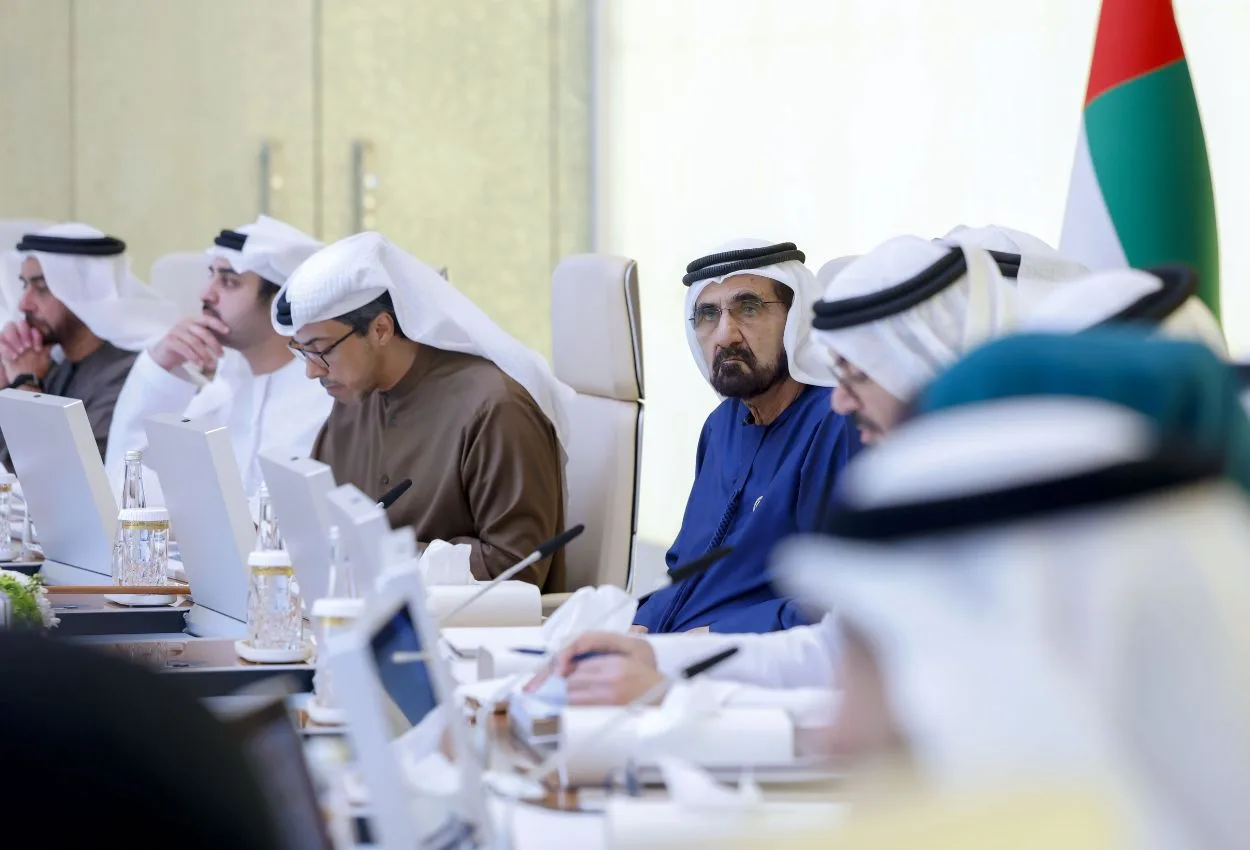
Sheikh Mohammed bin Rashid Al Maktoum, Vice President and Prime Minister of the UAE and Ruler of Dubai, has chaired a Cabinet meeting at Qasr Al Watan in Abu Dhabi, marking 20 years since he assumed the role of Prime Minister on January 5, 2006.
The meeting was attended by Sheikh Mansour bin Zayed Al Nahyan, Vice President, Deputy Prime Minister, and Chairman of the Presidential Court; Sheikh Hamdan bin Mohammed bin Rashid Al Maktoum, Crown Prince of Dubai, Deputy Prime Minister and Minister of Defence; Sheikh Maktoum bin Mohammed bin Rashid Al Maktoum, First Deputy Ruler of Dubai, Deputy Prime Minister, and Minister of Finance; Lt. General Sheikh Saif bin Zayed Al Nahyan, Deputy Prime Minister, and Minister of the Interior, and Sheikh Abdullah bin Zayed Al Nahyan, Deputy Prime Minister, and Minister of Foreign Affairs.
“Today, I chaired the Cabinet meeting at Qasr Al Watan, Abu Dhabi. In the meeting, we have reviewed the Cabinet’s achievements over the past 20 years. During that journey, the Federal government, through 16,000 resolutions, thousands of work teams, and with budgets exceeding AED1.1 trillion, has managed to reshape the structure of the governmental work in the UAE. Our government has made strides in streamlining government services, updating legislation, modernising all types of infrastructures, including technology, investment, digital, and legal frameworks, and transitioned to a new phase of developmental work,” Sheikh Mohammed said in a statement.
UAE leads world in 280 development indices after 20-year journey, says Sheikh Mohammed
“Under the leadership of my brother, President of the UAE, His Highness Sheikh Mohamed bin Zayed Al Nahyan, our country’s journey has become a role model of development. The UAE is currently leading the world in more than 280 development indices related to citizen well-being, education, health, and housing. We are also ranking at the top thanks to our trade and economic relations, our global standing in artificial intelligence, space industries, sovereign assets, our ability to attract the best talent, and our position as an economic hub connecting East and West.
“We decided, 20 years ago, to aim for the first place… some doubted… However, today – thank God – the UAE has become a model of development that other countries are imitating. Moreover, we are exporting this model to over 55 countries around the world. Excellence will continue under the umbrella of the Union. With the guidance of the leader of the Union, Mohamed bin Zayed, our future will be even better. We are full of hope and optimism. We assure our glorious People that a good life, of further excellence, pride, and glory, is yet to come for the future generations, God willing,” he added.
The Cabinet reviewed the 20-year journey since Sheikh Mohammed bin Rashid assumed the role of Prime Minister. The period featured the development of government work culture through the application of work systems that drove changes in progress, national gains, and the UAE’s standing.
The government launched the UAE Government’s first strategy in 2007 and the Government Performance System in 2008. Six strategic planning cycles have been implemented in the federal government.
Dubai Ruler reviews UAE Cabinet’s 16,000 resolutions, government modernisation journey since 2006
The UAE Vision 2021 was launched in 2011, aiming to make the UAE one of the best countries in the world by its Golden Jubilee. The National Agenda for the UAE Vision 2021 followed in 2014. The National Agenda’s teams were launched in 2016.
In 2017, the government launched the UAE Centennial 2071 plan, a vision for development spanning one hundred years, focusing on education, economy, and national identity.
The Preparing for the Next 50 Years project was launched in 2020, a programme to plan the next fifty years of the UAE. In 2021, a methodology for government work was launched to accelerate achievements, grant authority to ministries, and adopt a faster work style guided by the Principles of the 50.
The We Are the UAE 2031 plan was launched in 2022, focusing on the first ten-year agenda for implementing the UAE Centennial 2071 and presenting a vision and action plan for the next decade.
The Federal Government launched initiatives during the last 20 years. The Sheikh Khalifa Government Excellence Program was launched in 2006, followed by the UAE Government Leaders Programme in 2008. The Global Agenda Councils were hosted in 2008.
The Emirates Competitiveness Council was established in 2009, along with the launch of the Mohammed bin Rashid Government Excellence Award and the Government Experience Exchange Programme. The Emirates Government Service Excellence Program was launched in 2011.
The Mohammed bin Rashid Smart Learning Initiative was launched in 2012, followed by the inception of the World Governments Summit. The UAE Government Annual Meetings was launched in 2017. The Regulations Lab was launched in 2018, and the Arab Government Excellence Award was launched in 2019.
UAE Cabinet approves world’s first regulatory intelligence office powered by AI
The UAE appointed the world’s first AI minister in 2017 and launched a strategy to accelerate AI adoption across sectors.
In 2025, the UAE government established the world’s first Regulatory Intelligence Office, designed to transform the legal ecosystem from static texts into a framework powered by artificial intelligence.
The government launched the UAE legislation platform, the first digital platform for all federal and local legislation. The platform contains over 2,500 laws and regulations and attracts an average of one million visits per month.
The government adopted more than 350 national policies, strategies, and programmes in sectors during this period.
The UAE government spending exceeded AED1.1 trillion in the last two decades. The government budget has grown by 167%, from less than AED27 billion in 2006 to AED90 billion in 2026. The UAE ranked first on the Efficiency of Government Spending index.
Education received the portion of government expenditure with an allocation of over AED170 billion. The health and prevention sector received more than AED60 billion. Social development programmes were supported with over AED100 billion, and over AED55 billion was dedicated to citizen housing programmes.
The UAE’s real GDP scored a 94 per cent growth, from AED918 billion in 2006 to over AED1.77 trillion in 2024.
UAE non-oil trade surges 599% to $817 billion
Non-oil foreign trade experienced a surge of 599 per cent, from AED415 billion in 2006 to around AED3 trillion in 2024. Non-oil exports saw an increase of 1827 per cent, jumping from AED29 billion in 2006 to AED559 billion in 2024.
The UAE labour market has witnessed developments over the past twenty years. In the last five years, the number of labour market establishments has grown by 45.76 per cent. The workforce has increased by 101.76 per cent, the skilled workforce by 49.92 per cent, and women’s participation in the labour market by 101.92 per cent.
The Cabinet meeting highlighted the UAE’s rise in international competitiveness rankings, the result of efforts across federal and local governments teams and public and private sector institutions.
The UAE has ranked first in 279 international indicators and ascended into the top five countries in 525 indicators. The UAE now ranks among the top 10 countries in 738 indicators.
The Cabinet discussed the National Plan for Inscribing Cultural Heritage Elements on UNESCO Lists for 2026-2036. The plan is designed to register cultural heritage elements, enhancing the UAE’s standing, preserving heritage, and reinforcing identity.
The Cabinet reviewed the 2024 results of the UAE Tourism Strategy 2031. Achievements include an increase in hotel establishments and hotel rooms, reaching 1,252 and 217,000, respectively.
The Cabinet reviewed updates to the UAE Circular Economy Policy 2031. Teams will develop studies and policies, focusing on green government procurement, incentives for the circular economy sector, and programmes for water management and reuse.
UAE Cabinet approves new policy to boost healthcare for People of Determination
The UAE Cabinet approved a policy to enhance healthcare for the People of Determination. The policy focuses on providing them with healthcare throughout their lives.
The Cabinet approved the formation of the Higher Committee to oversee the National Strategy for Anti-Money Laundering, Countering the Financing of Terrorism and Proliferation Financing.
Chaired by Sheikh Abdullah bin Zayed Al Nahyan, Deputy Prime Minister and Minister of Foreign Affairs, members include the Minister of State for Financial Affairs, Minister of Economy and Tourism, Minister of Justice, the Governor of the Central Bank of the UAE, and heads of state security departments and federal authorities. The committee will operate under the mandate of Federal Decree-Law No. (10) of 2025.
The Cabinet approved the restructuring of the UAE Circular Economy Council, chaired by His Excellency Abdulla bin Touq Al Marri, Minister of Economy and Tourism.
The Cabinet approved the Guidebook for Sustainable Digital Services in the federal government. The guidebook aims to promote the adoption of renewable energy, leverage technologies like AI and cloud computing, and integrate practices into IT operations.
The Cabinet ratified two agreements: one with the Republic of Tajikistan concerning air services between and beyond their territories, and another with the Slovak Republic on economic cooperation.
The Cabinet approved the negotiation and signing of 21 international agreements and MoUs.