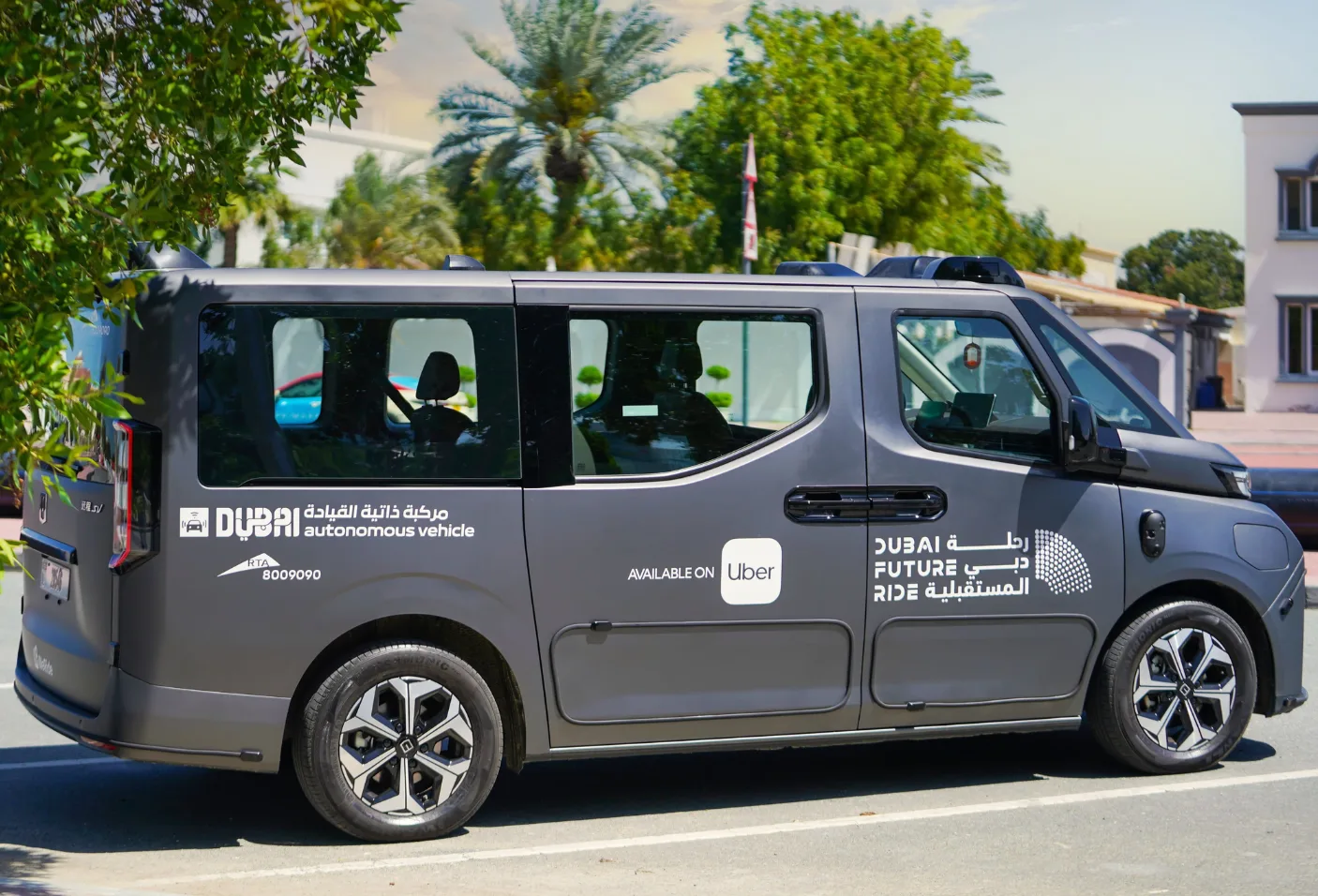
The Roads and Transport Authority (RTA) in Dubai has begun commercial operations of its autonomous taxi service in the districts of Umm Suqeim and Jumeirah, in partnership with Apollo Go and WeRide (Nasdaq: WRD).
“The commencement of commercial operations further reinforces Dubai’s position as an ideal destination for the expansion of global autonomous driving companies, supported by its advanced infrastructure, clear strategic vision, and the readiness of its smart systems. It also contributes to achieving the objectives of the Dubai Self-Driving Transport Strategy, and strengthening Dubai’s standing as a global leader in adopting future mobility solutions,” the Dubai Media Office (DMO) said in a statement.
RTA Dubai deploys 100 self-driving taxis in partnership with WeRide, Apollo Go
WeRide vehicles are available to the public through the Uber app, with Tawasul Transport responsible for fleet management and operations.
Apollo Go, a subsidiary of Baidu, provides autonomous mobility services through its own app in collaboration with the Dubai Taxi Company, which supports local operations.
Both platforms are now live in Umm Suqeim and Jumeirah – two neighbourhoods located near public beaches – allowing users to book journeys through either application.
The first phase of the commercial rollout includes the deployment of 100 autonomous taxis within Dubai’s transport network. The RTA has indicated plans for the gradual expansion of the fleet in the coming years, in line with growing demand for smart mobility and the emirate’s direction towards advanced transport technologies.
The launch contributes to the objectives of the Dubai Self-Driving Transport Strategy and, according to the authority, reinforces Dubai’s position as a destination for the expansion of autonomous driving companies, supported by its infrastructure, strategic vision, and smart systems.
In the lead-up to the launch, a series of operational trials was conducted on roads across Dubai to evaluate system performance and ensure readiness within the emirate’s traffic environment.
Autonomous vehicles operate within a system powered by artificial intelligence, sensing technologies, and autonomous decision-making systems.
The vehicles use high-definition digital maps and deep learning algorithms, enabling data processing and decision-making during operation.
The system allows vehicles to interact with traffic conditions, including intersections, traffic signals, pedestrians, and other vehicles, while complying with traffic regulations.
The operator’s fleet has accumulated more than 150 million kilometres of safe driving and completed over 10 million autonomous trips across cities worldwide. This track record has, according to the RTA, enabled the development of operating models for commercial deployment.