
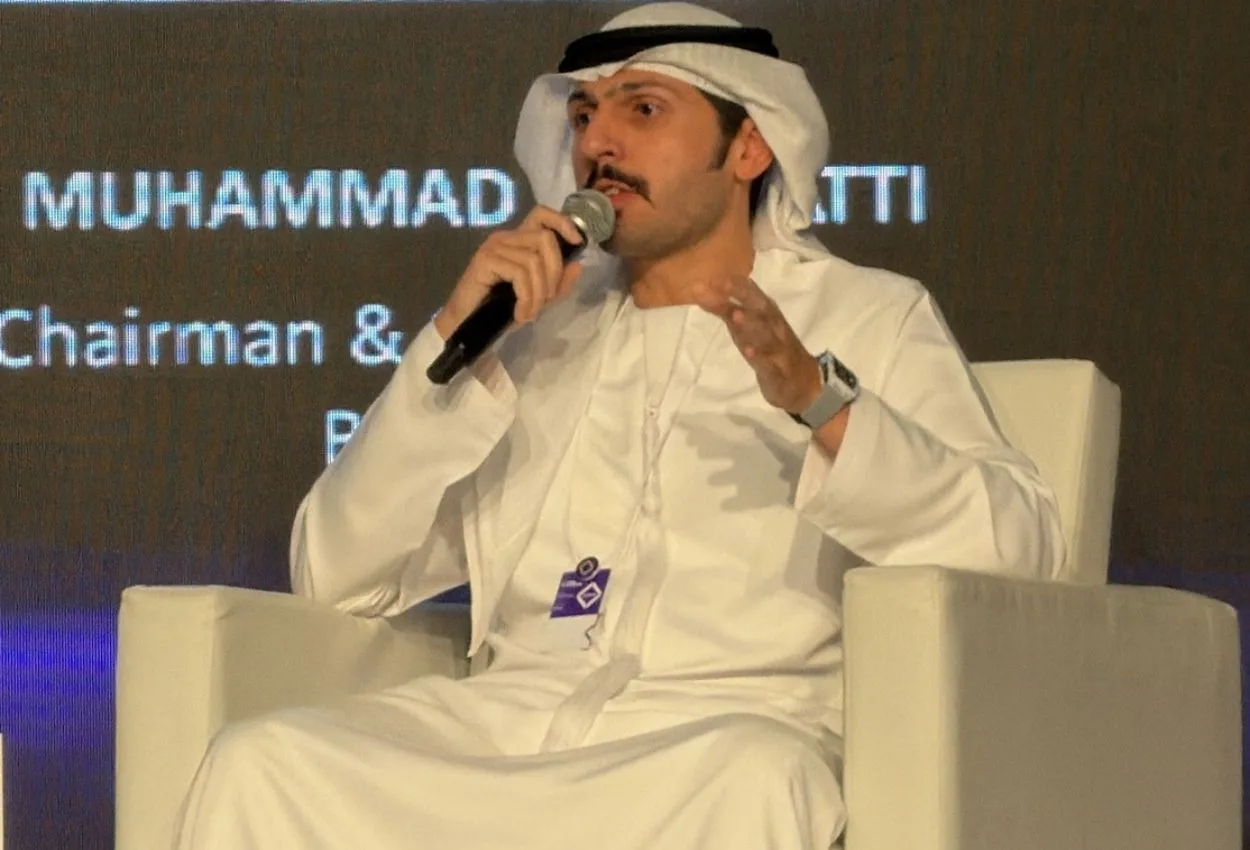
Property developers risk losing customer leads by relying on artificial intelligence (AI) for sales and customer interactions, according to Muhammad Binghatti, Chairman and Chief Architect of BinGhatti, who urged the real estate sector to focus on automating administration and operations instead.
Speaking at the Dubai AI Festival 2026, Binghatti said the technology has the potential to change how properties are designed, constructed and managed. However, he warned that using AI without considering costs, customer relationships and the limitations of the technology could undermine the benefits developers expect to achieve.
“Don’t wait for AI to change your industry, be among those who change their industry through AI,” Binghatti told the audience.
He also predicted that the future of housing would move beyond the marketing of luxury properties towards communities designed for groups such as athletes, entrepreneurs and people seeking wellness-related lifestyles.
AI in real estate: Three questions developers must ask before investing
Binghatti said developers should evaluate AI solutions by asking whether they solve a problem, whether the cost of implementation is justified and whether the technology will remain relevant as customer expectations evolve.
“The first question I would ask is, does this technology solve a problem? Does it solve a real problem that exists?” he said.
“Can I use AI to reduce construction efficiency issues? Can I use AI to reduce building maintenance? And these are real problems we deal with on a day-to-day basis in property development.”
He said addressing such problems would establish a use case for AI, rather than introducing the technology because of interest surrounding it. However, he warned that the cost of implementing AI could exceed the savings it delivers.
“I think this is one of the most important questions when it comes to AI as an industry globally today, is what are the costs associated with implementing the solution?” he said, pointing to the investment required for data centres, hardware and computing infrastructure supporting AI networks.
“Because the technology is not ubiquitous enough today, we’re still not at that stage of economies of scale,” he said. “Sometimes you’re trying to solve a problem using AI, you think you’ve found a brilliant solution, and then you realise, you know, I was better off with my employees and my standard payroll.”
He referred to an Arabic saying about the lining of a garment costing more than the garment itself, explaining that the expense of an AI solution could outweigh the value it provides.
The third consideration, he said, concerns how long the technology will remain relevant. “How relevant will this technology be as customer expectations evolve?” Binghatti asked.
He compared the attention surrounding AI with the interest previously generated by the metaverse, non-fungible tokens (NFTs) and digital twins. “I still remember a conversation with a friend of mine asking me, did you get your NFT? Did you buy an NFT? And when I replied no, he looked at me like I was from the Stone Age,” he said.
“I’m resisting the urge to call my friend and ask him how his NFTs are doing.”
The experience, he said, demonstrated why companies must assess whether technology will continue to serve a purpose years after its introduction.
Binghatti says AI can reduce architectural design time from weeks to seconds
Discussing how Binghatti incorporates AI into its design process, Binghatti said the technology has changed the way architects develop concepts and visualise projects. “AI has become extremely indispensable in the design process,” he said.
“As an architect, the very first thing we do in the design process is we sketch. And the biggest issue with sketching is you’re pretty much generating a drawing that can either be understood or not by your team.”
AI, he explained, enables architects to turn sketches into visualisations that closely resemble what they have imagined, reducing the time required to examine design options. “With AI, that sketch can become very close to the final result in your head or your imagination in a few seconds.”
Previously, architecture teams would prepare mood boards, convert them into three-dimensional models and wait for design iterations. “Before, we used to build mood boards, and then mood boards would be translated into a 3D model, and then it would take at least a week to see some iterations,” he said.
“Now we’re just feeding mood images or references into AI, and then within seconds we’re getting option A, B, C, D, 50 options. Then we can narrow down into three and then potentially drive into one.”
Despite these benefits, Binghatti said architects remain responsible for decisions involving building codes, planning approvals and development requirements. “You still need very experienced human beings when it comes to very specific tasks,” he said.
He cited gross floor area regulations, Dubai Municipality codes and requirements imposed by design authorities as areas where human experience remains necessary.
Architects also need to understand which exceptions to planning rules might be accepted by authorities, based on experience gained through previous developments. “AI can’t really do that. And you still need very experienced architects who have done this time and time again to understand all the sort of idiosyncrasies related to that,” he said.
Binghatti added that AI can generate master plan concepts, including proposed unit numbers, configurations, building orientations and roads, but architects must still determine how those ideas become developments.
“I would use AI, for example, to generate multiple options of a specific master plan that we’re trying to design,” he said. “But then when it comes to actually detailing that master plan, when it comes to rationalising it, when it comes to specific unit types, you actually need to be involved as a human being.”
“AI is good at giving you the rough sketch, but the substance needs to be” provided by people, he added.
Binghatti explains how AI can preserve a developer’s design identity
As AI design tools become accessible across the property sector, Binghatti said developers must ensure the technology follows their architectural identity.
He compared working with AI to managing architects who join a design team and bring ideas that may not align with the company’s approach. “Sometimes I find that you really have to keep some of these people on a leash because they have these ideas and you’re trying to respect your established style,” he said.
“If you’re a brand, you have a style, you have a diagram, you have a DNA, and it’s similar with AI,” he added.
Binghatti said the result depends on the references, information and instructions provided to AI systems. “Whatever you feed AI is directly proportionate to the result that it feeds you back,” he said.
“The more you can prompt AI in a good way, or in a desirable way towards a certain result, the more that result is going to match your expectations.” He said developers should establish guidelines governing the use of AI, including the features that define their architectural identity.
“You’ve got to go through that machine learning to teach the AI what are the guidelines, the criteria that establish the Binghatti style or DNA,” he said.
Discussing the company’s approach to branding, Binghatti said its objective from the beginning had been to create buildings that people could identify without seeing a logo.
He referred to the company’s white-and-orange developments in areas such as Dubai Silicon Oasis and Jumeirah Village Circle (JVC). “To us, the idea of iconicity, creating iconicity through real estate as a product, was essential from day one,” he said.
“You look at a car, you know what it is. You know what a Bugatti is, you know what a Mercedes-Benz is from a mile. You look at a watch, you know what a Rolex is, a Richard Mille, a handbag from Hermès.”
“We started off with this question of, can you look at a building from a developer and always know who this developer is?,” he added.
The company has since extended its approach through branded residential projects with Bugatti, Mercedes-Benz and Jacob & Co, as well as a community development partnership with Mercedes-Benz.
“We were behind the first Bugatti residences in the world. We were also behind the first Mercedes-Benz residences in the world, and also the first Jacob & Co residences in the world,” he said. “We are a very design-led developer. So design leads and everything else follows for Binghatti.”
Human experience remains central to understanding property buyers
Binghatti said AI could help developers analyse customer behaviour and identify patterns in how people interact with buildings and services. He referred to an AI application using restaurant CCTV footage to identify tables requiring attention and support decisions about customer service.
“There are very useful ways in how AI can mass analyse customer trends and then give us ways of making informed decisions,” he said. However, he argued that data analysis alone cannot replace experience gained from delivering developments and listening to customers.
“AI is very good at analysing. AI is very good at proposing certain solutions, but nothing beats the continuous feedback loop of an iterative process, an iterative human process.”
Binghatti said the company has handed over thousands of apartments and reviews its projects to understand residents’ experiences. “Every time we hand over a project, we do lessons learned, and then there’s a feedback loop, understanding all the feedback from customers and clients, what worked, what didn’t work, what they liked, what they didn’t like,” he said.
AI could gather some of that information from online reviews and other sources, but he said there were limitations to relying exclusively on data. “There’s things that you can’t capture unless you’ve actually experienced the project yourself. There’s things you can’t capture unless you’ve had that continuous feedback loop.”
Binghatti also questioned whether AI could generate the vision behind a business or a product. Referring to Steve Jobs and Apple’s role in the development of smartphones, he said business ideas often emerge from people identifying opportunities rather than following existing trends.
“If AI could replace that, then we’d have many more, much more billionaires around these days,” he said. “Because it would be the solution for everyone. This is what’s trending. This is how you do it. And this is how you become a billionaire and build the next unicorn globally.”
“But AI is not really that right now. It’s more of a mass analysing tool and a suggestive tool that you can use in your process as a visionary to achieve a certain goal.”
Why Binghatti believes craftsmanship and scarcity will continue to command property premiums
Binghatti said the availability of AI design tools would not eliminate the importance of brand identity, scarcity and craftsmanship in property development.
“What really differentiates any product, any good product in any industry, it always boils down to the same thing,” he said. “It needs to be iconic. It boils down to things like scarcity.”
He compared property development with the practices of brands such as Hermès and Patek Philippe, where customers cannot necessarily purchase products simply by visiting a boutique. “Scarcity, iconicity are still very important,” he said.
“I think things like quality craftsmanship, these are really big differentiators when you’re commanding premiums.” Binghatti also drew a comparison with Rolls-Royce, where craftspeople remain involved in producing elements of the vehicles.
“Why do you still pay a very high premium when you’re buying a Rolls-Royce versus another car? Because of things like having that craftsman draw the coachwork with their hand, rather than relying on technology,” he said.
He said Binghatti had combined technology with craftsmanship in its Bugatti Residences project. “Yes, we used a lot of technology to achieve the impressive architecture. A lot of parametric software and a lot of AI involved with that too.”
However, he pointed to the use of stone washbasins carved by craftspeople in Italy and transported to Dubai for installation. “There’s still a big appreciation to the sort of hand-carved stone basins, washbasins that were carved by a craftsman in Italy and flown into Dubai,” he said.
“I think it’s still important to have that human touch when it comes to product, when you’re trying to command premiums with your product.”
Binghatti warns AI sales agents could cost developers customer leads
When asked what advice he would give developers and investors considering AI adoption, Binghatti urged them to begin with administrative and operational processes. “My advice to everyone in this room about AI is, AI is definitely here. It’s here to stay. We need to be looking towards different ways of how we can apply this,” he said.
“But my advice is try to focus on solving problems that are related to administrative, repetitive sort of operational requirements on a day-to-day basis.”
He said Binghatti processes hundreds of sale and purchase agreements (SPAs), reservation agreements and unit registrations, providing opportunities to automate document generation and cross-checking.
“As a developer, we generate hundreds of SPAs per day. We register hundreds of units per day. We generate hundreds of reservation agreements and cross-check them every day,” he said. “AI is very good at doing these tasks. You don’t need an admin team to be doing these tasks.”
However, he warned that developers should exercise caution when applying AI to activities requiring interaction and an understanding of customer behaviour. “Be very careful with using AI in tasks that require human interaction and that require emotional intelligence,” Binghatti said.
He described an experiment in which the company attempted to use an AI agent to manage telesales calls from leads generated through advertising campaigns on platforms including Meta and Snapchat.
“I remember I was very passionate about applying AI every single place I could in the organisation,” he said.
“I told the team, listen, let’s create this lead funnel from our marketing campaigns on Meta and Snapchat and all that, and let the telesales happen through this AI agent.”
The company tested the system, but Binghatti said the experience exposed limitations in the agent’s ability to communicate with customers. “A couple of calls down the line, I realised this wasn’t ideal because AI still wasn’t at that level,” he said.
“The technology was still not at that level that was able to interact with the client in the right tone, reacting the right way, understanding fully from the emotional intelligence side how to speak to this client, how to qualify them.”
He warned that developers could damage their sales pipelines by handing over such interactions before the technology is capable of managing them. “So you’re at very big risk of losing your most valuable asset in your business, which is your leads,” he said.
He identified sales, telesales and collections as activities where companies must assess the risks of replacing human communication with AI. “There’s a very fine line. I guess we will reach there. Ultimately, there will be a day,” he said, acknowledging that the technology could develop.
However, he added that the system he had tested had not delivered the results he expected. “For me, personally, it didn’t work.”
AI could change how Dubai properties are valued in five to 10 years
Binghatti predicted that AI could become a factor in property valuations over the next five to 10 years, as homes begin using the technology to manage household tasks, identify maintenance requirements and respond to residents’ preferences.
“AI is definitely changing our lives rapidly across different industries. I think real estate is not immune to that, and I think, ultimately, AI will change how we live,” he said. “Are we completely there today? Perhaps not fully. But let’s take an example. For decades, we have valued real estate based on the same metrics: unit type, unit size, unit layout, view, etc.”
He said the emergence of AI-powered homes could change how buyers compare properties with similar specifications.
“If we think into the future, let’s say five to ten years down the line, and you have two one-bedroom units with similar layouts and similar sizes, but only one is intelligent and one isn’t.”
Binghatti said agentic AI, when integrated into smart home systems, could enable properties to perform tasks on behalf of residents.
“I think with the use of agentic AI and infusing that into smart systems, your home or apartment could potentially order your groceries for you. I can foresee this. It could potentially learn your preferences, discover maintenance issues and raise those to building management without you having to do so.”
He said these capabilities could eventually influence property valuations, placing intelligence alongside the measures traditionally used to assess residential units. “And when that day comes, we will start valuing properties not only on the metrics I mentioned earlier but also on intelligence. I think that is the direction we are heading towards in real estate.”
“We’re not quite there yet. It’s not ubiquitous, but I would definitely advocate for that direction,” Binghatti added.
Future of Dubai housing will shift towards sports, wellness and entrepreneur communities
Looking ahead, Binghatti predicted that residential developers would increasingly focus on designing properties around the requirements of groups rather than relying on materials, finishes and luxury branding.
“I think people think that with housing, it’s all about the most expensive materials, the most expensive finishing, and marketing that,” he said.
“But I think the future trends in housing are to curate housing to very targeted audiences.”
He argued that luxury had become a term used throughout the property sector, making it difficult for developers to differentiate projects through marketing alone.
“We’ve heard in the past decades luxury, luxury real estate, luxury real estate, until it’s become a cliché,” he said.
“Everyone’s trying to push luxury. But you see instances now where there’s sports-related living. There’s wellness-related living.”
Binghatti said developers were beginning to consider projects where the amenities, services and living experience revolve around the needs of a particular audience.
“You see developers now building so deep into targeted, curated living where a building would be built for people who are athletic, for athletes, and then all the amenities and all the lifestyle and all the concepts that exist in this building are targeted towards that audience.”
He said the concept could extend beyond sports and wellness to other groups.
“It’s similar, you could build a building for entrepreneurs, for founders.”
Such projects would require developers to consider what residents want from their homes and communities, rather than focusing primarily on the materials used in construction.
“I think with time, this is becoming the future of property and real estate. This is the next trend,” Binghatti said.
“I think the developer that’s able to successfully curate concept-specific living, targeted at a very specific audience, is the development that wins tomorrow.”
Binghatti concluded that AI would continue to play a role in property development, but developers should adopt the technology to address business needs rather than replace the judgement, experience and relationships underpinning the industry.