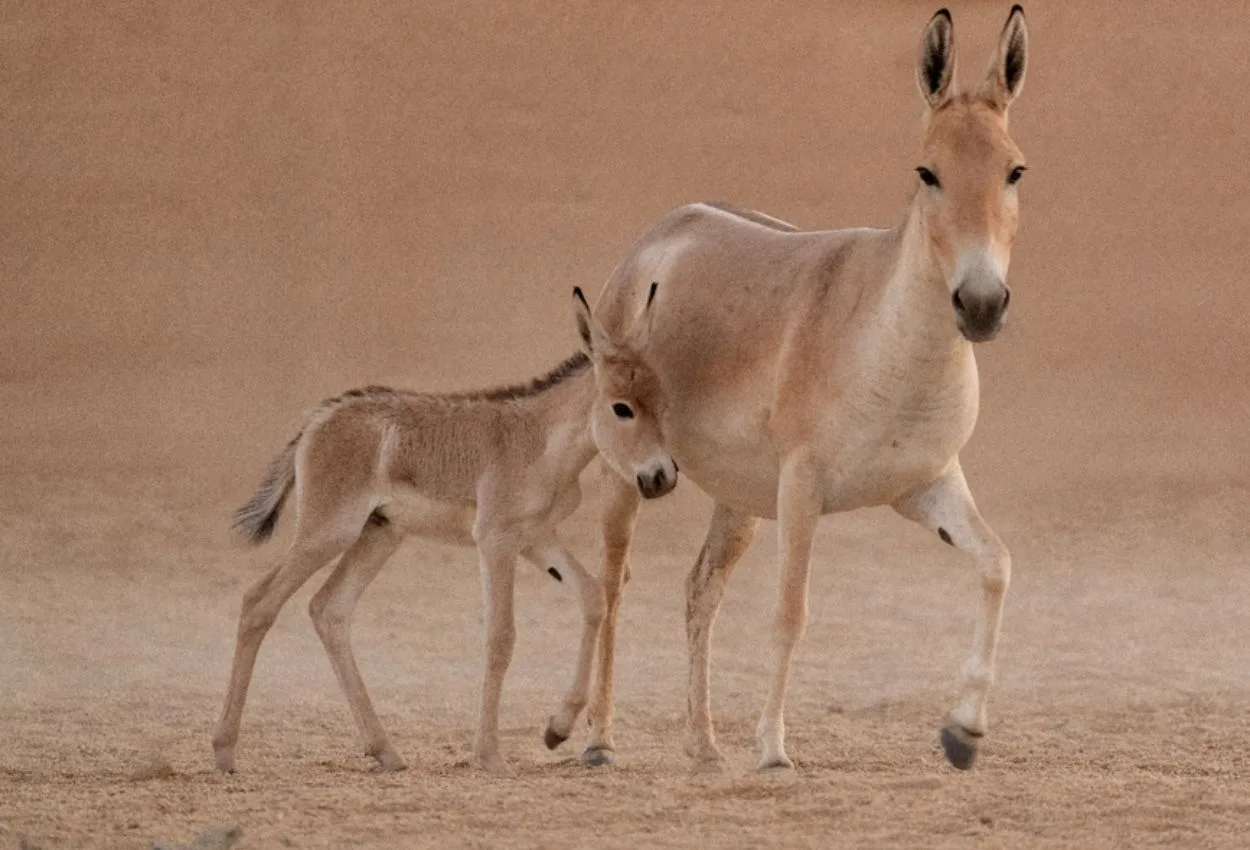
The Prince Mohammed bin Salman Royal Reserve has announced the birth of the first onager foal bred on Saudi Arabian soil in more than 100 years, a milestone in the Reserve’s ongoing effort to restore native species to their historical ranges.
The male foal was born in June 2025 but the announcement was withheld until now, after the animal survived its first twelve months. Onager foals face a 50% mortality rate in their first year, making that threshold a standard measure of viability in conservation work. Two mares in the herd are currently pregnant, with births expected this winter.
The timing carries added weight. The IUCN uplisted the Persian onager to Critically Endangered in 2025, with projections showing a potential 90% population decline by 2050. Fewer than 600 now survive in the wild.
The onager’s return to Saudi Arabia began in April 2024, when seven animals, five females and two males, were transported 935 kilometres overland from Jordan’s Shaumari Wildlife Reserve, in a partnership with the Royal Society for the Conservation of Nature. A female foal born in Jordan arrived with the group. Two subsequent births were unsuccessful, and one mare was lost, a reminder of how precarious early-stage rewilding can be. The current herd stands at five females and three males, including sub-adults, and is the only onager population in the Kingdom.
The species carries deep cultural weight in the region. The onager appears in more than 80 pre-Islamic and early Islamic poems, often cast not as prey or working animal but as a symbol of wildness and refusal to be tamed. The eighth-century poet Dhū al-Rummah, considered the last major voice of the classical desert Bedouin tradition, wrote of the animal in his Bā’iyya: “Off they sped. They pounded the foothill so vigorously, that the stones of the rocky terrain were almost set ablaze.”
Andrew Zaloumis, CEO of the Reserve, said: “The birth of the first onager foal bred on Saudi soil in over a century marks more than a conservation milestone. Immortalised in the verses of Arabia’s earliest poets as the spirit of the open sands, it signals the return of a symbol of freedom, endurance, and the wild heart of the desert.”
Nasser Ashour, the Reserve’s Animal Keeper Team Leader, who was born and raised in the area, added: “Knowing this is the only population in Saudi Arabia makes it a great responsibility, but also a privilege to help protect such a rare species.”
The onager is a subspecies of the Asiatic wild ass, a member of the equid family that predates both the horse and zebra, with origins dating back four million years. Its closest relative, the Syrian wild ass, once roamed the Arabian Peninsula in herds of up to one hundred before hunting and habitat loss drove it to extinction. The last wild individual was shot in Iraq in the early 1920s.
The birth is part of the Reserve’s broader ReWildArabia programme, which is working to reintroduce 23 historically occurring native species. Fourteen have been reintroduced so far, and six, including the Arabian oryx, Nubian ibex, and now the onager, have successfully bred on site. A new mare is currently in quarantine and is expected to join the herd from Jordan later this year, with the longer-term goal of establishing two separate breeding groups to improve genetic diversity.