
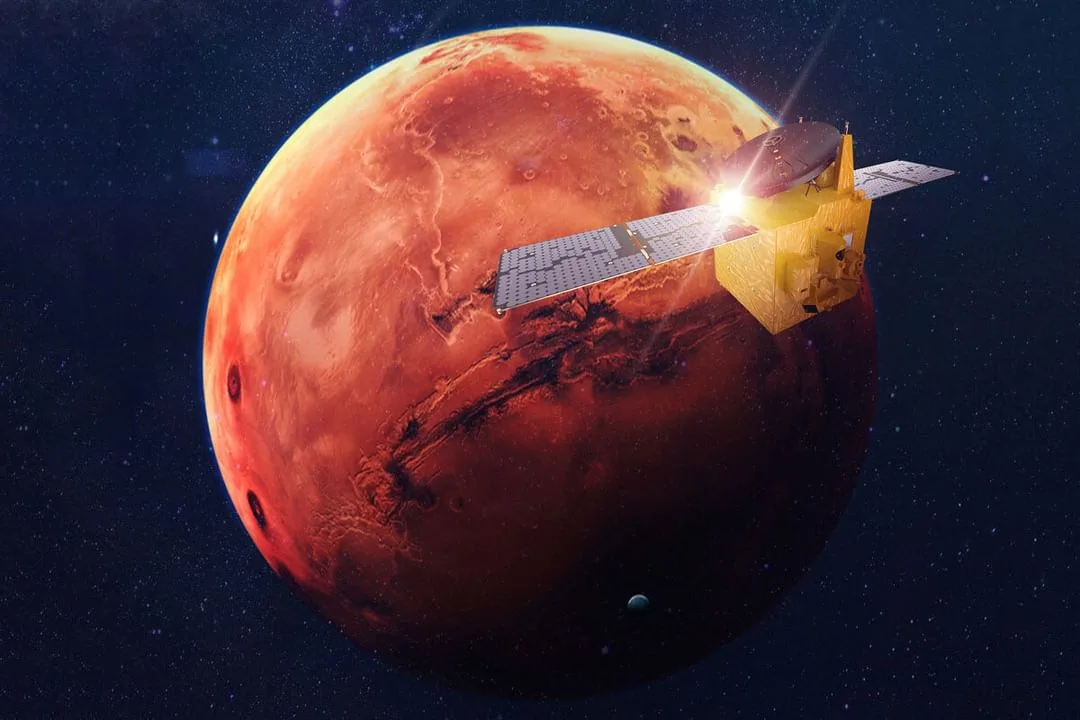
The UAE Space Agency has extended the Emirates Mars Mission until 2028, marking a continuation of the Arab world’s first interplanetary exploration programme.
The decision follows the performance of the Mars Hope Probe, which will continue to provide data on the Martian atmosphere while offering experience for future deep space missions.
Dr Ahmad Belhoul Al Falasi, Minister of Sports and Chairman of the Board of Directors of the UAE Space Agency, said the extension “reflects the UAE’s commitment to maximising the scientific value of its space investments and strengthening its role as a significant contributory partner to the global scientific community,” according to a statement by the Emirates News Agency (WAM).
Emirates Mars Mission gets extension until 2028 for continued research
He said the mission “highlights the UAE’s dedication to leveraging space science to serve humanity, improve understanding of climate change and support a future built on knowledge and innovation.”
Dr Al Falasi said the Emirates Mars Mission represents a choice “that embodies the wise leadership’s vision of the space sector as a foundational pillar for building a sustainable knowledge economy, empowering national talent and strengthening the scientific returns of the state’s strategic investments in this field.”
He said the extension decision “reflects confidence in the capabilities of national teams and in the probe’s technical readiness, affirming that what has been achieved is not a temporary milestone, but a sustained trajectory that reinforces the UAE’s presence and global standing in the space sector.”
The Hope Probe entered Mars’ orbit in 2021. Since then, the UAE has recorded progress in outcomes alongside expansion of the space ecosystem since 2020.
The number of entities operating in the sector have tripled in size from 2020 to 2025, with an increase in investment across research and development. Between 2015 and 2025, the number of UAE universities offering aerospace engineering and space-related degree programmes has doubled, reflecting the country’s expansion of its space ecosystem and talent pipeline.
In October 2025, the Hope Probe captured images of Comet 3I/ATLAS. The images were captured in wavelengths using the EXI and EMUS instruments, as part of a campaign whereby the spacecraft directed its instruments away from Mars and toward the sky in an attempt to capture the comet.
Comet 3I/ATLAS is the third-ever detected interstellar object to enter the Earth’s solar system, creating an opportunity to study the composition of other star systems. The comet made its approach to Mars on 3 October 2025, passing within 0.2 astronomical units of the Red Planet, giving Mars spacecraft a vantage point due to their proximity.
The mission was launched as a two-year programme. Hope Probe has supported operations beyond its scope, including discoveries and observations of Mars’ auroral fields and a series of fly-bys of Mars’ moon, Deimos, that have provided understanding of Deimos’ origins.
With a goal of collecting a terabyte of data on Mars’ atmosphere and climate, the mission has gathered ten terabytes of information released in a series of 16 data releases to a community of more than 200 institutions.
“The extension of the Emirates Mars Mission until 2028 is a remarkable testament to the design and construction of the probe and to its enduring contributions not only to Mars science, but to the development of the UAE space sector. EMM has not only delivered new insights about Mars, leading to more than 35 published peer reviewed scientific papers in international journals, but it has also been at the core of a transformation of the Emirates’ education, science, research and innovation ecosystems. It has created potential for tens of thousands of new career opportunities and built the foundations for many more,” Salem Butti Al Qubaisi, Director-General of UAE Space Agency added.
“In four years of operations, the mission exceeded all expectations, making vital new discoveries about the Martian atmosphere but also transforming the Emirates science, technology and education landscapes,” Mohsen Al Awadhi, Director of Space Missions Department at UAE Space Agency, further explained.
He said EMM and the Hope Probe have been “the bedrock for the development of a fast-expanding, rich and vibrant national space and innovation ecosystem creating new skillsets and career opportunities for young Emiratis.”
The deep space mission operations for the Emirates Mars Mission will provide experience for the Emirates Mission to the Asteroid Belt team, who are set to launch a mission to complete the survey into deep space and the main asteroid belt.