Almost half of the US data centres planned for this year are expected to be delayed or cancelled, according to Bloomberg, as a shortage of transformers, switchgear and batteries chokes the country’s ability to build the infrastructure its artificial intelligence ambitions depend on.
The components are needed not only for AI but also for the expansion of the electricity grid, which faces demand from electric cars and heat pumps, the report said, adding US manufacturing capacity for these devices cannot keep up, and the shortage has forced data centre builders to rely on imports.
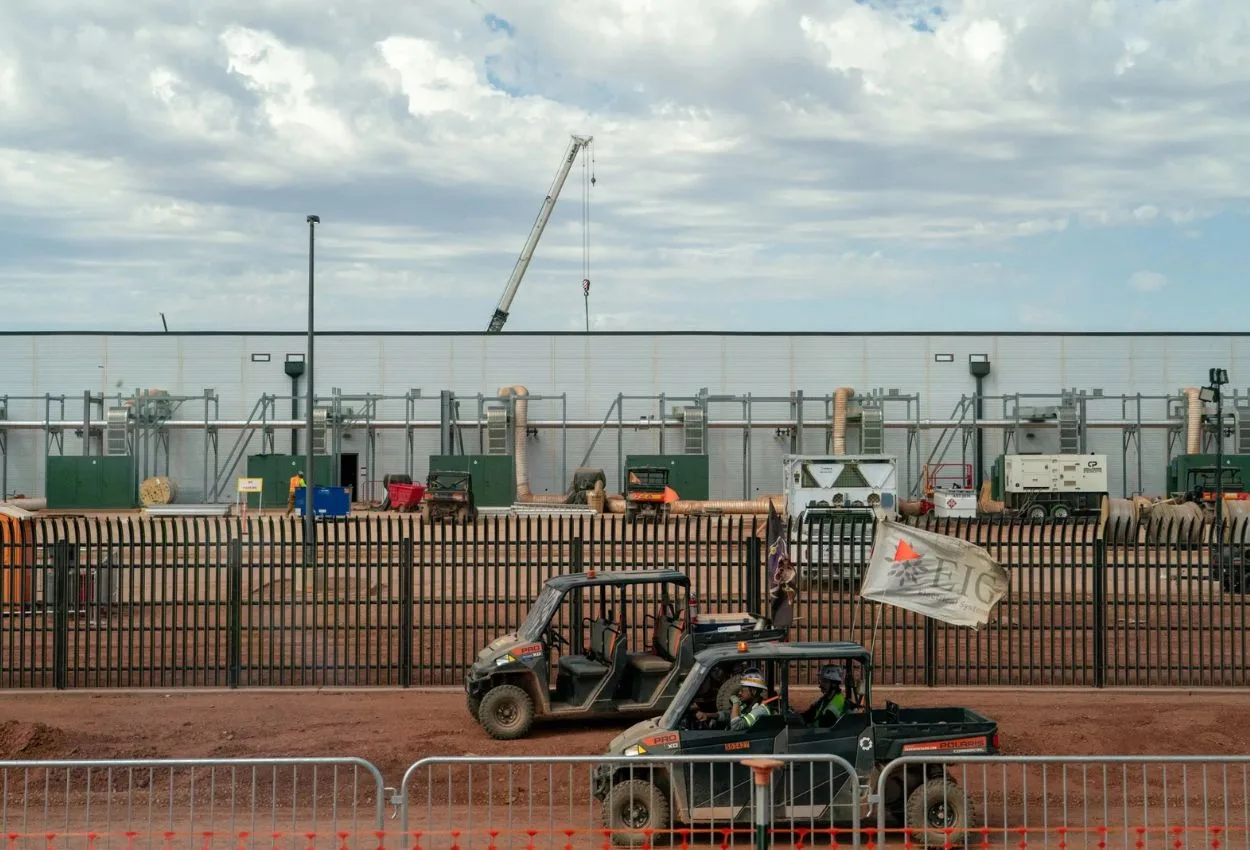
In Abilene, Texas, more than 6,000 workers travel on buggies across a construction site where eight buildings are being erected for OpenAI. When the data centre is completed this year, it will consume 1.2 gigawatts of power – enough electricity for 1 million households in the United States.
The construction is part of a race among technology companies to build data centres to meet the demand for artificial intelligence. Alphabet, Amazon, Meta Platforms and Microsoft have committed to spending more than $650 billion this year alone. But neither money nor ambition is sufficient to materialise all the components these facilities require.
The reliance on imports is creating a problem. President Donald Trump said in December: “There’s only going to be one winner, and that’s probably going to be the US or China.”
While Trump has stated his intention for the US to prevail, his trade policy calls for barriers that would cut imports – the same imports the data centre industry depends on.
Equipment for the electrical infrastructure adds up to less than 10 per cent of the total cost of a data centre, but without it, the operation cannot function.
The US has been outsourcing its manufacturing to other countries, chiefly China, for decades. That has contributed to a shortage of components in the US, the report said.
In January, a group of US utility executives visited a transformer factory in China and noticed that around half the transformers slated for delivery bore the US flag. Some were going to data centre companies, according to one person on the trip who requested anonymity to share information of a commercial nature.
Over the past 10 years, the US government has tried a series of policies to reshore manufacturing, but those efforts have not yielded a boost to capacity sufficient to meet demand. That means the US needs parts from China to dominate the AI race, while China needs chips from US companies to stay in it.
In March, Trump issued a framework to speed up permitting of power plants for data centres. Without addressing equipment shortages, many are concerned that the trillions of dollars earmarked for data centres will not produce results.
Data centres now consume more electricity than their predecessors a decade ago. That demands bigger transformers, which pull electricity from the grid at a voltage that can be used by computer chips.
The rise in demand from data centres and grid expansion has pushed up prices and extended delivery times to as much as five years. Some companies, including Crusoe, have resorted to refurbishing transformers from shuttered power plants as a stopgap.
Neither investment offers relief in the near term, which forces data centre developers to look abroad, the report said. While most of the US’s transformers come from Canada, Mexico and South Korea, US utilities imported more than 8,000 transformers in 2025 through October from China, up from fewer than 1,500 in all of 2022, the report said.
Once transformers lower the voltage of electricity for use in data centres, the power must be distributed through switchgear, which includes circuit breakers and fuses. Data centre developers are seeing delivery delays for switchgear as well, though not as long as those for transformers.
With transformers and switchgear secured, a data centre can begin operations. But without batteries, the racks of computer chips could degrade. When a user uploads a dataset and asks AI to analyse it, the demand for electricity at the data centre can spike. That spike can change the flow of electricity and reduce the lifetime of the equipment.
Lithium-ion batteries smooth out these spikes. They store electricity when there is too much and release it when there is not enough.
The share of US imports of transformers and switchgear from China has declined in recent years, though for some types of equipment it remains around 30 per cent. The share of battery imports from China remains above 40 per cent.
China controls many parts of the supply chain for this equipment, from materials to processing to manufacturing, and the gap between China and the US is set to grow. In its five-year plan released last month, China announced it will expand its grid with renewables.
The Trump administration, by contrast, has dismantled policies to deploy solar and wind power.
In March, the US opened trade investigations into China to justify tariffs. China retaliated by starting its own investigations against the US, the report said.