
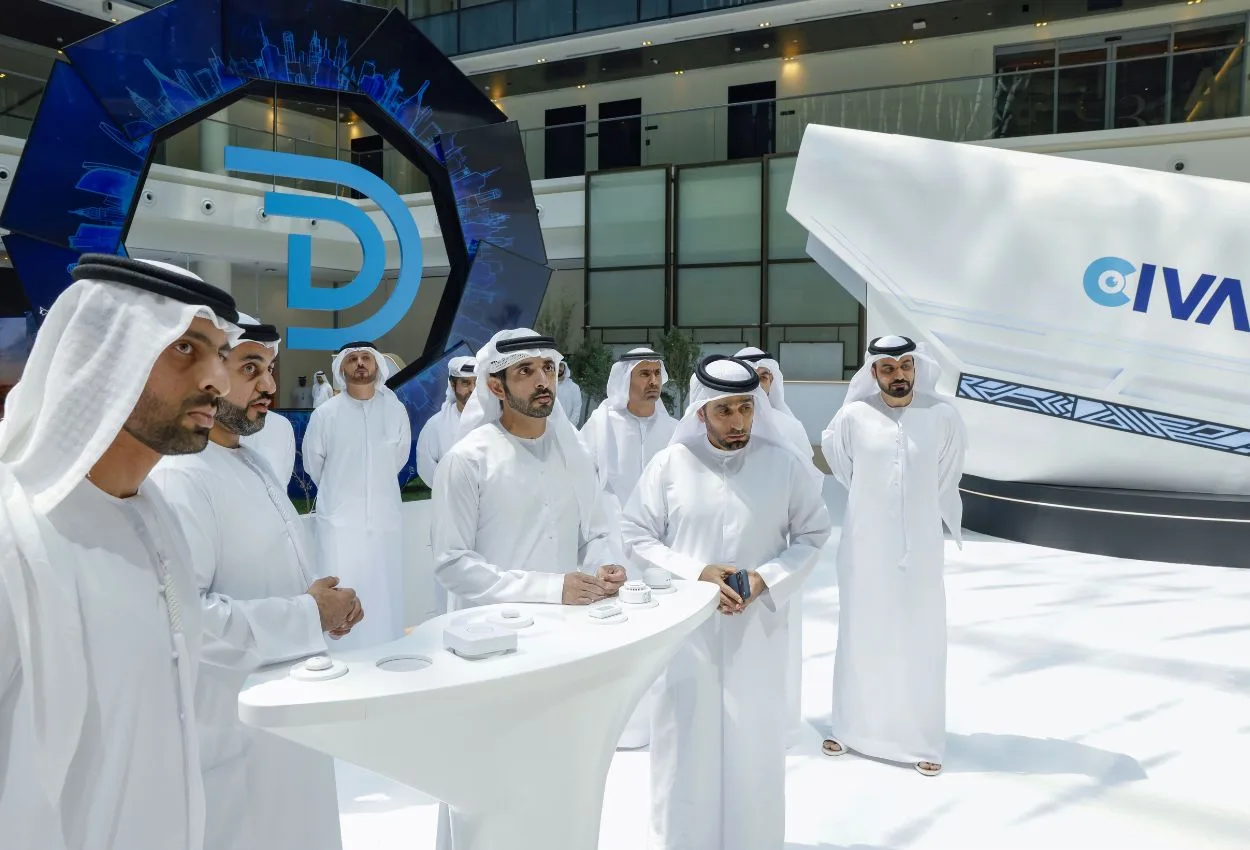
Dubai has entered a new era in which the city is managed through data and artificial intelligence, Crown Prince Sheikh Hamdan bin Mohammed bin Rashid Al Maktoum announced during a visit to Digital Dubai.
Sheikh Hamdan, who also serves as Deputy Prime Minister and Minister of Defence of the UAE, and Chairman of The Executive Council of Dubai, said that integrated systems and unified data would work to create a living experience for residents. During the visit, he launched a series of projects marking progress in the emirate’s digital transformation agenda.
“Digital Dubai’s work with government entities is an investment in the future, reinforcing Dubai’s leadership in safety and quality of life,” Sheikh Hamdan said in a statement, directing all Dubai government entities to integrate services for individuals and businesses into a unified digital ecosystem within one year, with services to be delivered through platforms that reduce time and effort. Digital Dubai has been tasked with coordinating across all entities to oversee implementation and ensure full integration.
Dubai enters AI-managed city era as Sheikh Hamdan launches digital transformation projects
“Our goal is to make life easier, simplify procedures, and reduce the number of platforms, delivering more efficient and seamless services that strengthen Dubai’s competitiveness as a global hub for business and investment. Dubai today is a vibrant digital city, where all government entities work as one team through integrated systems and unified data to serve people and enhance quality of life, reinforcing its position as a global model for digital cities and a preferred place to live,” he said.
“Dubai’s journey of development never stops, regardless of the challenges or changing circumstances. Continuous improvement is our approach, excellence is our benchmark, and the future is our destination. What we ask for today is what we have always upheld: to be the fastest, the best, and the most responsive to people’s needs,” he added.
Hamad Obaid Al Mansoori, Director General of Digital Dubai, said the projects launched represent a leap in Dubai’s digital transformation journey, where “technology no longer operates in silos but as part of an integrated intelligent ecosystem that sees, thinks, and acts with awareness to serve people and enhance quality of life.”
“At Digital Dubai, we lead this transformation in partnership with all entities, inspired by the directives and vision of our leadership. We remain committed to building a unified digital infrastructure where systems are integrated, data is connected, and artificial intelligence is embedded at the heart of proactive government services to strengthen safety and security and ensure the highest levels of happiness for the residents of Dubai. Our goal goes beyond efficiency to establishing a human-centric digital city where technology serves and protects people and supports a sustainable future,” he added.
Sheikh Hamdan also reviewed projects developed by the Dubai Data and Statistics Establishment, which serves as the official source of Dubai’s data.
The initiatives combine open data and analytics powered by generative AI, enabling access to information and serving as the destination for those seeking city data.
Additional projects from the Establishment aim to establish a government model in which government performance becomes 100% data-based, supported by infrastructure including AI accelerators and an algorithm bank containing production-ready machine learning models.
The projects also provide sandbox environments enabling government entities to develop and test AI use cases while maintaining compliance, data privacy, and operational governance.
Among the targets set out, the projects aim to support GDP growth by more than AED 10 billion within two years of operation, and to position Dubai among the world’s top 10 cities in the Government AI Readiness Index. They also seek to enable at least 80% of government policies and strategies through AI-supported data, and to enhance the knowledge and skills in AI and analytics of 100% of government leaders.
“Today, data is a key driver of economic growth, shaping the future of cities. Dubai is a global leader in transforming data into a strategic asset that enables a more competitive and sustainable digital economy and advances the objectives of the Dubai Economic Agenda D33,” Younus Al Nasser, Chief Executive of the Dubai Data and Statistics Establishment, said.
“The projects reviewed by His Highness reflect this vision, as data evolves from a tool for analysis into an integrated ecosystem that enables proactive decision-making, enhances the efficiency of urban planning, and strengthens security and quality of life, further reinforcing Dubai’s position as one of the world’s best cities to live, work, and invest in. Citywide data integration, powered by artificial intelligence, is driving new sources of economic value, improving sector productivity, and anticipating future opportunities, reinforcing Dubai’s leadership as a global model in harnessing data to serve people and society,” he added.
Sheikh Hamdan reviewed the second generation of Government Resource Planning Systems, a project between Digital Dubai, the Department of Finance, and the Dubai Government Human Resources Department. The initiative aims to strengthen government integration and meet future needs by adopting emerging technologies, including artificial intelligence, within a unified systems ecosystem.
The project covers finance, human resources, payroll, procurement, contracts, asset and property management, and maintenance, supporting a model that enhances planning, decision-making, and service experiences for employees and customers.
Digital transformation to contribute AED100 billion annually to Dubai Economy
“Future government readiness is built on integration before technology, prioritising unified policies and platforms before multiple solutions. Today, we witness the launch of a future-ready model of government operating as a single, integrated ecosystem, supported by a unified digital infrastructure and intelligent systems that enhance efficiency and accelerate delivery,” Matar Al Hemeiri, Chief Executive of the Digital Dubai Government Establishment further explained.
Sheikh Hamdan also reviewed projects highlighting national capabilities in developing internal solutions for digital city management. The systems process data streams and visual inputs in real time, transforming them into insights that enable authorities to respond to situations including service performance monitoring, emergency response in public facilities, and traffic flow management.
Among the projects reviewed was an Agentic AI solution that enables users to engage with an AI agent through conversational interfaces to request and complete government services. The system relies on generative AI and autonomous agents capable of understanding requests and independently executing required actions.
Sheikh Hamdan further reviewed projects demonstrating the implementation of the Internet of Things within the city, through a sensing ecosystem capable of detecting phenomena such as smoke or fires and sending alerts to relevant entities, including Civil Defence.
The projects form part of Dubai’s vision to become a digital city where digital transformation contributes AED100 billion annually to its economy, in support of the objectives of the Dubai Economic Agenda D33.