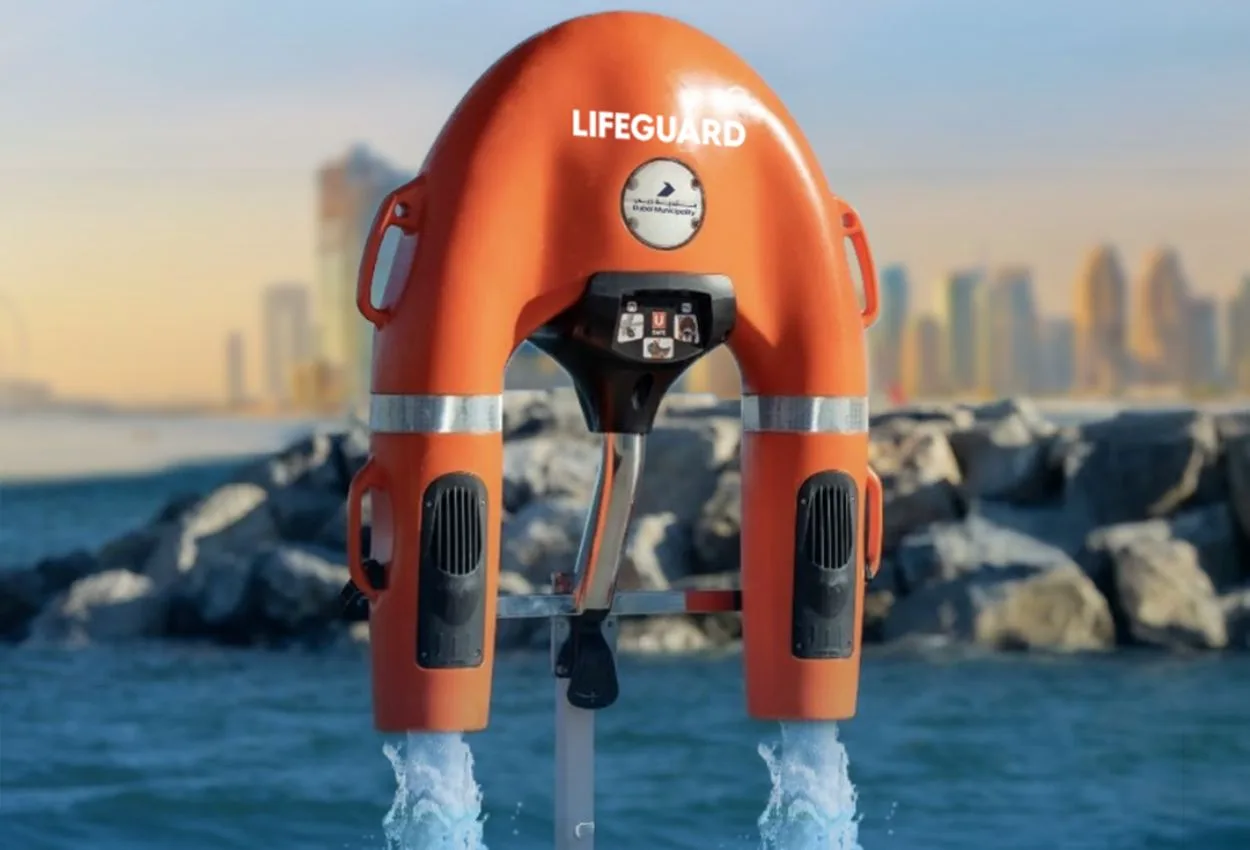
Dubai Municipality has launched an aquatic rescue robot and water rescue drone across its public beaches, marking a first for the region in coastal safety technology.
The robot, described as the first of its kind in the Middle East, is remote-controlled and self-propelled, operating at speeds up to five times faster than a lifeguard swimming to a casualty.
It has a range of up to one kilometre within line of sight and can tow up to 500 kilograms, enabling lifeguards to reach swimmers in distress while reducing physical risk during the initial phase of a rescue.
Dubai Municipality unveils ‘flying lifebuoy’ drone and rescue robot at public beaches
Working alongside the robot, the water rescue drone – referred to as a “flying lifebuoy” – can be deployed over water, land on the sea surface, and provide buoyancy support to individuals in distress. The drone is fitted with a live-feed camera that delivers visuals to lifeguard teams in real time, supporting incident detection, risk assessment, and coordination of rescue operations.
The two systems form part of an framework supported by trained lifeguard teams, centralised control systems, and continuous monitoring. Dubai Municipality says the combination of air and water-based rescue technologies strengthens its capacity to respond across coastal areas, particularly during complex or time-critical incidents.
“Dubai Municipality continues to advance a proactive, technology-led approach to public safety. The integration of the aquatic rescue robot with the water rescue drone represents a significant step forward in how coastal safety is delivered, combining speed, intelligence, and operational precision. These solutions enhance protection for beach users while reducing risk to lifeguards, and reflect Dubai’s commitment to applying innovation and artificial intelligence in service of quality of life,” Bader Anwahi, Chief Executive Officer of the Public Facilities Agency at Dubai Municipality said in a statement.
“Our objective is to ensure that Dubai’s beaches set global benchmarks for safety, readiness, and visitor confidence. By investing in smart rescue technologies and continuously upgrading our safety ecosystem, Dubai Municipality is reinforcing its role in shaping future-ready public spaces that place people, wellbeing, and experience at the centre,” he added.
Dubai Municipality oversees all public beaches and canals across the emirate, including Umm Suqeim 1 Night Beach, Jumeirah 3 Night Beach, Jumeirah 1 Beach, Jumeirah 2 Beach, and Al Mamzar beaches. Each destination is supported by trained lifeguards, rescue systems, and continuous monitoring.
The initiative reflects a shift by Dubai Municipality towards the use of artificial intelligence and automation in public safety management, positioning the emirate as a reference point in coastal safety for the region.