

Emirates has introduced a comprehensive data-driven approach to reduce the impact of turbulence on its operations, combining multiple real-time data sources and artificial intelligence systems to improve flight planning and safety.
The airline’s strategy integrates data from SkyPath, Lido mPilot by Lufthansa Systems, and the IATA Turbulence Aware programme, with the aim of minimising unexpected severe turbulence encounters across its global network.
“We recognise that turbulence remains an ongoing challenge that cannot be completely eliminated, but we’re committed to doing everything possible to minimise unexpected severe turbulence encounters through working with partners who share our vision of using advanced technologies and adopting AI to enhance operations. While we are still in the early stages, we are already seeing validation of the potential benefits these systems can deliver,” Captain Hassan Alhammadi, Divisional Senior Vice President Flight Operations at Emirates said in a statement.
Emirates uses AI-based systems to reduce turbulence impact
“While we cannot promise turbulence-free flights, these initiatives have contributed to a significant reduction in unexpected severe turbulence incidents over the past year, helping make journeys safer and more comfortable for our customers. Our multi-layer approach with weather prediction and technology partners and active participation in the IATA Turbulence Aware programme also enables us to contribute valuable data and insights to the broader aviation industry as we collectively work to address this growing meteorological challenge,” he added.
According to Emirates, the integration of multiple data layers has already resulted in fewer severe turbulence events and improved onboard experience for passengers and crew.
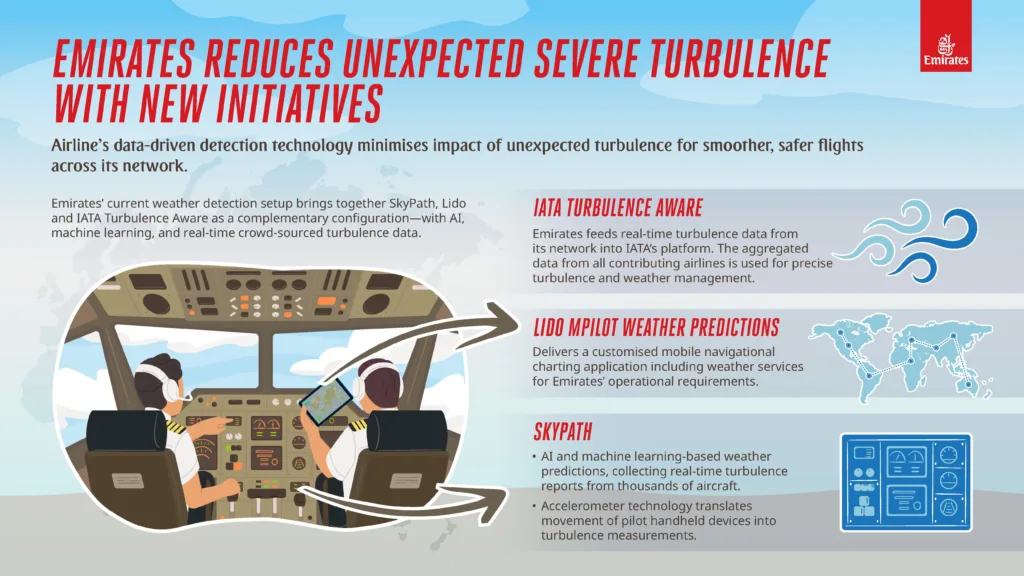
The airline’s current weather detection setup brings together SkyPath, Lido mPilot, and IATA Turbulence Aware as a combined configuration using AI, machine learning, and pilot feedback to enhance turbulence prediction and response.
SkyPath and Lido mPilot integrated into Emirates flight operations
Emirates partnered with SkyPath last year to improve AI and machine learning-based weather predictions. SkyPath’s platform integrates real-time turbulence reports from thousands of aircraft using advanced analytics to generate accurate forecasts, even for areas without current flight activity or where clear-air turbulence occurs.
SkyPath gathers data from multiple sources, including Eddy Dissipation Rate (EDR) for turbulence measurement, Automatic Dependent Surveillance–Broadcast (ADSB) transponder data, and SkyPath’s patented iPad accelerometer technology, which converts device movement into turbulence readings for pilot use. This system provides global coverage and enhanced prediction accuracy.
Emirates’ long-standing collaboration with Lufthansa Systems includes the use of Lido mPilot, a mobile navigational charting application customised for the airline’s operational needs. In partnership with the German Weather Service, the platform provides live weather reports, cloud and convection data, and turbulence and icing predictions. Emirates continues to work with the Lido team to improve data quality and coverage.
Emirates joins IATA Turbulence Aware to share live flight data
Emirates joined IATA’s Turbulence Aware programme last year and now contributes and consumes live turbulence data from flights across the Middle East, Africa, Asia, and Australia.
This data is integrated into IATA’s global turbulence platform, which combines inputs from participating airlines to offer a comprehensive, real-time picture of atmospheric conditions.
By integrating these insights into its electronic flight bag charting application, Emirates provides pilots with live visualisations of turbulence. This allows crews to make informed decisions in real time, anticipate turbulence zones, and improve operational safety and fuel efficiency.