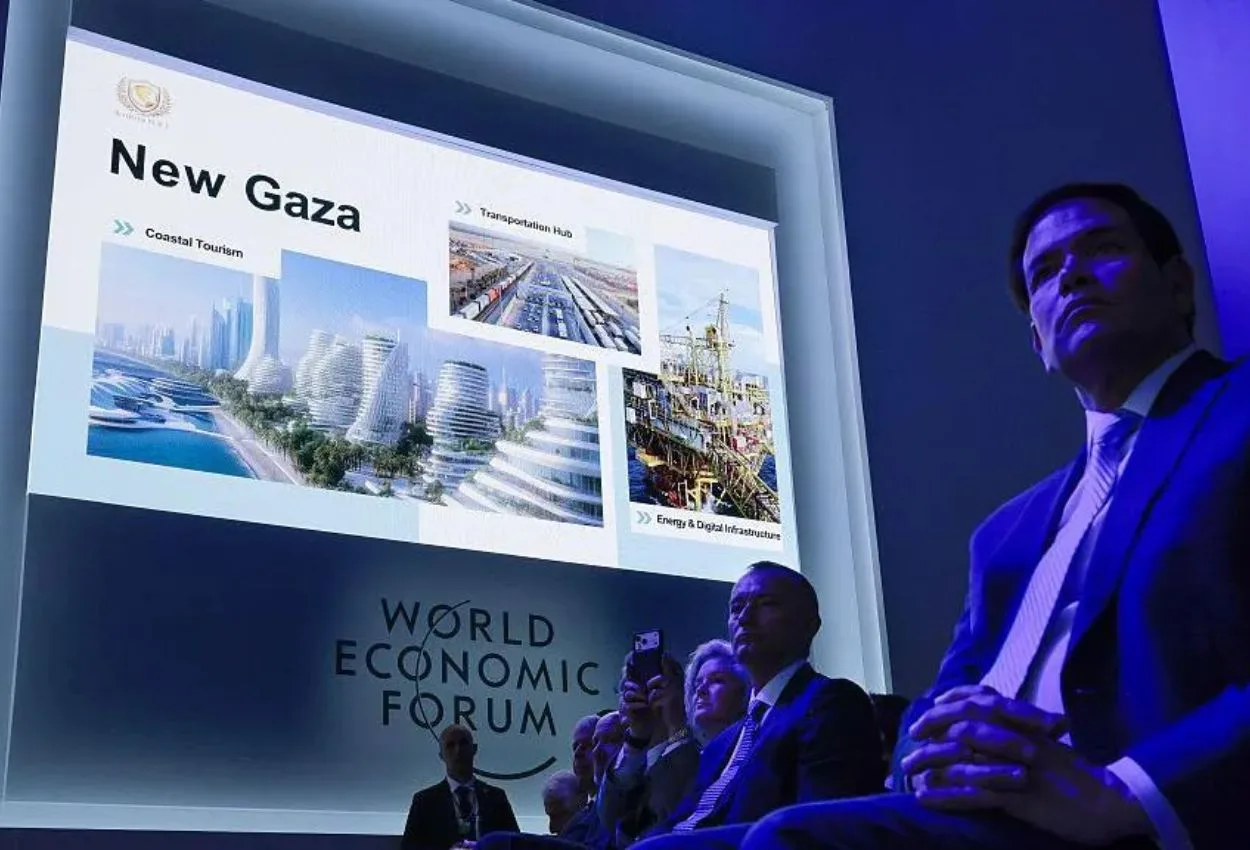
President Donald Trump has revealed US proposals to rebuild Gaza entirely, displaying blueprints that feature high-rise buildings along the Mediterranean shoreline and residential developments in Rafah during a World Economic Forum (WEF) ceremony in Davos.
The proposals emerged at a signing event for Trump’s Board of Peace, an initiative designed to conclude hostilities between Israel and Hamas whilst supervising the territory’s reconstruction.
Trump stated: “We’re going to be very successful in Gaza. It’s going to be a great thing to watch.”
He added: “I’m a real estate person at heart and it’s all about location. And I said: ‘Look at this location on the sea. Look at this beautiful piece of property. What it could be for so many people.’”
Blueprint details 180 high-rise structures and tourism development
Documents outlining the Master Plan identified an area designated for tourism along the coast, featuring 180 tower structures alongside sections for housing, industry, data facilities, manufacturing operations, parkland, farming zones and sports venues.
Plans include constructing a seaport and airport close to the Egyptian frontier, plus a border point where Egyptian and Israeli territories meet.
The rebuilding programme divides into four stages, beginning in Rafah before progressing northward to Gaza City.
Documentation also displayed a buffer zone along both the Egyptian and Israeli frontiers, representing what Trump’s 20-point proposal terms the security perimeter, where Israeli military personnel will stay “until Gaza is properly secure”.
Rafah redevelopment to feature 100,000 residential properties
Presentation materials indicated New Rafah would contain over 100,000 residential properties, 200 educational institutions and 75 healthcare facilities.
Approximately 280,000 residents previously inhabited Gaza’s southernmost municipality, though Israeli bombardment and systematic demolitions during hostilities have destroyed it. The area currently sits within Israeli-controlled zones.
Jared Kushner, Trump’s son-in-law who negotiated the ceasefire implemented in October, noted that 90,000 tonnes of explosives had struck Gaza, leaving 60 million tonnes of debris requiring removal.
Kushner told attendees: “In the beginning, we were toying with the idea of saying: ‘Let’s build a free zone, and then we have a Hamas zone.’ And then we said: ‘You know what, let’s just plan for catastrophic success’.”
He continued: “Hamas signed a deal to demilitarise, that is what we are going to enforce. People ask us what our plan B is. We do not have a plan B.”
Kushner projects two to three year timeline for Rafah construction
Kushner expressed confidence that completing New Rafah construction within two to three years was “doable”.
He said: “We’ve already started removing the rubble and doing some of the demolition. And then New Gaza. It could be a hope, it could be a destination, have a lot of industry.”
He stated that upcoming weeks would bring a Washington conference announcing financial commitments from nations and outlining “amazing investment opportunities” for commercial entities.
Last February, Trump provoked international criticism by proposing the permanent relocation of Gaza’s Palestinian population to surrounding nations, whilst the US would assume control to create “the Riviera of the Middle East”, according to a report by the BBC.
UN assessments indicate 81 per cent of Gaza’s structures have sustained destruction or damage.
Weapons surrender process declared underway
Kushner announced the disarmament of Gaza was “starting now”, remarking that “without security nobody is going to make investments”.
He explained the National Committee for the Administration of Gaza, a technocratic Palestinian administration, would be “working with Hamas on demilitarisation to really take the principles that were agreed to in the document to the next phase”.
“They have to give up their weapons and if they don’t do that, it’s going to be the end of them,” Trump warned Hamas, and additionally demanded Hamas return the remains of the final deceased Israeli captive in Gaza, which Israel maintains should have occurred before phase two last week.
Truce unstable despite agreement
Phase one terms included the truce, reciprocal release of living and deceased Israeli captives in Gaza for Palestinians held in Israeli detention, Israeli military pullback, and increased humanitarian deliveries.
The truce has proven unstable, with no fewer than 477 Palestinians killed in Israeli operations over three months, per Gaza’s Hamas-run health ministry. Israeli military sources report three soldiers killed in Palestinian militant operations.
Thursday saw five Palestinians reportedly killed by Israeli forces throughout Gaza, including four in an artillery bombardment in Gaza City’s eastern Zeitoun district.
Circumstances remain critical, with nearly 1 million people without proper shelter and 1.6 million experiencing severe food insecurity, UN data shows.
Hamas issued a Thursday statement affirming commitment to the October accord whilst charging Israel with attempting to “undermine international efforts aimed at consolidating the ceasefire”.