

The National Center of Meteorology (NCM) is “testing a suite of advanced technologies” to boost rainfall in the UAE, Alya Al Mazrouei, Director of the UAE Research Program for Rain Enhancement Science (UAEREP), told Lana in an exclusive interview.
“These include nanotechnology-based seeding materials such as core-shell NaCl-TiO₂ (CSNT), autonomous unmanned aerial systems (UAS) for precise seeding and atmospheric measurements, high-power mobile laser demonstrators for rainfall enhancement trials, and artificial intelligence (AI) models for cloud forecasting and targeting,” she said.
The programme marks a major shift from traditional cloud seeding methods, which relied exclusively on manned aircraft dispersing seeding agents. Today, operations are increasingly automated and data-driven.
Cloud seeding
AI Generated
Cloud seeding is a weather modification technique that aims to increase precipitation by dispersing substances into the air that serve as cloud condensation or ice nuclei, altering the microphysical processes within the cloud. Common substances used include silver iodide, potassium chloride and dry ice, which provide a base for water molecules to condense upon, ultimately leading to rainfall or snowfall.
UAE expands next-generation rainfall enhancement technologies
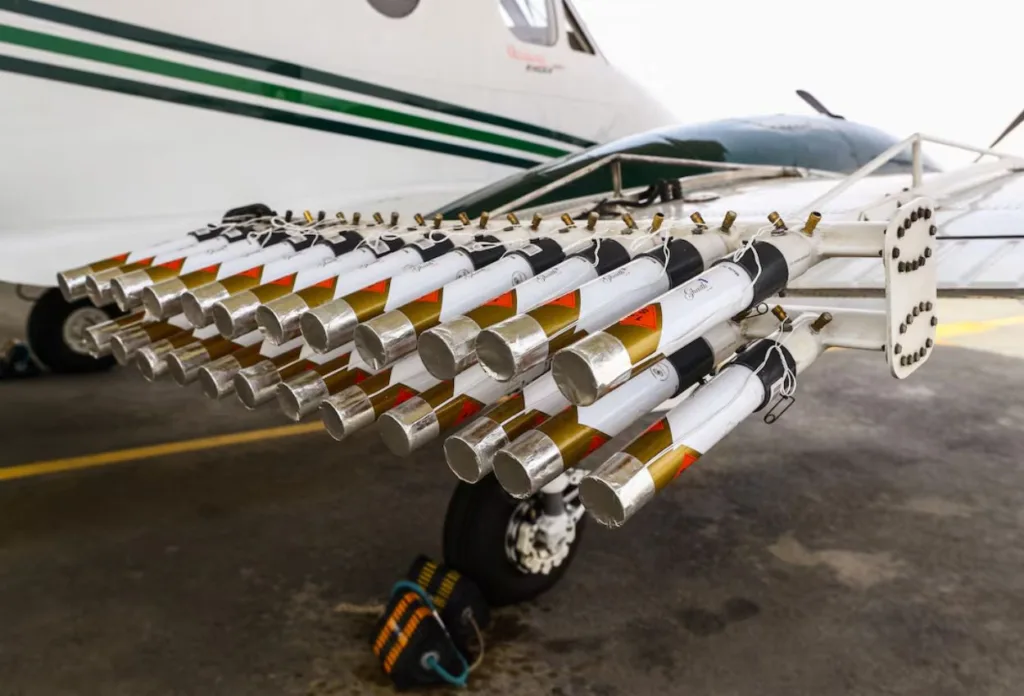
“The program also explores novel cloud formation systems, advanced remote sensing, and ground-based interventions to stimulate precipitation in arid environments,” she added.
According to Al Mazrouei, the current approach combines autonomous drones with AI-powered forecasting to enhance the precision and efficiency of cloud-seeding missions.
The drones enable “more targeted and flexible” operations, while AI-driven models provide real-time identification and prediction of clouds most suitable for seeding.
Additionally, advanced nanomaterials are being deployed to accelerate condensation and promote droplet growth, the UAEREP Director explained.
“This, in turn, increases the likelihood of droplet collisions and coalescence, ultimately resulting in improved rain enhancement,” she said.
UAEREP operates as a major component of the nation’s water-security strategy, addressing challenges in a region where annual rainfall averages less than 100 millimetres, high evaporation rates, with groundwater recharge remaining far below consumption levels, she explained.
“[UAEREP] contributes to diversifying water sources and reducing dependence on conventional solutions, ensuring the long-term sustainability of water resources.
“These efforts underscore the UAE’s commitment to safeguarding water security as a cornerstone of national security and to mitigating the impacts of climate change, rising global temperatures, and growing water demand driven by population growth. Furthermore, UAEREP reinforces the UAE’s position as a global leader in scientific innovation and collaborative solutions for water sustainability in arid and semi-arid regions,” she said.
The programme uses statistical randomisation experiments to validate effectiveness. Data from over 150 weather events where seeding was conducted has been collected.
“By analysing radar imagery, researchers can objectively determine the extent of rainfall enhancement following seeding operations. In our previous experiments, we observed an increase in rainfall of 10 per cent to 15 per cent under turbid atmospheric conditions, while this enhancement rate rose to 25 per cent in clean and optimal weather environments,” Al Mazrouei revealed.
‘Challenges’ facing drone-based cloud seeding and climate interventions

However, there are a few challenges in ensuring reliability and regulatory compliance of autonomous UAS platforms, she said, adding that integration of real-time atmospheric sensing with decision-making tools presents difficulties.
“Other challenges involve developing robust communication protocols to enable coordinated operations among multiple drones, scaling up the production of advanced seeding materials, and adapting complex models to the UAE’s unique climate. Continuous field validation and system integration are essential to address these complexities and to ensure efficiency and reliability,” she said.
Al Mazrouei explained further explained that historical climate data collected over 20 years supports infrastructure design in Dubai and other UAE locations.
The data, which includes wind speed and direction, enables assessment of rainfall patterns, flood risks, and climate trends.
This information also aids projects such as the Tasreef stormwater network .
Tasreef stormwater network
AI Generated
The Tasreef stormwater network is an infrastructure project in Dubai and other locations in the UAE designed to manage rainfall and mitigate flood risks, informed by historical climate data collected over 20 years. This network is part of a broader strategy to address climate trends and ensure effective urban planning in the region.
Aside from this, both the NCM and UAEREP collaborate with over 1,800 researchers from more than 800 institutions across 76 countries.
Partners include the World Meteorological Organization, US National Center for Atmospheric Research, Russian Academy of Sciences, Chinese Academy of Sciences, Khalifa University, NYU Abu Dhabi, Yale University, and the Technology Innovation Institute.
Additional collaborators include NASA, CERN, UNDP, Karlsruhe Institute of Technology, and Vaisala.
“These collaborations span joint research projects, technology development, field campaigns, and knowledge exchange to advance rainfall enhancement science,” Al Mazrouei explained.
How NCM selects clouds for seeding using AI, radar and satellite data in the UAE
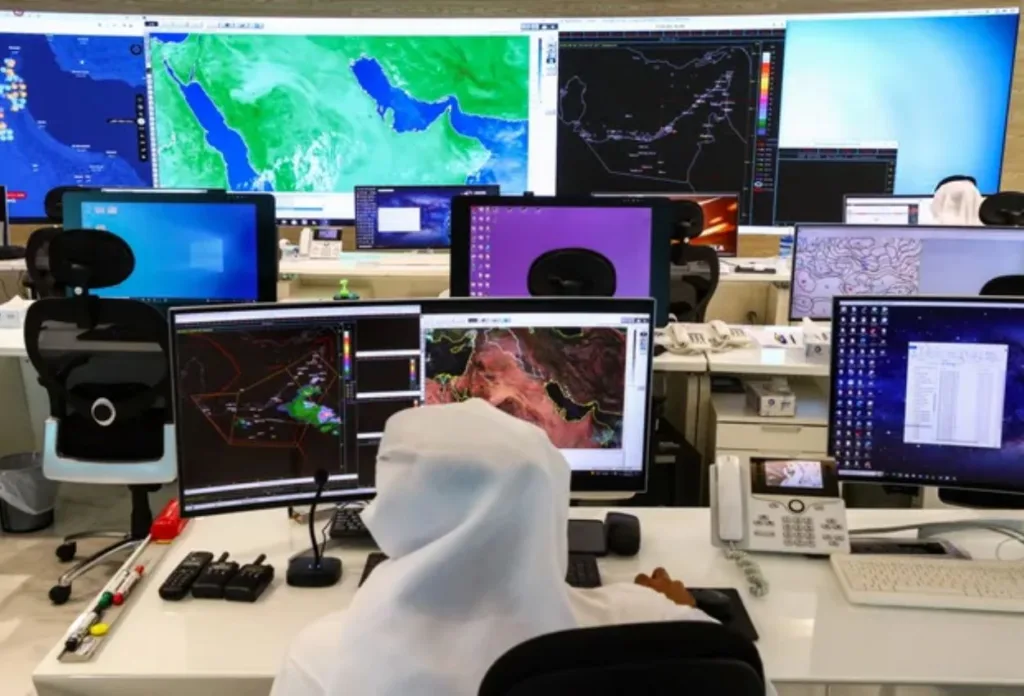
To cloud seed, the NCM often selects cumuliform clouds with strong updrafts at their base using forecasting models, AI-driven decision support tools, and real-time data from radar and satellite networks.
“Algorithms and expert analysis are used to maximise the likelihood of precipitation. Field validation and continuous model refinement ensure that seeding operations are both effective and efficient. In practice, this process involves daily weather analysis, careful planning, and real-time monitoring by specialists at the NCM, who coordinate aircraft equipped with seeding materials to execute operations precisely when suitable cloud conditions are detected,” she said.
The team then assesses potential impacts of seeding materials on ecosystems and evaluates risks and benefits of climate interventions and compliance with legal and governance frameworks.
“The program prioritises the use of eco-friendly materials, conducts rigorous field and laboratory testing, and engages with regulatory authorities to ensure responsible and transparent operations,” she said.
However, over the past decade the NCM has observed a rise in temperatures at the beginning of summer.
“It is well noticed that the temperature is getting hotter during the beginning of summertime, due to the apparent movement of the sun towards the north of the equator initiating thermal lows over the southwestern region accompanied with warm dry air and erupted dust from the empty quarter, while the convective clouds start to be more frequent along the mountainous terrains in the middle of July to the middle of September,” she said.
NCM to ‘accelerate’ cloud seeding operations with ‘special attention’ on new technologies
Yet, over the next 5 to 10 years, the NCM aims to “accelerate” deployment of rainfall enhancement technologies and strengthen scientific leadership.
“Special attention will be given to employing emerging technologies such as artificial intelligence, unmanned aerial vehicles (UAVs), nanotechnology, and laser-based systems to enhance accuracy, effectiveness, and operational efficiency,” Al Mazrouei said, adding key goals include commercialising seeding materials, operationalising autonomous UAS platforms, and expanding collaboration.
“Risks include technical uncertainties, regulatory challenges, and the need to continuously assess environmental impacts and societal acceptance,” she concluded.