
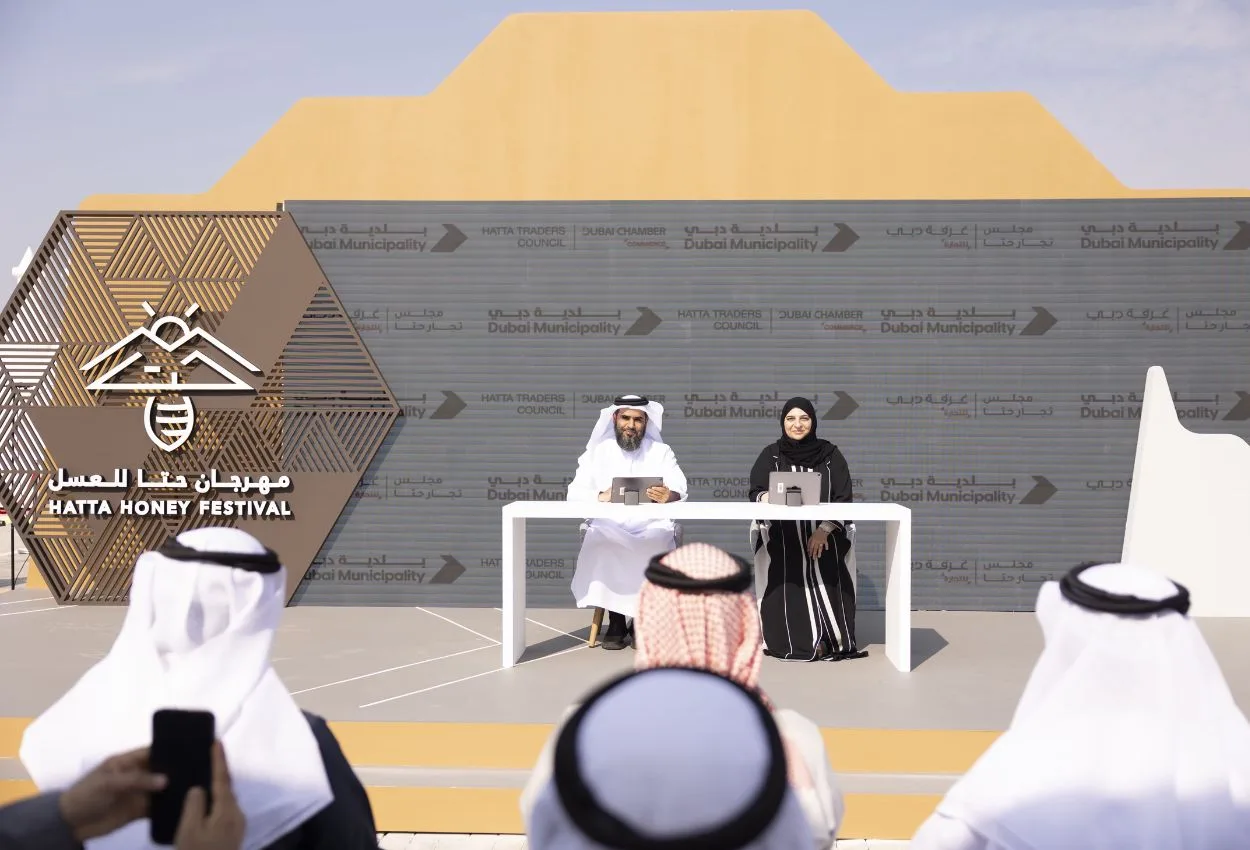
Dubai Municipality has signed a memorandum of understanding with the Hatta Traders Council to support the National Fingerprint Project for Emirati Honey. The agreement was signed during the tenth season of the Hatta Honey Festival.
Dr. Naseem Mohammed Rafee’, Acting CEO of the Environment, Health and Safety Agency at Dubai Municipality, signed the memorandum on behalf of the Municipality. Dr. Manea Al Kaabi, Chairman of the Hatta Traders Council, signed on behalf of the Council, which operates within the framework of the Dubai Chamber of Commerce.
The project aims to enhance the quality and safety of Emirati honey and increase its credibility at local and international levels.
Dubai Municipality and Hatta Traders Council sign MOU to develop Emirati honey database
The memorandum will support the establishment and development of a database for Emirati honey, based on laboratory testing and analytical techniques, in addition to botanical and geographical differentiation studies.
The agreement includes several areas of cooperation. These include the updating of the national honey database, the exchange of knowledge and expertise in the fields of honey and pollen, coordination in the implementation of studies and analyses, and collaboration on regulatory and awareness activities.
Dubai Municipality will undertake laboratory analyses as part of the National Fingerprint Project for Emirati Honey, manage and develop the national database, and provide technical and scientific support.
The Hatta Traders Council will provide honey and pollen samples from locations in line with production seasons, supply the Municipality with data, facilitate field visits, and cooperate in media and awareness activities.
“This memorandum reflects Dubai Municipality’s commitment to adopting advanced scientific solutions that enhance the quality and safety of local food products, protect consumers, and increase the credibility of Emirati honey, thereby strengthening its position as a national product that meets high standards of quality and transparency,” Dr. Rafee’ said in a statement.
She added that the project represents a model of integration between government entities and the private sector and contributes to supporting knowledge-based national products driven by technologies.
“We are pleased to cooperate with Dubai Municipality to enhance and support local Emirati honey products through seasonal studies covering all local honeys, extending over the coming years. This will contribute to establishing a scientific database that will serve as a comprehensive reference on Emirati honey and pollen for each geographical area in the country. This, in turn, will help distinguish between Emirati, local, and imported honeys through the local honey fingerprint, which will play a key role in identifying honey composition and properties from chemical and physical perspectives, and in enhancing its medical uses based on precise scientific and research foundations,” Dr. Al Kaabi added.
The signing of the memorandum aligns with the objectives of the National Food Security Strategy 2051 by supporting the quality and safety of local food products, strengthening traceability systems and scientific verification of their sources, contributing to the local economy and sustainability, and empowering national products while enhancing their competitiveness.
The memorandum of understanding will be valid for three years from the date of signing, allowing both parties to expand areas of cooperation in the future in support of the project’s objectives and the national interest.