
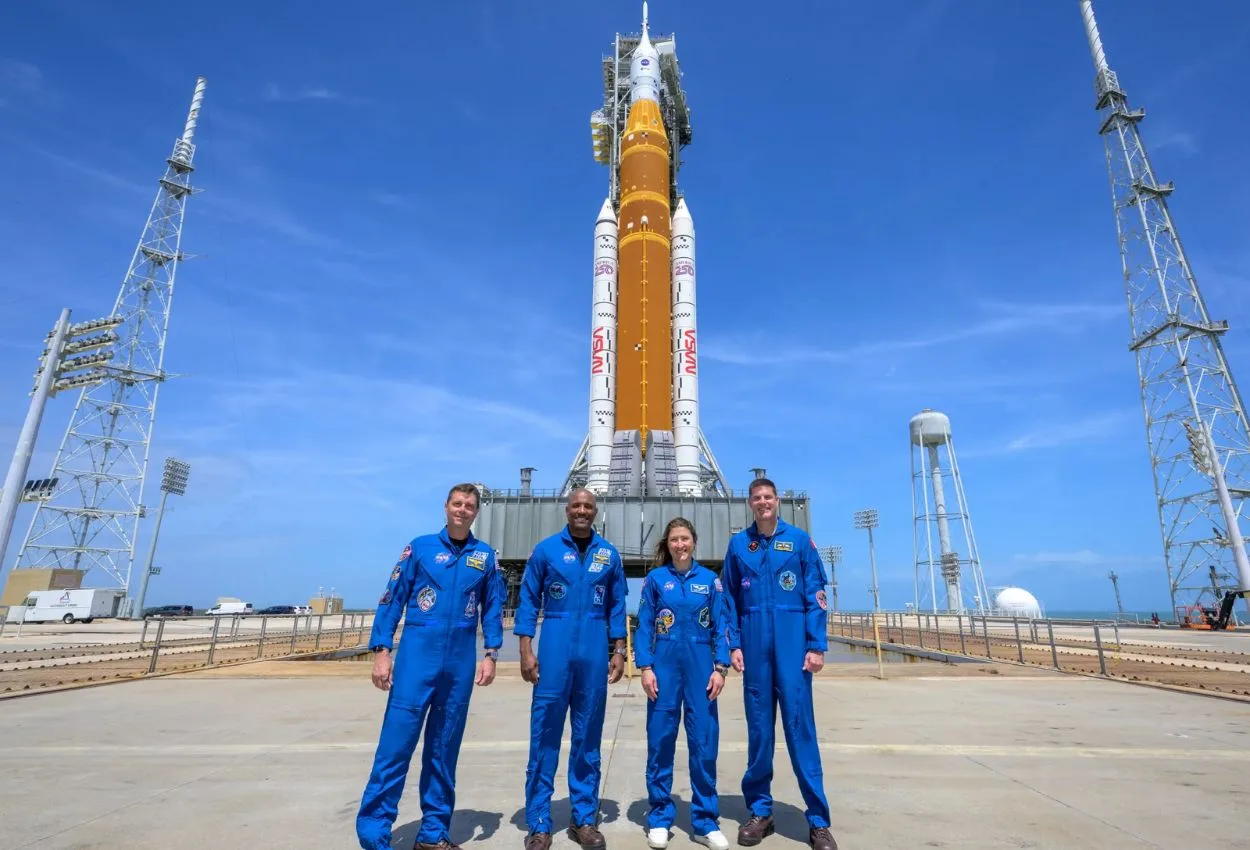
NASA is to send four astronauts around the Moon and back today, in a mission that does not include a lunar landing but marks the first time humans have ventured so far from Earth in more than five decades.
The flight is scheduled to lift off at 6:24pm Eastern time on Wednesday, April 1 (2:24 AM GST on Thursday), from NASA’s Kennedy Space Centre in Florida.
The 10-day mission will test life-support and other systems aboard the Orion spacecraft, and the crew will follow what is known as a “free return” trajectory – meaning the Moon’s gravity will swing the capsule back towards Earth without any need to fire the engines. This means the spacecraft could return even in the event of a propulsion failure.
Artemis II: Who are the astronauts of the first crewed Moon mission since Apollo 17 in 1972?
The crew was selected in 2023 and has been in training since. It comprises three NASA astronauts and one from the Canadian Space Agency (CSA).
Reid Wiseman serves as commander. Victor Glover is the pilot and is set to become the first Black man to travel around the Moon. Christina Koch, a mission specialist, will be the first woman to do so. All three have previously served aboard the International Space Station.
Jeremy Hansen, a mission specialist from Canada, has not yet been to space and will become the first person who is not a NASA astronaut to make the journey around the Moon.
Space Launch System rocket: How NASA’s Moon rocket works for Artemis II
The vehicle carrying the crew is NASA’s Space Launch System (SLS) – a rocket 322 feet tall and weighing 5.75 million pounds when filled with propellant. It is capable of sending approximately 60,000 pounds of payload to the Moon.
The core stage engines were built for the Space Shuttle programme, and the upper stage burns the same liquid mixture of hydrogen and oxygen used during the Apollo missions.
According to the NASA website, the SLS core stage draws its propulsion from four RS-25 engines running on liquid hydrogen and liquid oxygen. L3Harris Technologies, based in Sacramento, California, is modifying a stock of 16 RS-25 engines to meet SLS performance standards – work that involves a new engine controller, updated nozzle insulation, and the ability to operate at a maximum thrust of 512,000 lbs. Together, the four engines generate roughly 2 million lbs. of thrust during the eight-minute ascent to Earth orbit.
NASA led the design of both the Space Launch System and the Orion capsule, while it contracted commercial companies SpaceX and Blue Origin to provide lunar landers for future Artemis missions.
NASA Artemis II: What is the Orion spacecraft and how will it reach the Moon?
The Orion spacecraft – named Integrity by the crew and built by Lockheed Martin – will carry the four astronauts to the Moon and back. On return, the crew module will splash down in the Pacific Ocean, off the coast of San Diego.
Orion has two main sections. The crew module, where the astronauts will remain throughout the mission, sits above the service module – a cylindrical component provided by the European Space Agency that houses propulsion, power and life-support systems.
The capsule can support four astronauts for missions of up to 21 days. Its interior offers the volume of approximately two minivans, leaving no room for privacy. In the event of a radiation event such as a solar flare, the crew can shelter in stowage lockers beneath their seats.
After separating from the upper stage of the rocket, the crew plans to test Orion’s ability to execute docking manoeuvres that will be needed for future flights. Should any problems arise while the spacecraft remains in Earth orbit, mission managers will return the crew to Earth.
Once Orion heads towards the Moon, there will be a communications blackout of between 30 and 50 minutes while the Moon passes between the spacecraft and Earth. During this time, the astronauts will observe parts of the lunar surface – including sections of the far side that have never been seen by human eyes.
The timing of this mission means sunlight will fall on parts of the Moon’s far side that were not visible during the Apollo missions, which were scheduled to coincide with the start of the lunar day at their landing sites.
According to a report by the New York Times, after Neil Armstrong’s first steps on the Moon, interest in further lunar missions declined as the space race with the Soviet Union was considered won.
In the decades since, NASA directed its focus towards low-Earth orbit exploration through the Space Shuttle programme and the International Space Station.
The Artemis programme was elevated as a priority during the first Trump administration and continued under President Joseph R. Biden Jr.
The goals of the programme include scientific discovery, the extraction of resources such as frozen water for use on future missions, and the mining of helium-3 for future fusion power plants.
Artemis I, launched in November 2022, sent an uncrewed Orion capsule into orbit around the Moon and back over 26 days, testing whether the capsule’s heat shield could withstand re-entry temperatures of up to 5,000 degrees Fahrenheit.
In February of this year, NASA revised its plans for what follows Artemis II. Artemis III, originally intended as a crewed Moon landing near the south pole by the end of 2028, has been rescheduled to launch in mid-2027 as a test flight in Earth orbit to practise rendezvousing with the lunar landers under development by SpaceX and Blue Origin.
If Artemis III proceeds without issue, it could pave the way for two landing attempts – Artemis IV and Artemis V – in 2028, meeting President Trump’s stated goal of returning NASA astronauts to the Moon before the end of his second term.
Over the past two decades, NASA has spent more than $50 billion developing and building the SLS, the Orion capsule and the ground systems required to launch them.
A 2021 report by the NASA inspector general found that each launch of the Space Launch System and Orion capsule carries a cost of approximately $4.1 billion.