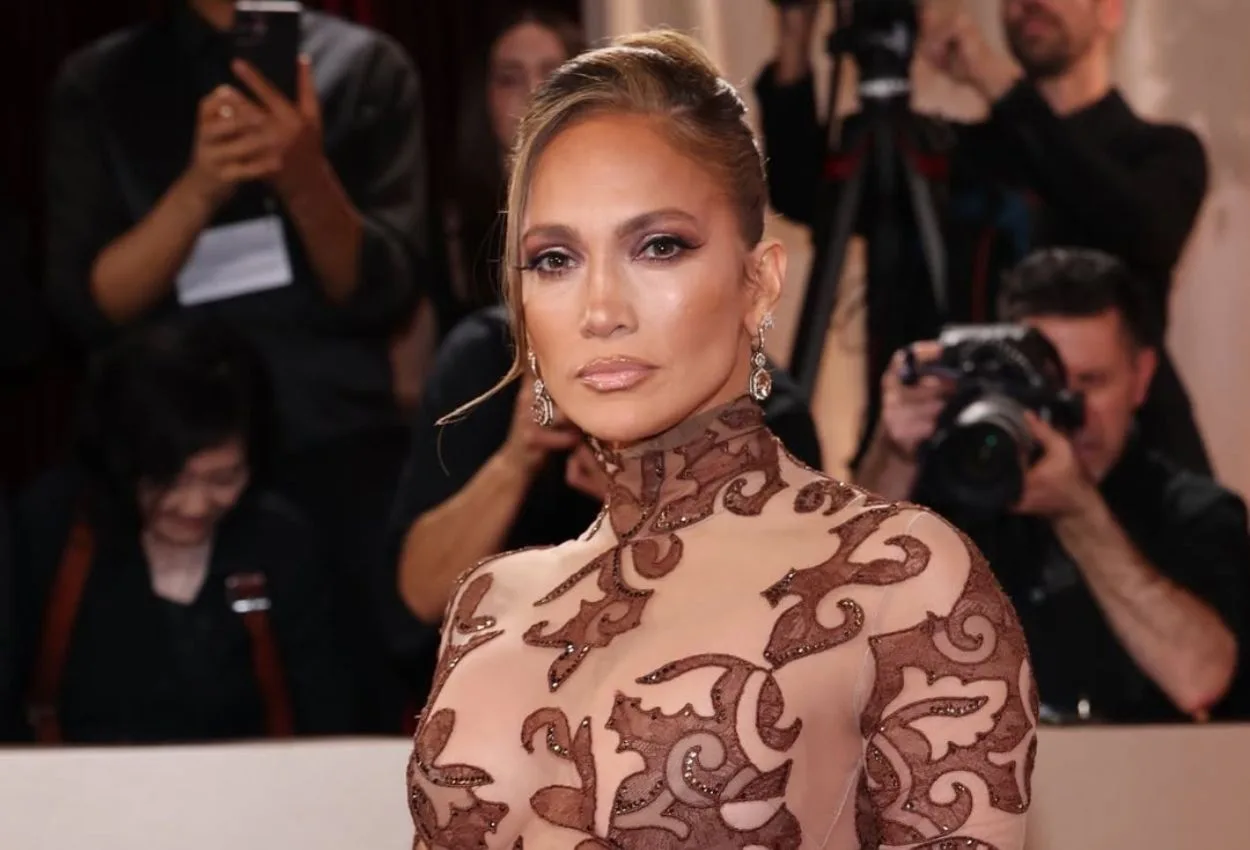
In one of the most audacious red carpet moments of the year, global superstar Jennifer Lopez captivated audiences at the Golden Globes 2026 ceremony with a nearly completely sheer gown that redefined the concept of “neo-nude” dressing on Hollywood’s most prestigious red carpet.
Lopez selected an archival haute couture gown from the legendary French fashion house Jean Louis Scherrer, originally designed in 2003—nearly 23 years before gracing the Beverly Hills red carpet.
The gown consisted of an almost imperceptible nude-toned tulle base, layered with intricately embroidered brown lace embellished with crystal and rhinestone beading. The embellishments were strategically distributed to cover select areas of the body while leaving expansive sections transparently exposed, achieving a delicate equilibrium between allure and sophistication.
A piece from her personal collection
The silhouette hugged the body closely to the knee before opening into a mermaid-style skirt rendered in pale butter yellow tulle, adding dramatic movement and dimension as Lopez navigated the red carpet.
What made this choice particularly noteworthy was the revelation that this gown was not merely borrowed from a fashion house, but rather something Lopez owns herself.
During a televised red carpet interview, she disclosed that she had personally purchased the dress from Lily et Cie, the renowned Beverly Hills archival boutique, and that it has become part of her private collection.
This detail reflects Jennifer’s profound relationship with fashion—not merely as a brand ambassador or corporate representative, but as a genuine fashion enthusiast who recognises the inherent value of rare archival pieces and considers them long-term investments in personal image and identity.
Carefully curated beauty and accessories
Lopez coordinated her look with luxurious jewelry from Sabyasachi, featuring elongated drop earrings studded with brown and gold-toned stones, accompanied by a small gemstone-encrusted clutch in complementary warm hues. This cohesive color palette lent the overall look warmth and visual harmony.
She completed the ensemble with Christian Louboutin heels, an elegant upswept hairstyle with a delicate face-framing piece of hair, and makeup emphasizing smoky eyes and naturally radiant skin. This approach ensured that all attention remained focused on the gown’s refined details and architectural construction.
A powerful return following a significant personal chapter
This appearance marked a notable comeback for Jennifer Lopez to the Golden Globes red carpet, representing her first attendance at the ceremony following her formal divorce from Ben Affleck, finalized at the beginning of 2025.
Although she was not nominated this year—her participation in “Kiss of the Spider Woman” did not receive recognition—her presence conveyed the confidence of a star utilising the red carpet as a platform to assert her distinctive style identity rather than simply accompanying a nominated project.
Her strategic choice to wear an archival piece from a legacy French couturière demonstrated a deliberate statement of artistic independence and sartorial confidence during a transformative personal period.
“Neo-Nude” is not a fleeting trend
Jennifer Lopez’s appearance was part of a broader wave of “neo-nude” and sheer gowns that characterized the Golden Globes 2026 red carpet, with the ceremony featuring multiple looks that employed strategic transparency and bold body-conscious silhouettes.
However, what distinguished Lopez’s choice was her selection of an archival piece—a decision that reinforced an important reminder: what contemporary fashion commentary labels as the “naked dress trend” is neither new nor a passing phenomenon.
Rather, it represents an extension of a lengthy historical continuum of playing with transparency, suggestion, and illusion in haute couture design.
Her decision to wear a gown from the early 2000s by a storied French designer like Jean Louis Scherrer created a meaningful bridge between the present red carpet moment and fashion history itself, suggesting that true elegance and allure derive not solely from the audacity of fabric transparency, but from the narrative and historical significance the gown carries with it.