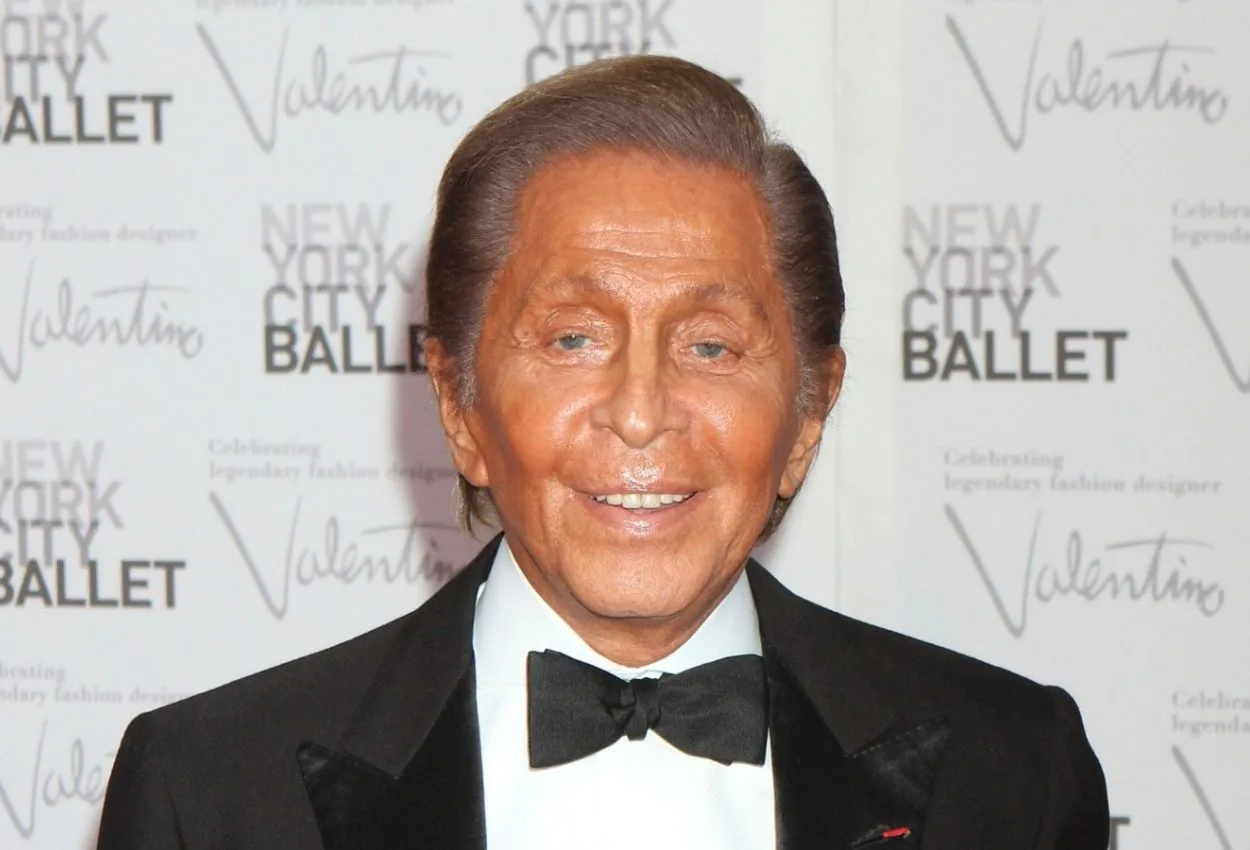
Valentino Clemente Ludovico Garavani, the Italian designer who turned the color red into an eternal signature and elevated femininity to a high art, has died at the age of 93 at his home in Rome, surrounded by loved ones.
The Valentino Garavani & Giancarlo Giammetti Foundation confirmed his passing, marking the close of an entire chapter in the history of global haute couture.
The public will be able to pay their respects at PM23, the cultural space in Piazza Mignanelli 23 in Rome, on Wednesday and Thursday, January 21 and 22, from 11 a.m. to 6 p.m. His funeral will be held on Friday, January 23, at the Basilica of Santa Maria degli Angeli e dei Martiri in Piazza della Repubblica.
From Voghera to the Runway throne
Valentino was born on May 11, 1932, in the town of Voghera, in Italy’s Lombardy region. He was named after silent film idol Rudolph Valentino, as if destiny itself were foreshadowing a life of fame. From an early age, he was drawn to drawing and fabrics, long before he formally entered the world of fashion.
As a teenager, he moved to Paris—then the undisputed capital of style—to study at the École des Beaux-Arts and the Chambre Syndicale de la Couture Parisienne, the most prestigious fashion institutions in France. There, he honed his eye and his hand.
In Paris, he trained at storied maisons such as Jean Dessès and Guy Laroche, learning technical rigor in cutting, the precision of pattern-making, and a near-religious reverence for detail. In 1959, he returned to Rome and opened his first atelier on Via Condotti, channeling the city’s unique blend of classical grandeur and modern romance into his work.
Giancarlo Giammetti: His other half
In the summer of 1960, in a café on Via Veneto at the height of La Dolce Vita, Valentino met Giancarlo Giammetti, a young architecture student who would become his friend and partner in both life and business for more than half a century.
Valentino was pure creative genius; Giammetti was the sharp business and strategic mind who transformed that vision into a functioning empire.
The Valentino red
Valentino’s true global breakthrough came in 1962 at the Pitti Palace in Florence, where he presented a collection that shook the press and buyers alike, cementing his status as one of the leading new voices of Italian couture.
But the legend of his red began even earlier. As a young man in Barcelona, he spotted a blonde woman with silver hair at the opera, dressed in a crimson velvet gown. Amid the sea of colors around her, she seemed to stand apart in her own luminous aura. Later, he would say: “That’s when I understood that red could be a complete language on its own.”
From that moment, Rosso Valentino was born—the house’s proprietary shade of red, calibrated with near-scientific precision: 100% magenta, 100% yellow, and 10% black, later registered officially as a Pantone color. Valentino would explain: “For the Valentino maison, red is not just a color. It is an indelible sign, a logo, an iconic element of the brand’s identity.”
From his first collection in 1959 to his final couture show, not a single runway presentation passed without at least one red dress. His red was never merely loud; it pulsed with life. “Red is life, it is passion, it is love; it is the cure for sadness,” he once said.
Valentino was never just a “celebrity designer.” He was the architect of historical moments—on red carpets and in presidential palaces alike.
Jacqueline Kennedy Onassis: From mourning to immortality
In 1964, Jacqueline Kennedy discovered Valentino and ordered six black-and-white dresses from him for the period of mourning following the assassination of President John F. Kennedy. That collaboration became his passport into Washington and New York society.
In 1968, Jackie chose her wedding dress for her marriage to Aristotle Onassis from Valentino’s now-legendary “all white” collection: a Chantilly lace gown in pure white, with long sleeves and a short, pleated skirt—a bride’s look that felt both regal and strikingly modern. Valentino would later say, “I owe a large part of my fame to Jackie Onassis.”
Elizabeth Taylor and the era beyond classic Hollywood
Elizabeth Taylor wore Valentino to the premiere of Spartacus in 1961, marking the beginning of a long relationship woven from lavish jewelry, luxurious fabrics, and unforgettable images. From then on, the Valentino atelier in Rome became a destination for European and American film stars seeking a particular brand of cinematic glamour.
Julia Roberts: One dress that changed the red carpet
At the 2001 Academy Awards, when Julia Roberts walked up to collect her Oscar for Best Actress for Erin Brockovich, she was wearing a black-and-white Valentino couture gown from 1992: a vertical white band running from the bodice down the front of the dress, splitting into a Y-shape at the top, with a black tulle train traced in white piping.
That dress—still in Roberts’ personal archive today—has been ranked among the most iconic looks in Oscars history and even has its own dedicated Wikipedia page, a rare honor for an evening gown. Valentino himself considered that moment “the proudest” of his entire career, despite having dressed hundreds of stars over the decades.
The honour roll
From Princess Diana to Sophia Loren, from Gwyneth Paltrow to Anne Hathaway, Jennifer Lopez, Halle Berry, and Sharon Stone—virtually every woman seeking an unforgettable entrance passed through his doors.
In the worlds of royal and celebrity weddings alike, the name Valentino became shorthand for the ultimate dream dress: a promise that the woman wearing it would not simply be well dressed, but forever etched into the visual memory of her moment.