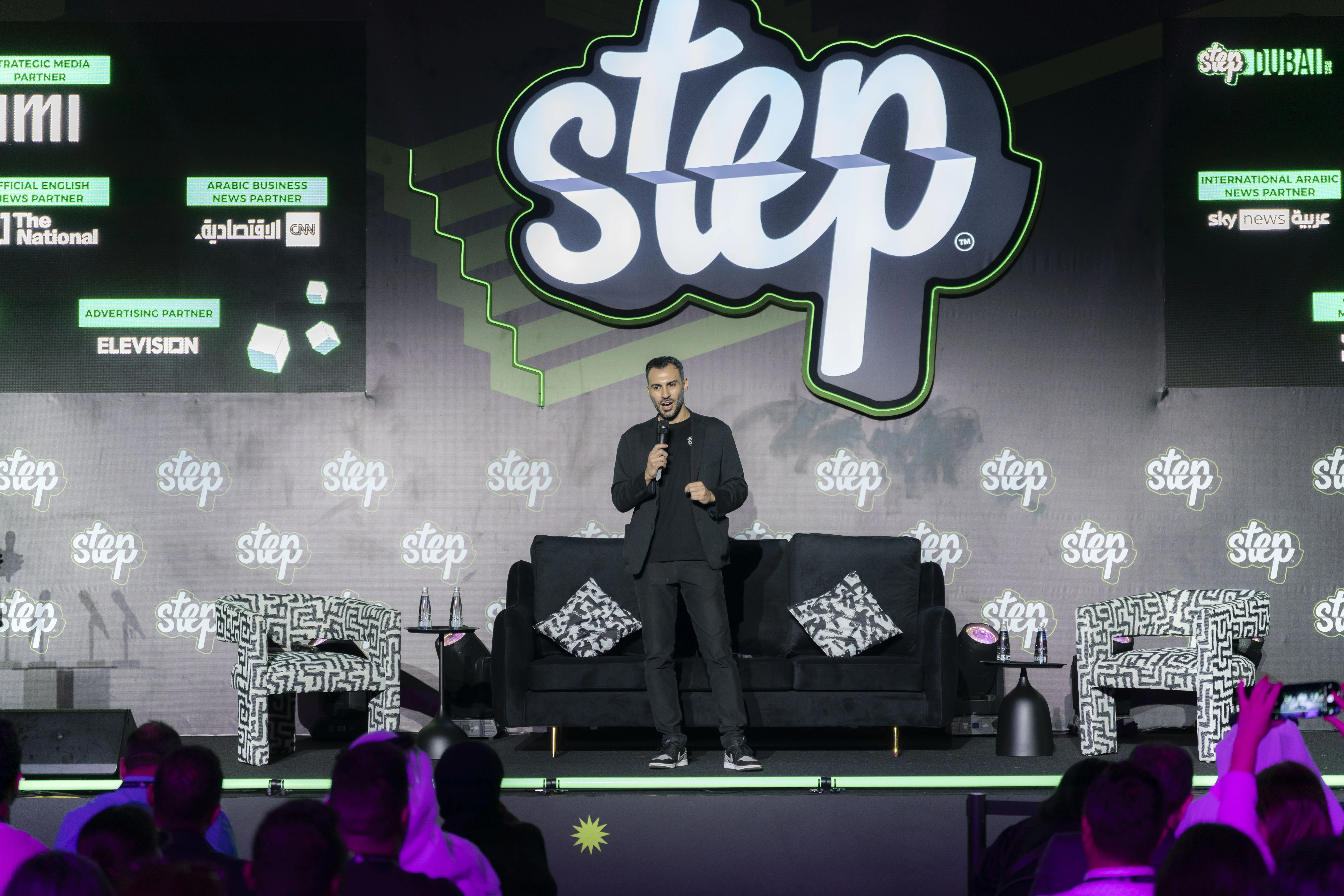
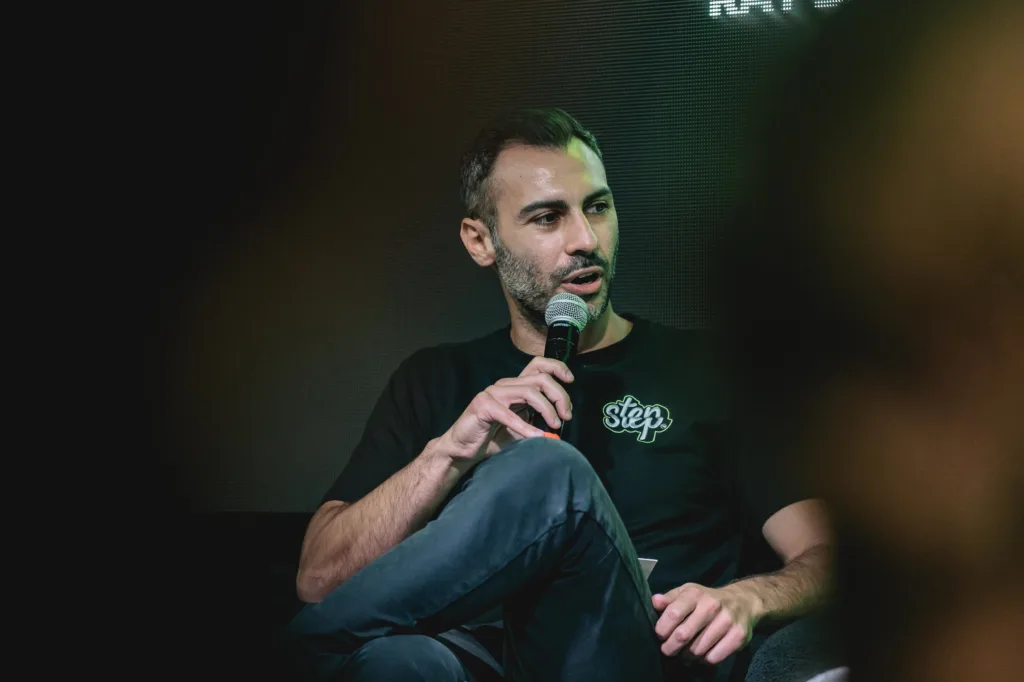
“AI won’t save a bad idea.” That is the warning founders across the region need to hear, according to Ray Dargham, the CEO and Founder of Step Group who argues that artificial intelligence is exposing weaknesses rather than masking them.
While AI can add efficiency, it will not repair weak distribution, poor leadership or a lack of focus, he told Lana ahead of the 2026 Step Conference taking place in Dubai from February 11-12.
“In fact, it often makes those issues more visible. The fundamentals still matter, maybe more than ever,” he said.
AI should be treated as a strategic complement, not a disruption threat
Moreover, AI is already reshaping core industries in the region. Financial services, logistics, healthcare administration and energy are undergoing measurable change, driven by automation and optimisation in data-intensive and operationally complex environments.
Yet Dargham resisted describing this shift as disruption. “I wouldn’t frame AI as a disruption risk so much as a strategic complement to ongoing operations. Companies today need to think carefully about how to adopt AI in ways that help them adapt faster, make better decisions, and stay competitive,” he said.
Dargham said the difference between real progress and hype lies in how deeply AI is embedded into systems that already operate at scale.
“In the UAE, we’re seeing AI being embedded into systems that already operate at scale,” he said. “So far, this includes government services, financial infrastructure, logistics, and enterprise operations.”
According to him, the impact is tangible when AI improves decision-making, reduces friction or unlocks efficiency across millions of users or transactions. That level of implementation, he noted, requires data maturity, regulatory clarity and long-term commitment – areas in which the UAE has invested.
Surface-level AI adoption risks becoming noise rather than real innovation
However, what concerns him more is what he described as surface-level adoption.
“I think what’s noise is when AI is treated as a marketing layer rather than a structural capability. If a product’s value proposition doesn’t essentially change with AI, or if success can’t be measured in outcomes such as cost reduction, time saved, accuracy improved, then it’s likely surface-level adoption,” he said.
That distinction has shaped Step’s own direction. This year, the organisation announced its evolution into what Dargham calls an “AI-first” company.
“AI has moved from trend to necessity in the startup ecosystem, and at Step, we wanted to reflect that shift,” he said. “This year, we went all-in to connect founders, investors, and ecosystem players in smarter, faster, more meaningful ways.”
For Step, that shift includes integrating AI into its event infrastructure, from the Step Event App to a WhatsApp AI Event Assistant, as well as internal tools such as Buzz and Uniqorn aimed at improving matchmaking and data-driven decision-making.
“For us, it’s not about hype, it’s about building systems that learn, adapt, and scale alongside the ecosystem,” he said. “We are announcing our evolution into an AI-first organisation, showing the same transformation we encourage across startups.”
Dubai among ‘best places’ in the world to build
And with the UAE positioning itself as a hub for artificial intelligence, Dargham believes the country is transitioning from experimentation to execution.
“In my opinion, the UAE is between the learning and executing phase,” he said. “The good news is that the infrastructure is there, but what matters now is investing in talent, applied research, and founders who are building for global markets, not just regional ones.”
He cautioned against expecting global AI champions to emerge overnight, arguing instead for endurance and differentiation.
“Global AI companies won’t emerge overnight, but the conditions required to build them already exist,” he said. “The focus now should be on endurance and differentiation, not speed alone.”
Reflecting on the evolution of the ecosystem since launching Step in 2012, Dargham pointed to measurable growth.
“When we started Step in 2012, only a handful of startups joined us,” he said.
By contrast, Step Dubai 2026 is set to host more than 400 startups, over 100 companies and an investor community representing more than $12.6 billion in deployable capital.
“Today, we’re seeing hundreds of founders from the UAE and the wider MENA region, alongside thousands of global investors actively engaging with the ecosystem. That level of participation simply didn’t exist a decade ago,” he said.
“I believe that only a few ecosystems offer this combination of ambition, access, and institutional support within such a compact market. For founders willing to execute with discipline, Dubai remains one of the best places in the world to build,” he added.
AI can only accelerate what a company has already built
Yet even with stronger capital flows and policy support, Dargham stressed that government backing should not replace market validation.
“Government support in the UAE is a powerful accelerator, especially in regulated or capital-intensive sectors,” he said. “But founders still need to build independently viable businesses.”
“Public-sector backing can open doors and de-risk early stages, but long-term success depends on customer demand, execution discipline, and sustainable economics,” headed.
For Dargham, the core message remains consistent across industries and funding cycles: artificial intelligence amplifies whatever foundation a company has already built.
“AI magnifies both strengths and weaknesses,” he said. “If fundamentals like product-market fit, pricing, and distribution aren’t solid, scaling AI will only accelerate failure.”
As founders prepare to gather in Dubai this week, his advice is direct. AI can be transformative, but it cannot compensate for weak fundamentals.
“The strongest companies use AI to deepen their advantage, not to justify why they exist,” he said.
That principle, Dargham argued, becomes even more critical when startups begin to scale.
“Most startups underestimate how hard it is to operationalise AI at scale,” he said. “It’s one thing to build a model but it’s another to integrate it into real workflows and deliver consistent value.”
He warned that many teams attempt to grow too quickly, before proving repeatability or demonstrating clear return on investment for customers.
“Many teams also scale too early before they’ve proven repeatability or clear ROI for customers,” he said, adding that the rush to embed artificial intelligence into products has also led to what he sees as a wave of superficial innovation.
“Yes, and honestly, it’s easy to see why,” he said when asked whether too many founders are building AI features instead of real businesses.
“AI is everywhere right now, and it’s tempting to just tack it on as a feature but features alone don’t make a company, solid business models do.”
AI ‘a tool’ to strengthen business, not create business
He also urged founders to reassess their starting point before adding AI to their stack.
“Before jumping into AI, founders need to ask themselves if their business solves existing customer problems and offer real value,” he said. “AI, when used effectively, can help strengthen your business but it cannot be the reason your business exists.”
Beyond product strategy, Dargham also addressed what he believes remains a persistent misconception about the UAE startup landscape.
“There’s still a perception that the UAE is a satellite market rather than a place where category-defining companies can be built,” he said.
He argued, founders in the UAE operate in a globally connected environment from the outset, navigating diverse markets, complex use cases and sophisticated customers.
“Building Step since 2012, we’ve had the opportunity to see how much the ecosystem has matured,” he said. “Today, capital is smarter, founders are more experienced, and there’s a growing culture of repeat entrepreneurship.”
“We’re also increasingly seeing local innovations making a mark in international markets, which goes to show that this isn’t a speculative ecosystem anymore but an increasingly execution-driven one,” he concluded.