
Mattar Al Tayer, Director General and Chairman of the Board of Executive Directors of Dubai’s Roads and Transport Authority (RTA), announced the completion of 10 per cent of construction works on the Dubai Metro Blue Line five months after the groundbreaking ceremony in June 2025.
The 30-km project comprises 14 stations and currently has more than 500 engineers and experts, along with 3,000 workers, deployed at 12 sites.
Al Tayer confirmed that work on the project is progressing as scheduled, with completion expected to reach 30 per cent by the end of 2026 and the line’s opening targeted for September 9, 2029.
RTA announces Dubai Metro Blue Line on track for September 2029 opening
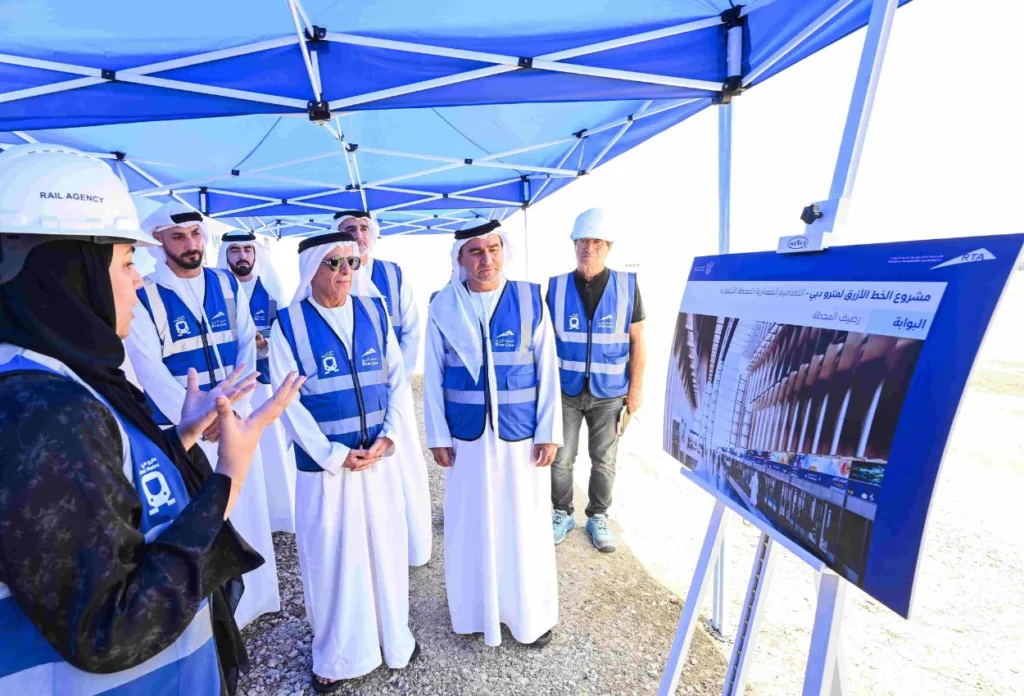
“The Dubai Metro Blue Line is one of RTA’s most strategic projects. The line connects the Red and Green Lines of the Dubai Metro and serves areas expected to accommodate around one million residents by 2040. It will also provide direct journeys to Dubai International Airport in just 20 minutes,” Al Tayer said in a statement.
“The project supports the objectives of the Dubai Urban Plan 2040 by linking Dubai’s fifth urban area to the Metro network, enhancing the quality of life for residents and visitors, and realising the ‘20-minute city’ concept, which enables access to more than 80% of essential services within 20 minutes of travel,” he added.
The project reinforces Transit-Oriented Development (TOD) principles and aligns with the Dubai Economic Agenda (D33). The project’s total economic benefits are estimated to exceed AED56.5 billion by 2040, resulting from savings in time and fuel and a reduction in accident-related fatalities.
The project is anticipated to boost land and property values by up to 25 per cent around Metro stations and reduce traffic congestion by 20 per cent along the corridors served by the Blue Line.
Al Tayer emphasised that work on the Dubai Metro Blue Line is progressing in accordance with the highest international standards. More than 500 engineers and experts, along with Emirati talents, in addition to 3,000 workers, are deployed across 12 sites along the alignment.
Dubai Metro Blue Line to connect one million residents by 2040
The project consortium has achieved over 3 million work hours in various locations without recording any fatalities, reflecting RTA’s adherence to the highest occupational safety and construction quality standards, as well as the efficiency of its field supervision systems and project management frameworks.
Al Tayer added that the engineering teams continue to advance their work. A total of 11 traffic diversions have been implemented so far, with more than 10 diversions planned across the project to facilitate station construction and ensure traffic flow.
More than 260 deep foundations have been completed across multiple sites, whilst excavation works exceeding 400,000 cubic metres have commenced at station locations in International City (1), (2), and (3).
Several station columns have also been constructed in the Academic City area, along with retaining walls at most underground stations, such as International City (1).
The project consortium has established two ready-mix concrete plants, along with two yards for the production and storage of precast concrete elements in Al Ruwayyah 3 and International City. This step reflects RTA’s approach to managing infrastructure projects, enabling control over the quality and efficiency of construction materials and oversight of manufacturing and supply chains.
World’s highest metro station to stand 74 metres tall in Dubai Creek Harbour
Dubai Metro Blue Line extends in two directions. The first begins at Creek Interchange Station on the Green Line in Al Jaddaf and runs through Dubai Festival City, Dubai Creek Harbour, and Ras Al Khor Industrial Area, before reaching International City (1), which includes an underground interchange station. It then continues through International City (2) and (3), Dubai Silicon Oasis, and ends at Dubai Academic City. This section spans 21 km and comprises 10 stations.
The second direction starts from Centrepoint Interchange Station on the Red Line in Al Rashidiya, passing through Mirdif and Al Warqa and linking to the interchange station at International City (1).
This section stretches 9 km and includes four stations. The project also features the construction of a depot and maintenance facility in Al Ruwayyah 3.
The Emaar station will be the world’s highest metro station, standing 74 metres tall and 38 metres wide. It will serve as a landmark, adding to Dubai’s urban landscape.
Covering an area of 11,000 square metres, the station is designed to accommodate 240,000 passengers per day by 2040. Upon commencement of operations, the number of users is expected to exceed 70,000 passengers per day.
The station will serve the residents of Dubai Creek Harbour, estimated at 40,000 people, in addition to visitors to the area.
RTA completes 260 deep foundations for Dubai Metro Blue Line stations
The station’s exterior design features a façade that blends with the surrounding urban environment. Its central gateway allows light to reach the platform level, creating an atmosphere during the day as sunlight reflects off the stone surfaces.
By night, the station transforms into a beacon guiding passengers, thanks to a lighting strategy that enhances its character and reinforces its role as a gateway to Dubai’s future.
In line with RTA’s commitment to community engagement, a communication strategy has been developed to raise awareness of the Dubai Metro Blue Line project. The strategy aims to familiarise residents, particularly those living near the project route, with the nature of construction activities and the various stages of work planned in their vicinity.
RTA provides updates and information on upcoming traffic diversions through various media channels and social media platforms.
RTA’s project teams have carried out field surveys across the areas within the project’s scope. The plan also includes the Customer Council, through which RTA organises community gatherings in all areas affected by the project to listen to and address feedback and enquiries.
The first session was held in October at Mirdif and Al Warqaa, during which the project alignment and traffic diversions for the next phase were presented.